Euronext, Deutsche Börse face split oversight
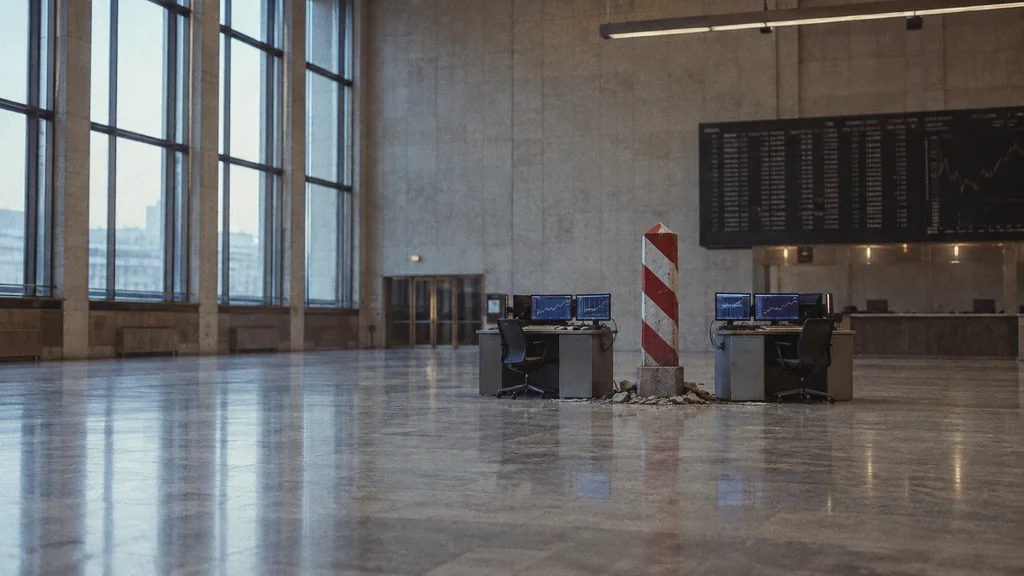
A common supervisor comes closer, but the boundary remains.
Image composition · tobriefOn 9 October, EU finance ministers agreed that the European Securities and Markets Authority (ESMA, the EU's Paris-based markets regulator) should directly supervise the biggest cross-border exchanges, clearing houses and settlement systems (Council). The test applies to every firm alike. Reporting expects it to move Euronext under ESMA while Deutsche Börse's trading venues stay with German supervisors, an outcome Berlin made a condition of its support (Reuters). None of it is law yet.
Today these firms mostly answer to national regulators. A group that runs markets in several countries therefore deals with several authorities, each enforcing the same EU rulebook. The deal aims to give the largest cross-border groups one European supervisor instead.
Where the line falls
On 5 October, the Irish presidency (Ireland chairs ministers' meetings this half-year) circulated a draft under which a trading venue qualified if its group handled at least 5% of relevant EU trading and ran venues in at least two member states (Presidency paper). In plain terms, a group needs both a sizeable share of European trading and a presence in more than one country. A second route, meant for bigger venues, required most of their business to be cross-border. An exchange serving mainly its home market cannot meet that condition.
Euronext runs markets in Paris, Amsterdam and Milan, so it clearly meets the two-country condition. Geography alone does not prove it clears the 5% bar, and those thresholds come from a draft written before the ministers' deal. Les Echos presents Euronext's move to ESMA as an expectation, not a settled ruling (Les Echos). That is how it should be read until the final criteria are published.
Simon Harris, Ireland's finance minister, chaired the meeting. He rejected talk of company carve-outs and said the deal sets out criteria, timelines and transition periods (RTÉ). The text names no company. Belgium's Jan Jambon cast the only abstention (Agence Europe). He argued that comparable venues, Deutsche Börse among them, would stay under different regimes, which would keep markets fragmented and distort competition.
Who gains, and how much
Euronext had pushed for integrated EU supervision. Under the expected outcome, its cross-border business would answer to one main supervisor. The European Commission estimated recurring savings of €0.5 million to €5 million a year for cross-border exchange groups (Commission impact assessment). That figure is a forecast of the operators' own costs. Nothing in the deal requires the saving to reach companies that list their shares or the savers who buy them, so an operator could simply keep it.
Ministers trimmed the scope for clearing houses as well. A clearing house steps between buyer and seller so a trade still completes if one side defaults. Reuters reports that the number expected to move under ESMA fell from nine to six (Reuters).
What happens next
Ministers have agreed only the political outline. The Council must still adopt its formal position. The European Parliament then sets its own, and the two negotiate the final law (Council). Any handover would come slowly once that law is passed. The draft allowed up to three years to move venues and clearing houses to ESMA, plus a possible further 12 months. National authorities would keep market-abuse surveillance (watching for insider dealing and price manipulation) (Presidency paper).
As drafted, the boundary turns on how far a group operates across borders, not just on its size. A group already spread over several countries would swap several national supervisors for one European one. Deutsche Börse's large German venues, which reporting places outside the line, would keep their national supervisor. One caveat applies: the final criteria have not yet been set, and no one has shown that any savings will reach investors.
Details about this article
- Model:
- claude-opus-5-5
- Generated:
- 10/10/2026, 1:35:37 AM
- Pipeline run:
- eu_pipeline_20261010_005006
- Watermark:
- SynthID (Google's invisible watermark)
- Human review:
- None before publication