Europe bets €2.4bn on an untested factory
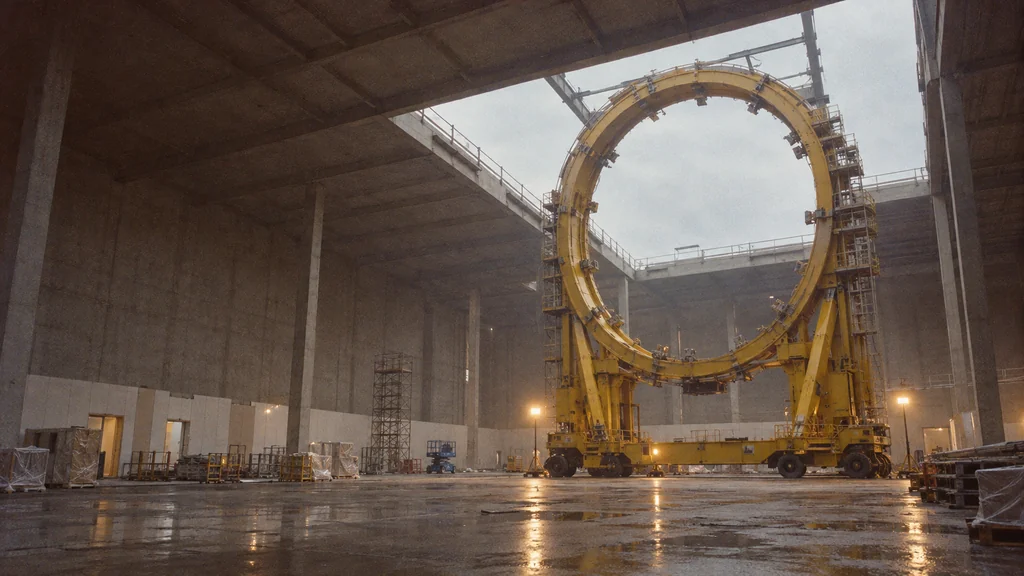
Europe’s satellite ambitions now wait inside an unfinished factory.
Image composition · tobriefAerospacelab's Marcinelle megafactory in Charleroi, Wallonia, was still under construction as of mid-August, with production planned from 2027 (Kölnische Rundschau). On 10 September, the company announced it had won a €2.4 billion contract to build 264 low-Earth-orbit spacecraft for IRIS², the EU's sovereign satellite constellation for encrypted government communications (Aerospacelab, Reuters). That is roughly 80% of the constellation's low-orbit layer and three-quarters of the entire fleet (European Commission, Aerospacelab). Europe has placed most of IRIS²'s manufacturing burden on a startup whose new plant has not yet demonstrated it can produce at scale.
What the factory must prove
Aerospacelab claims the Charleroi plant will handle up to 500 satellites per year once operational (Kölnische Rundschau). The company has not published evidence that the plant has passed acceptance testing, quality certification or any serial-production milestone (Aerospacelab).
The production chain adds a dependency. Aerospacelab builds the satellite platform: the structural body carrying power, propulsion and computing. Thales Alenia Space supplies the secure communications payload under a separate agreement worth approximately €500 million (Thales Alenia Space). Aerospacelab then combines the two and hands the finished spacecraft to Eutelsat (European Spaceflight). If Thales payloads fail required tests or arrive late, Aerospacelab's integration stations sit idle even if platforms roll off the line on time.
An earlier German report described the order as "up to 264" satellites worth "at least €1.8 billion," a gap that underscores how little of the actual signed contract is public (Kölnische Rundschau).
Who chose Aerospacelab and who can intervene
The Commission did not buy these satellites directly. It awarded a 12-year concession to SpaceRISE, a consortium of satellite operators Eutelsat, SES and Hispasat (European Commission). Within that structure, Eutelsat leads the low-orbit segment. Eutelsat selected Aerospacelab after a process in which possible solutions were negotiated before final bids. SpaceRISE was the sole consortium remaining after Airbus and Thales withdrew from the bidding core, which limited competitive pressure on terms (Journal of European Public Policy, European Commission).
For comparison, Airbus is building at least 66 first-batch satellites on its Toulouse line, due in 2029 (Airbus), and Germany's OHB says it won a contract worth nearly €1 billion for 18 medium-orbit platforms (OHB). Aerospacelab's share dwarfs both.
The reporting does not answer who can act if the low-orbit segment falls behind. Whether Eutelsat can reduce batch sizes, impose penalties or terminate the supplier agreement remains unpublished. The Commission's oversight powers over the concession are equally opaque. The concession's original value was €10.6 billion, including €6 billion from the EU budget and €550 million via ESA (the European Space Agency, which co-manages development), with over €4 billion from the private operators (ESA). After an August 2026 expansion to 348 total satellites, one trade outlet put the programme near €15.6 billion, though the Commission has not confirmed that figure (Advanced Television). The contract does not reveal whether operators, suppliers or the EU budget absorbs costs when delivery slips.
The clock
According to EUSPA (the EU agency overseeing space programmes), initial launches are planned for 2029, with Aerospacelab's satellites following from 2030 (EUSPA). The Commission still lists securing launch services as a future step, with no provider named (European Commission).
The award transfers real manufacturing responsibility to Aerospacelab. Delivery remains unproved. Aerospacelab owes evidence of plant commissioning and sustained output. Eutelsat owes clarity on acceptance milestones. The Commission owes the public an explanation of who pays when the schedule slips, because on the current record, no one can tell.
Details about this article
- Model:
- claude-opus-4-6
- Generated:
- 9/11/2026, 1:47:37 AM
- Pipeline run:
- eu_pipeline_20260911_005007
- Watermark:
- SynthID (Google's invisible watermark)
- Human review:
- None before publication