Europe names Ukraine team; Moscow says no
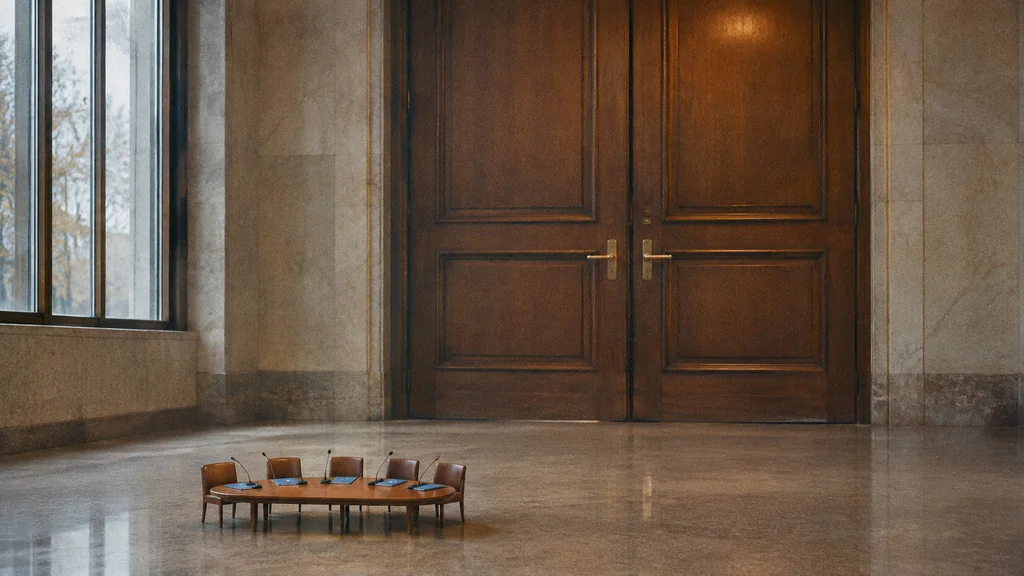
Europe has chosen its seats; Russia has yet to open the talks.
Image composition · tobriefEurope has chosen who will speak for it in Ukraine peace talks, and on 16 November that team held its first full call with Ukrainian and American envoys (Ukrainian presidency). The same day, Kremlin aide Yuri Ushakov said Moscow had not agreed to widen the talks and expected more rounds with only Ukraine, Russia and the US (Reuters). Europe can pick its negotiators. It cannot make Russia sit across from them.
Ushakov's denial cuts against a week of apparent momentum. That week included a Lithuanian report, which we covered, that Russia had accepted European participation (To Brief). Russia's public statements say otherwise.
In the preparation, not the negotiation
So far Europe's role has been preparatory. In Abu Dhabi on 10 November, officials from the EU, several European governments and NATO met Ukrainian and American negotiators to prepare the next stage (European Council).
The talks with Russia were a separate event, involving only Ukraine, Russia and the US, with American envoys mediating. Europeans attended the preparation but never faced the Russian negotiators, as France's foreign ministry later acknowledged (France Diplomatie). Those three-way talks produced an agreement in principle on a prisoner exchange, not peace terms (AP).
After meeting Vladimir Putin on 12 November, the US envoys said Europeans would join the next round (Reuters). Moscow never confirmed it. On 13 November, Kremlin spokesman Dmitry Peskov said Russia first wanted to understand what Europeans intended and what they could contribute (Le Monde). Ushakov has since repeated that condition.
A team chosen by Europe, not by everyone in it
Europeans chose the lineup themselves, without negotiating it with Moscow. On 13 November, after an informal leaders' summit in Dublin, European Council president António Costa named France, Germany, Italy, Poland and the United Kingdom, plus the EU institutions (Costa's remarks). The European Council is where EU heads of government meet to set direction.
Costa also drew a boundary. Decisions on Ukraine's territory and sovereignty stay with Kyiv.
The team's instructions are still unwritten. Italian government sources describe its negotiating mandate, meaning what the team is actually authorised to offer, as a later step that has yet to be defined (ANSA).
Not every capital accepts the lineup either. Spain's foreign minister José Manuel Albares warned that the group was crowded enough to risk "cacophony" while still leaving out Spain and the EU's foreign-policy chief, Kaja Kallas (EFE via Infobae). His complaint shows that the team speaks for Europe because some governments announced it does, not because all of them signed off.
What the team cannot promise
Spain cannot stop five governments from talking to whomever they choose. It can block an EU decision. EU foreign-policy decisions generally require unanimity under Article 31 of the EU treaty, so every member government must agree and any one of them can veto (EUR-Lex). That covers any easing of sanctions that Russia might seek in a deal.
This sets the limit on what the team can bring. Britain sits on it but left the EU, so it has no vote on EU sanctions. The EU governments in the group can commit their own countries, but they cannot commit the rest of the bloc. A promise of EU sanctions relief would need approval from capitals outside the group, Madrid among them. Peskov's question about what Europe can contribute falls on exactly that gap, whatever Moscow's reasons for asking it.
The next step is coordination among Europeans and their allies. Germany has invited the Coalition of the Willing, the group of Ukraine's backers, to Berlin on 19 November to align diplomacy and security guarantees (German government). Russia will not be there, and it is not a negotiating round.
Europe has chosen a team, but Russia has not accepted it at the table, and the team has no defined mandate to offer EU-wide concessions. National leaders can still speak for their own governments in any talks. On the sanctions relief Moscow is most likely to want, only all EU governments acting together can give an answer.
Details about this article
- Model:
- claude-opus-5-5
- Generated:
- 11/17/2026, 1:53:48 AM
- Pipeline run:
- eu_pipeline_20261117_005009
- Watermark:
- SynthID (Google's invisible watermark)
- Human review:
- None before publication