Europe’s EV boom meets three million missing cars
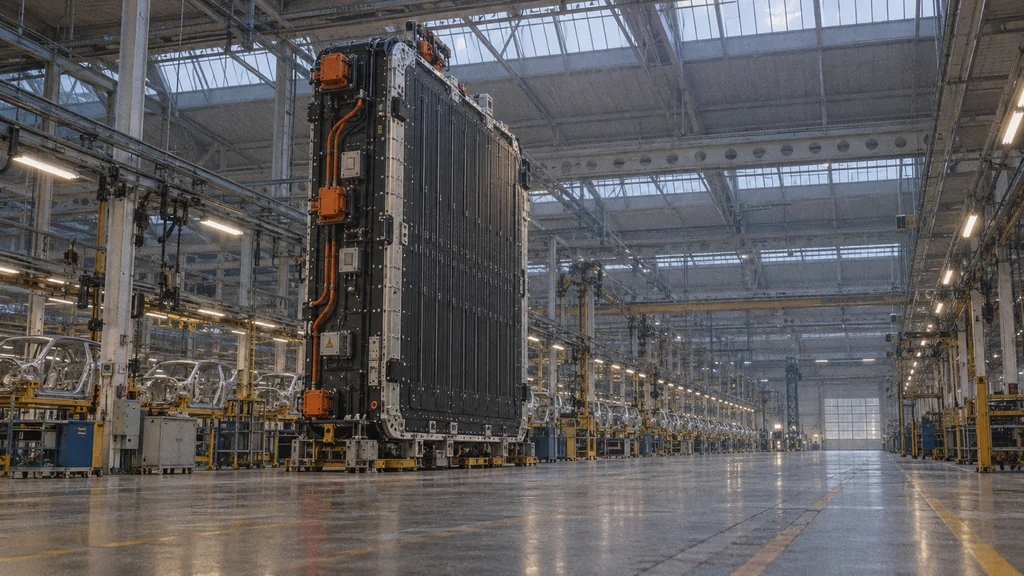
Electric growth fills a smaller space as Europe’s assembly lines fall silent.
Image composition · tobriefElectric vehicles are grabbing a bigger share of European car sales every year. But the market they're growing inside has shrunk. Roughly three million fewer cars were registered in 2024 than in 2019, according to industry data (ACEA). That means EV adoption is outpacing any recovery in total demand, and the gap is squeezing factories across the continent.
Why a shrinking market kills factory profits
Car plants are expensive to build and expensive to keep open, whether they're running or not. When fewer cars move through a factory, those fixed costs get spread across fewer vehicles, and profit per car falls. This is why "utilisation" matters so much. Utilisation is the share of a factory's maximum output that's actually being used. At low utilisation, a plant bleeds money even if every car it builds finds a buyer.
Stellantis, the group behind Peugeot, Fiat and Opel, plans to cut more than 800,000 units of European capacity and raise its utilisation from roughly 60% to 80% by 2030 (EFE). That gap between 60% and 80% is the difference between factories that drain cash and factories that can cover their costs. Volkswagen, separately, has approved around 50,000 further job cuts. The company acknowledged roughly 500,000 vehicles of excess capacity across its European network (To Brief). These are not independent problems. Fewer registrations mean emptier plants, which mean restructuring.
Battery-electric cars made up about 13.6% of EU registrations in 2024, up from roughly 2.3% in 2019 (ACEA). That growth is real. But it added around a million battery-electric units to a market that lost several million combustion-engine sales over the same period. Registration statistics, which track where a car is first put on the road, also say nothing about where it was built or how much of its value was produced in Europe (Eurostat).
Where the work is moving
Spain and Poland show two different ways European countries are trying to capture EV-era manufacturing, and the limits of each.
Spain's factories have established export logistics and relatively lower labour costs. Stellantis has reserved lines at its Madrid and Zaragoza plants for Leapmotor, its Chinese-backed partner brand. Yet Spanish car production still fell 19.5% between 2019 and 2025 (Cinco Días). One plant designed to produce close to 500,000 vehicles a year assembled fewer than 100,000 in 2025 (La Vanguardia). Assembling a Chinese-developed vehicle protects factory jobs, but the batteries, software and key purchasing decisions remain outside Spain.
Poland tells the components story. Passenger-car production collapsed from 434,700 units in 2019 to 102,400 in 2025 (PZPM). At the same time, automotive component exports rose to €17.88 billion, and battery manufacturing capacity expanded to over 115 GWh (Trade.gov.pl). Volkswagen is investing more than PLN 1.5 billion in its Września plant for an electric van (Business Insider Polska). Mercedes is building an electric-van factory at Jawor worth over €1 billion (Interia). But other Polish plants are losing work: Stellantis's Tychy site cut a shift affecting about 740 workers (Rzeczpospolita). Poland is gaining battery and van investment while losing passenger-car assembly. Whether the new jobs compensate in number, wages and stability remains an open ledger.
What EVs replace and what they don't
An electric drivetrain eliminates the engine, gearbox, exhaust system and fuel injection. Those components sustained large workforces across supplier regions from Silesia to northern Spain. New battery and electronics work requires different skills, different capital, and often lands in different countries. The swap is not one-for-one.
EV adoption has moved faster than total car demand has recovered. The evidence from Spain, Poland and the broader registration data does not yet show that new electric production is replacing the European volume and employment being cut. Several of the investments cited here are plans, not operating factories. Carmakers can answer this by disclosing actual plant allocations and sourcing commitments. Until they do, rising EV market share measures a change in what Europeans buy, not proof that Europe's industrial base is keeping up.
Details about this article
- Model:
- claude-opus-4-6
- Generated:
- 9/21/2026, 1:41:26 AM
- Pipeline run:
- eu_pipeline_20260921_005007
- Watermark:
- SynthID (Google's invisible watermark)
- Human review:
- None before publication