Europe’s plant-glow satellite faces its test
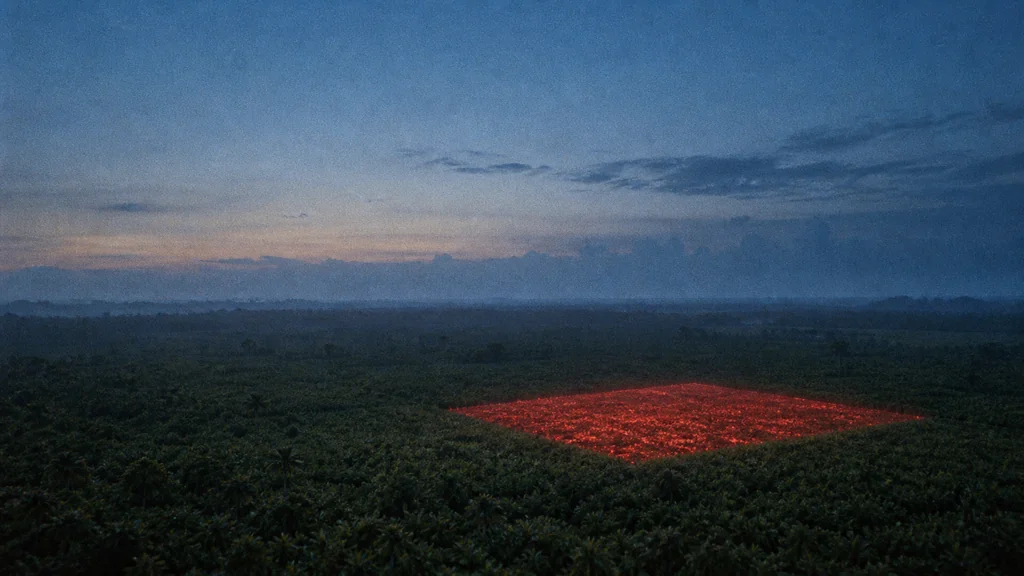
Europe waits for the first reliable whisper from living plants.
Image composition · tobriefA Vega-C rocket lifted off from French Guiana on 15 September carrying two European satellites into orbit. One of them, FLEX, is designed to detect a faint glow that plants produce during photosynthesis, a signal associated with how actively vegetation is functioning rather than simply whether it is green. Ground controllers in Darmstadt confirmed contact with both FLEX and the Copernicus Sentinel-3C satellite after they separated cleanly from the rocket. Everything after that, the actual science, remains ahead.
Both spacecraft reached Sun-synchronous orbits roughly 815 km above Earth. But reaching orbit is not the same as producing science. FLEX's instrument, called FLORIS, must still be calibrated, its atmospheric corrections validated, and its first fluorescence retrievals checked against ground measurements. Commissioning is expected to take about three months, followed by a 3.5-year science mission.
A clue, not a diagnosis
When chlorophyll absorbs sunlight, most of the energy drives photosynthesis or dissipates as heat. A tiny fraction is re-emitted as a faint red glow called solar-induced fluorescence, or SIF. Conventional satellite imagery tells you vegetation is present and green. A drought-stressed forest can look perfectly healthy from above while its photosynthetic machinery is slowing down. Fluorescence is associated with that functional activity, so changes in the signal can appear before leaves wilt or brown.
Think of it as the difference between checking whether a factory's lights are on and reading one gauge on the factory floor. The gauge gives you a clue about operations, but it is not the same as counting finished products off the assembly line. Carbon uptake can drop without a proportional fluorescence response when plants close their pores rapidly, as one controlled experiment showed. So fluorescence is informative, not definitive.
Other satellites have already picked up this signal. Japan's GOSAT produced early global retrievals, and NASA's OCO-2 and Europe's TROPOMI later added measurements. But none were purpose-built for fluorescence. They offer either fine detail along narrow ground tracks or broad coverage at coarse resolution. FLEX is designed to map both major fluorescence spectral regions across a 150 km swath at 300 m ground sampling, with an orbital repeat cycle of 27 days. At that resolution, many agricultural landscapes become distinguishable, though cloud cover and mixed land surfaces will limit what any single pass reveals.
How FLORIS picks out a whisper
Extracting such a faint glow from overwhelming reflected sunlight requires a spectral trick. Sunlight contains narrow dark gaps, wavelengths absorbed by gases in the Sun's or Earth's atmosphere. In those gaps the reflected background drops, making the small fluorescence contribution easier to model. FLORIS is designed to measure the spectrum at very fine resolution around these gaps and separate the plant signal from the background, after correcting for atmospheric effects. Whether it achieves its design accuracy in orbit is the first milestone to watch.
A fluorescence measurement alone is ambiguous. Low fluorescence could mean stressed crops or simply sparse vegetation absorbing little light. FLEX is designed to fly in tandem with a Sentinel-3 spacecraft, trailing it along the same orbit. Sentinel-3's instruments measure reflected light across multiple bands, from which scientists can infer canopy structure and leaf properties. Its thermal sensor tracks surface temperature, which rises when drought-stressed plants close their pores and stop cooling themselves through evaporation. Together, these measurements help researchers constrain models of how much carbon vegetation is actually fixing.
FLEX will initially pair with Sentinel-3A, in orbit since 2016. Sentinel-3C, its co-passenger on the launch, enters its own commissioning and will eventually take over the tandem role. Sharing a rocket saved a launch slot, but it did not instantly create an operational observing pair.
What comes next
Prior ground and satellite studies offer encouraging signs. At a Colorado forest, continuous fluorescence measurements tracked the seasonal activation of photosynthesis even though the evergreen trees stayed green year-round. A 2026 study found TROPOMI fluorescence declined roughly two years before beetle-killed forests visibly died. These results suggest the signal carries real ecological information, but they come from instruments with different designs and spatial scales than FLEX.
No calibrated fluorescence map existed on launch day. FLEX is designed to add a functional plant signal to the structural maps scientists already use. Commissioning must now show whether FLORIS can retrieve that signal reliably at the spatial scale its designers specified.
Details about this article
- Model:
- claude-opus-4-6
- Generated:
- 9/16/2026, 1:41:44 AM
- Pipeline run:
- eu_pipeline_20260916_005006
- Watermark:
- SynthID (Google's invisible watermark)
- Human review:
- None before publication