Europe’s protest arrests tell different stories
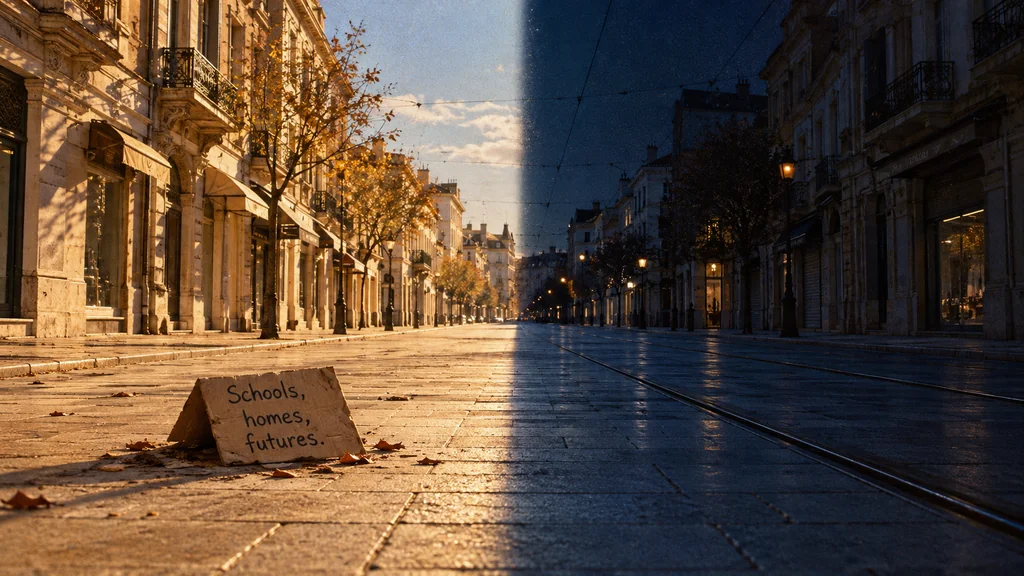
The marches end before the accounts of the night begin.
Image composition · tobriefYoung people marched across Europe on 31 October over schools, rents and prices, and Associated Press reporters described the marches as overwhelmingly peaceful (AP). Violence did follow in Paris, Frankfurt, Lisbon and Porto, but its link to the marches differed in each city. Governments are now counting much of it as protest, and their own figures do not fully support that.
Paris: one arrest total, two different nights
France's Interior Ministry counted 320,000 marchers, 70,000 of them in Paris (French Interior Ministry). The movement started in classrooms, over teacher shortages, crowded classes and Parcoursup, the national platform that sorts applicants into universities.
On 26 October the government promised to replace Parcoursup in 2028 and to cap general upper-secondary classes at 28 pupils from 2027 (Education Ministry). Students mainly object to how universities select them. The open question is whether the replacement changes those selection rules or only the website that processes applications.
The ministry's arrest total of 779 combines two periods. It adds 214 arrests made during the Halloween evening and night to the 565 recorded by 21:00 (French Interior Ministry). Calling all of them protesters folds a night of street disorder into a daytime march.
That does not make the Paris marches violence-free. Some clashes broke out at the end of a march, so the separation there is partial rather than clean.
Prime Minister Sébastien Lecornu blames an ultraleft effort to sustain disorder until the next presidential election. Paris prosecutor Laure Beccuau said she could not confirm that label for the people her office is holding in custody.
Lecornu's claim will get an indirect test this week. Party leaders agreed last month to investigate earlier riots and policing failures (To Brief). That National Assembly inquiry covers the events of 17–18 October and questions Interior Minister Laurent Nuñez on 3 November (Assembly inquiry record). It cannot rule on this weekend. It will show whether the government's earlier account of who caused disorder survives questioning.
Frankfurt: what the arrests can and cannot show
Frankfurt's march, organised by Gen Z regelt, campaigned on education spending, living costs and a possible return of conscription. It stayed mostly peaceful, apart from scattered fireworks, until police ended it in the early evening. The worst violence came afterwards on the central shopping streets, where police counted 54 arrests, more than 100 injured officers and five looted shops (ZDF).
Interior Minister Alexander Dobrindt blamed violent left-wing groups and people from a "migrant milieu". Hesse's interior minister, Roman Poseck, said most of those arrested were German citizens, and Defence Minister Boris Pistorius said Dobrindt's framing pointed the wrong way (Tagesschau).
These statements do not directly contradict each other. Citizenship says nothing about family background, and 54 arrests do not identify everyone who caused the damage. ARD reporters added a different point: at least some of the night-time attackers had probably never joined the march (Tagesschau).
The police special investigation can settle a narrower question, whether the people it charges had marched at all. It will not settle the ministers' argument about background, which no arrest list can answer.
Portugal: force during police clearances
In Portugal the demand was housing, including opposition to proposed changes to rental law. Here the force came during a police operation. Around 04:30 on 1 November, officers cleared tent camps in Lisbon and Porto and detained 13 people, and the emergency medical service treated 25 (Público, Público). Protest groups reported more injuries, counted differently.
A plainclothes officer in Porto drew his gun. Police call it deterrence, while protesters say he pointed it at people. Interior Minister Luís Neves responded that any such display must be justified and recorded.
In two other cities, the police operation itself was the event. Anonymous posts urging looting led The Hague's mayor to issue an emergency order, a temporary power to impose binding public-order rules without waiting for the city council. Police made 34 arrests, mostly of 15- to 18-year-olds, and no looting was reported (Dutch police). Catalonia's police ran 2,264 identity checks, while Barcelona recorded three arrests (El País). In both places, heavy policing met a threat that never arrived.
Across these countries, the record supports a narrower verdict than any minister has offered. Most marches were peaceful, and some violence occurred at their edges, as in Paris. The arrest totals and ministerial claims do not establish that marchers caused every later incident. In Portugal, the documented injuries came from a police clearance rather than from a march.
Details about this article
- Model:
- claude-opus-5-5
- Generated:
- 11/2/2026, 1:38:41 AM
- Pipeline run:
- eu_pipeline_20261102_005008
- Watermark:
- SynthID (Google's invisible watermark)
- Human review:
- None before publication