Europe’s supermarket freezers get new orders
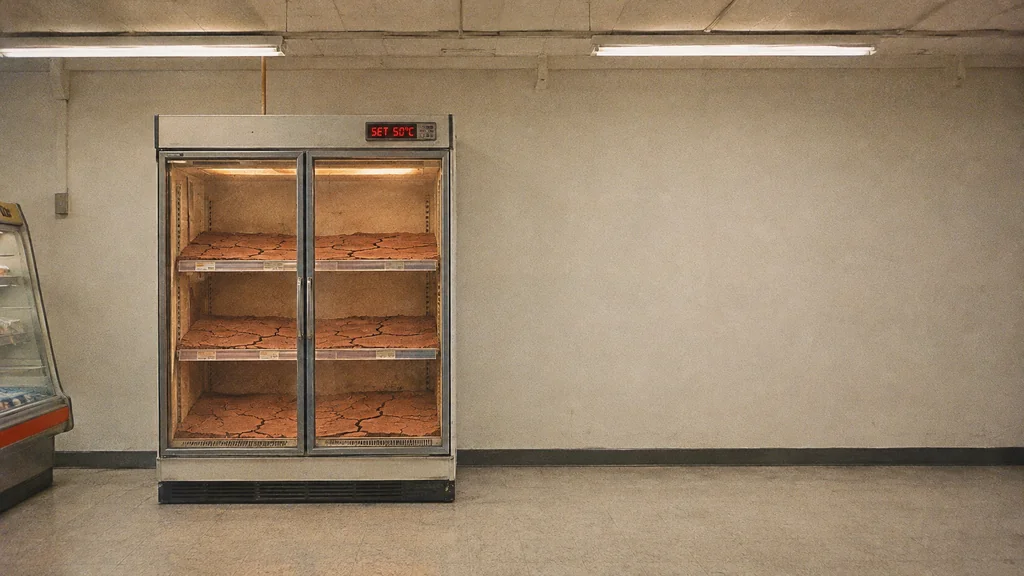
A changed cooling setting leaves a Swedish supermarket’s freezer shelves empty.
Image composition · tobriefStaff at ICA Kvantum in Sjöbo, southern Sweden, found the store's cooling controls had reportedly been set to 50°C (Sveriges Radio). The store threw out its chilled and frozen food, and a manager put the upper estimate of losses at one million kronor (SVT). The shop blames hackers, and stores in several other European countries have reported similar interference (Reuters).
Supermarket fridges and freezers are run by controllers, small computers that watch temperatures and raise an alarm when something goes wrong. Installers can often log into them from elsewhere to check on the equipment and, where allowed, change its settings. Picture a smart thermostat at home that you adjust from a phone app.
That comparison helps with this story. When you turn your thermostat up, you are setting a goal, and the room takes time to reach it. A freezer controller works the same way: whoever changes the setting chooses a target, and the food warms only as fast as the cabinet can heat it.
What a 50°C setting really means
Estonia shows the gap between the two. The head of contractor Kitman Coldtech told public broadcaster ERR that intruders reached the computer running an older Danfoss system at a Selver supermarket and set a freezer's target to +50°C (ERR). That figure is an instruction, the goal the machine was told to chase.
The freezer itself told a smaller story. Staff reversed the change within roughly 10–15 minutes, and by then the cabinet had warmed by only about 2–3°C, with no food damaged (ERR). So the 50°C in these headlines describes what machines were told to do. It says nothing about how warm the food got.
The pattern surfaced in France first. Last month, attackers disrupted refrigeration at hundreds of French supermarkets, which threw out chilled and frozen goods (To Brief). France's cybersecurity agency, CERT-FR, then named affected controllers from Danfoss, Copeland and Dixell. It warned that controllers whose login pages could be reached from the open internet were at risk (CERT-FR).
Similar headlines, different stories
Danfoss has since confirmed to Danish media that its products were involved in incidents in several countries, including older models also hit in France (Børsen). Still, the November cases look alike without being one event repeated, and the details change what each one means.
In Ireland, Musgrave said its monitoring system flagged a refrigeration problem at 13 SuperValu stores, and chilled and frozen goods were withdrawn as a precaution (RTÉ). Pulling food because it might be unsafe is a different outcome from food known to have spoiled.
Certainty varies too. In the Netherlands, a Danfoss spokesperson said cooling settings had been changed at at least 17 businesses, mostly smaller food shops (NOS). Romania's cybersecurity directorate described six stores of one unnamed chain whose controllers were reachable from the internet and ran old software. It has not confirmed that an attacker caused the temperature rise there (Digi24).
NOS also reported that some affected Dutch systems sat outside the shielded internal network a business keeps its own computers on. Some still used the passwords they shipped with, and Copeland equipment was hit as well as Danfoss (NOS). Those details describe how some systems were set up; they do not establish how any intruder got in.
Who is behind it remains open. Reuters could not establish who carried out the November attacks or whether they were linked to the French ones (Reuters).
In Sjöbo, the result was a supermarket emptied of chilled and frozen food after a reported change to its cooling settings, with losses its manager estimated at up to one million kronor (SVT). The 50°C behind that headline was an order given to a machine, never a reading taken from the food.
Details about this article
- Model:
- claude-opus-5-5
- Generated:
- 11/3/2026, 1:41:32 AM
- Pipeline run:
- eu_pipeline_20261103_005009
- Watermark:
- SynthID (Google's invisible watermark)
- Human review:
- None before publication