European-Japanese spacecraft attempts to enter Mercury orbit today
AI Daily Synthesis
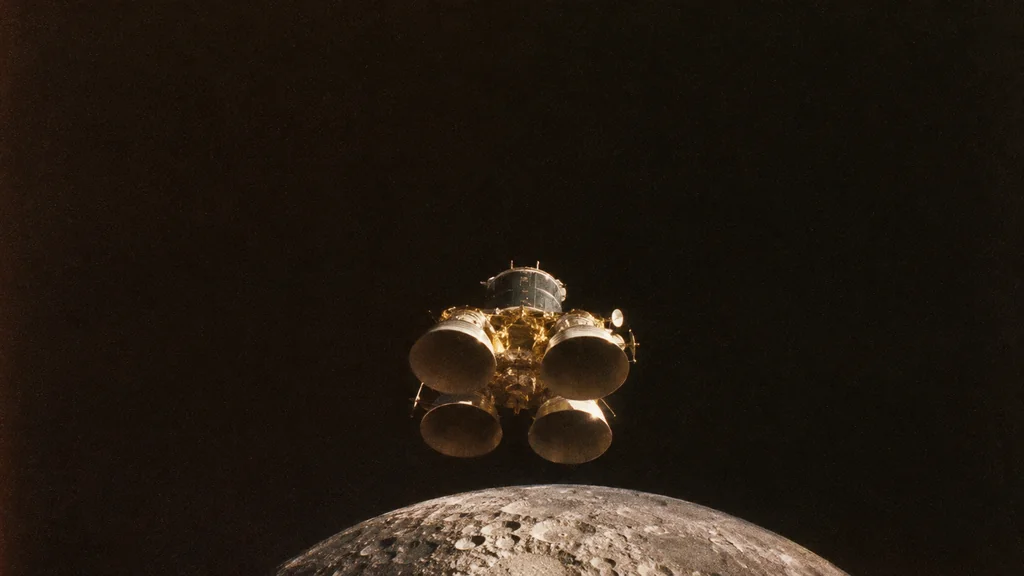
Image composition · tobriefToday, 21 November, four thrusters on the European Mercury Planetary Orbiter (MPO) are scheduled to slow the joint European-Japanese BepiColombo mission near Mercury’s south pole so the planet’s gravity can capture it (ESA). The manoeuvre follows an eight-year journey, and by the early hours there had been no announcement that it was complete. If it succeeds, the planet closest to the Sun will have two observers at once: a European spacecraft studying its surface and a Japanese spacecraft studying its invisible magnetic envelope.
The European Space Agency (ESA) will declare an "official arrival" only when the two probes, which are still travelling together, separate (ESA, 20/11). Before the manoeuvre, operations manager Ignacio Clérigo said there would be room for a second attempt if something did not go as expected (NPR).
Harder than reaching Pluto
The mission’s most counterintuitive detail is that entering a stable orbit around Mercury takes more energy than travelling to Pluto (ESA). The reason is the Sun. A spacecraft heading towards the centre of the Solar System is like a bicycle on an endless downhill slope: the Sun’s gravity keeps accelerating it. Mercury is moving too, racing around the Sun. If the spacecraft arrives much faster than the planet, it overtakes Mercury and flies on. It therefore had to lose energy gradually to avoid escaping (IFLScience).
The challenge was to slow down without carrying vast amounts of fuel. BepiColombo therefore made nine close passes: one of Earth, two of Venus and six of Mercury, according to ESA’s timeline.
Imagine a tennis ball hitting a racket. If the racket moves towards the ball, it sends the ball back faster. If it moves away at the moment of contact, the ball leaves more slowly. A planetary flyby works in a similar way, except there is no contact. The moving planet’s gravity bends the spacecraft’s path and, with the right geometry, takes away some of its speed relative to the Sun. Between flybys, the Mercury Transfer Module (MTM) provided a small but continuous thrust that gradually changed the spacecraft’s course, until the module was released on 3 September (ESA).
That approach takes years in itself. The mission tracker shows about 10.2 billion kilometres travelled as of today (ESA Quick-Look): 68 times the distance to the Sun to reach the planet closest to it. An electrical power fault in 2024 added another year, moving the arrival from December 2025 to November 2026 (Space.com).
Two spacecraft, two questions
Europe’s MPO, with 11 instruments, will study the planet itself: its surface, composition, topography and interior. Mio, the Japanese spacecraft operated by the Japan Aerospace Exploration Agency (JAXA), has five groups of instruments. It will measure the magnetic field and how it responds to the solar wind, the stream of charged particles that constantly flows from the Sun (ESA). MPO will travel close to the surface, while Mio will follow a much wider orbit, like two weather stations, one on the ground and the other high above it (Scientific American). When a gust of solar wind arrives, they will observe the same event from two positions. Scientists can then distinguish what came from outside from how the planet responded.
NASA’s MESSENGER, the only spacecraft previously to orbit Mercury, studied the planet from 2011 to 2015 and found something unexpected (NASA). On the planet closest to the Sun, where the surface bakes, polar deposits contain mostly water ice. Its origin remains an open question, as do Mercury’s disproportionately large metal core and weak magnetic field. An independent assessment links these questions to how rocky planets form, a group that includes Earth (Nature Communications).
Mercury’s surface reaches 430°C during the day and falls to about −180°C at night (ESA). To withstand sunlight about ten times more intense than on Earth, MPO was designed with insulation and heat pipes that carry heat into space, keeping its interior near room temperature (ESA).
If all goes to plan, Mio will be released on 9 and 10 December. MPO will descend until 10 March 2027 into an orbit that takes it from about 480 to 1,500 kilometres above the surface, much closer than Mio (ESA, ESA). Clérigo said 16 engine firings were planned over the coming weeks (NPR). Regular scientific measurements are scheduled to begin on 6 April 2027 (ESA).
If today’s braking succeeds, Europe and Japan will have placed two observers where only one spacecraft has orbited before.
Details about this article
- Model:
- claude-opus-5-5
- Generated:
- 11/21/2026, 4:21:25 AM
- Pipeline run:
- incremental_20261121_033011
- Watermark:
- SynthID (Google's invisible watermark)
- Human review:
- None before publication