Fan Glacier’s 300-metre ice may be frozen
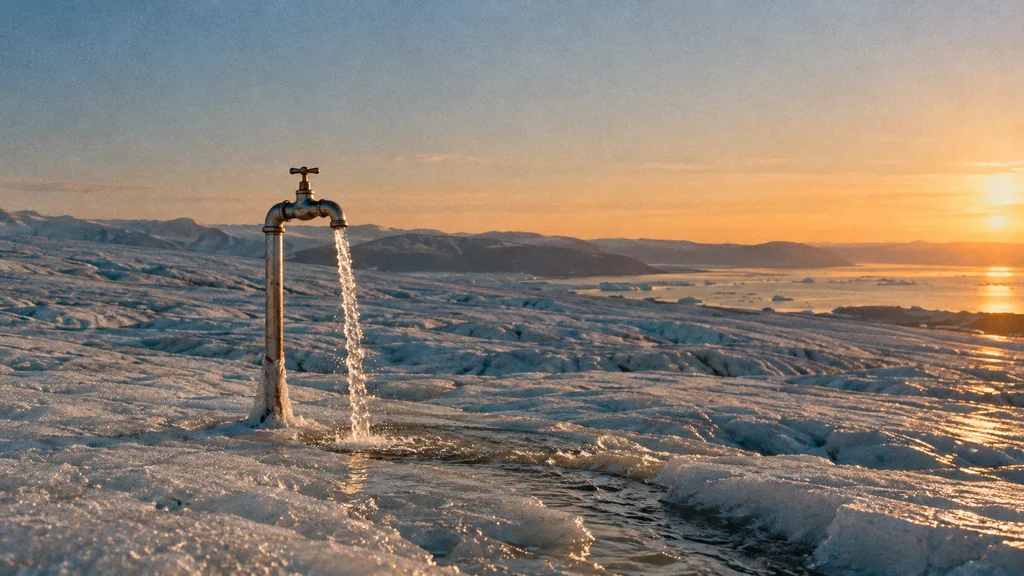
At Fan Glacier, water reaches the surface while the bed remains uncertain.
Image composition · tobriefWhether a glacier slides depends on what happens at its base. Ice frozen to bedrock grips the rock, while ice resting on a wet bed can slip faster. A University of Latvia team says its August radar survey of Fan Glacier in northwest Greenland points to cold ice even where it is about 300 metres thick, which the researchers read as ice frozen to the rock (University of Latvia). That gives scientists a reason to test a published map of the glacier's bed, one built on the assumption that much thinner ice could already be thawed underneath.
Fountains on top, cold ice below
The survey had a dramatic backdrop. The four geologists watched pressurized meltwater burst from the glacier's surface (University of Latvia). Researcher Lelde Švinka described one fountain as two to three metres high. She read that force as a sign that water at that spot could not drain freely along the bed (Research Latvia).
A gushing glacier sounds like a warm one, but the label works differently. Glaciologists call a glacier "cold" when the bulk of its ice sits below the melting point, and the US National Snow and Ice Data Center's definition explicitly allows for melt at the surface (NSIDC). Think of a frozen pond on a sunny spring afternoon. The puddles on top tell you the sun is out, but they tell you little about how cold the ice is further down.
Water can still find its way down through cold ice along narrow routes such as cracks and vertical shafts. The team's radar suggests tunnels near Fan's bottom (Research Latvia). The researchers have not yet published maps showing where those tunnels, the fountains and the thick ice sit relative to one another.
Listening for echoes in the ice
Ground-penetrating radar works like an echo sounder for ice. It fires radio waves downward and records what bounces back. Cold, dry ice and ice holding water return different patterns, so researchers can infer which is which. Radar never reads a temperature directly, though, so its picture of the ice is always an interpretation.
That interpretation runs up against a shortcut. A 2023 reconstruction of the Qaanaaq Ice Cap by Jonathan Carrivick and colleagues treated ice roughly 80 to 100 metres thick as able to sit at its melting point (Carrivick et al.). The authors themselves called this a simplifying proxy rather than a measurement. Applied to Fan, it produced a map in which only about 28% of the bed in the glacier's lower zone was frozen, a snapshot of the years 2000–2019 (Carrivick et al.).
Because that map describes an earlier period, showing a real disagreement means finding frozen bed in the same places the map marks as thawed. The Latvians had reason to expect a mismatch. In a 2024 paper with Hokkaido University's Shinta Ukai and Shin Sugiyama, they reported cold ice up to about 170 metres thick on two other Qaanaaq outlets (Lamsters et al., author manuscript). Fan, larger and thicker, is a sterner test of the same idea.
What would settle it
The stakes are local for now. Qaanaaq is a small ice cap separate from Greenland's main ice sheet, and the survey has produced no revised projection of ice loss or sea level (Research Latvia). A corrected map would change one input to models of how Fan moves. Its effect on any forecast would still have to be worked out.
The result so far rests on the university's announcement and interviews with the researchers. Geologist Kristaps Lamsters' publication list does not yet include a Fan paper (researcher profile). In a 9 September interview, Švinka said the team's passive seismic data had not yet been processed (LSM). Those recordings of natural ground vibrations could help show what sits where ice meets rock.
The first comparison is to lay the roughly 35 kilometres of radar routes over the older map (Research Latvia). Matching zones would be a start, but the radar would still be inferring temperature. Thermometers lowered through boreholes to the bed would test the claim directly, though none have been announced.
What Fan has given the Latvian team is a concrete, testable reason to recheck the bed map of one Greenland glacier. Publishing the radar profiles, with their exact locations, is what will show where that map goes wrong, if it does.
Details about this article
- Model:
- claude-opus-5-5
- Generated:
- 11/1/2026, 1:31:38 AM
- Pipeline run:
- eu_pipeline_20261101_005008
- Watermark:
- SynthID (Google's invisible watermark)
- Human review:
- None before publication