Finland enters France’s nuclear talks without guarantees
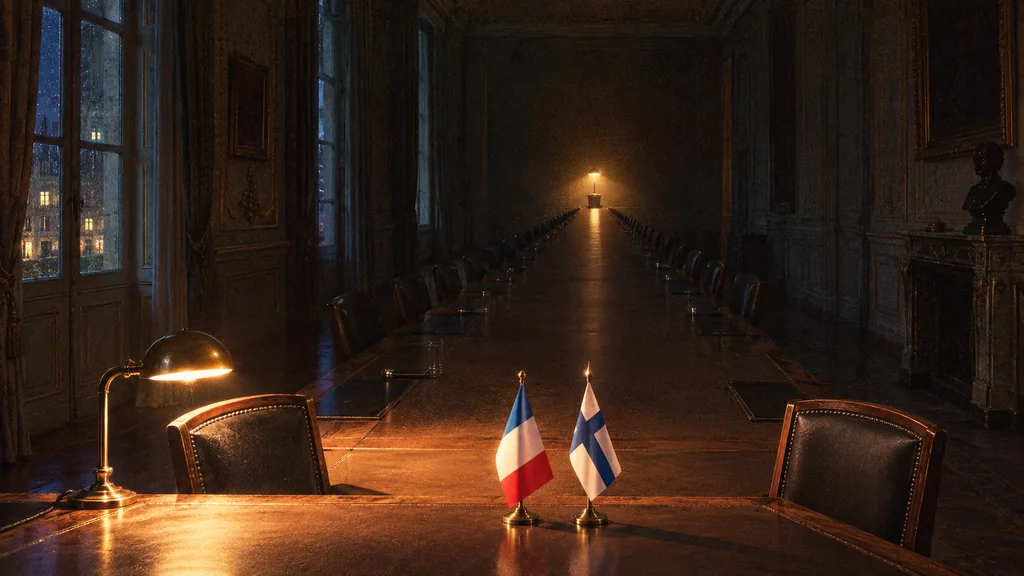
Finland joins France’s nuclear discussions while Paris keeps the decision to itself.
Image composition · tobriefFinland opened a formal nuclear dialogue with France at the first meeting of a joint steering group in Paris on 27 October (Élysée). A country with a long border with Russia now has a regular seat in French nuclear discussions. Paris has offered it no guarantee and kept every decision about its weapons for itself.
The delegations came from the Élysée and from the offices of Finland's president and prime minister, and their account speaks of a shared vision of closer strategic cooperation (Finnish president's office). Neither government's statement names an exercise, a crisis procedure or a timetable.
What Finland signed up for
The meeting put into practice a decision announced on 14 September, when Finland joined what President Emmanuel Macron calls forward deterrence (France–Finland joint statement). The idea is simple. Partner countries discuss nuclear threats with France and help send common warnings to an adversary, while France keeps sole control of its weapons.
Regular consultation could help Paris and Helsinki read a Russian threat the same way before a crisis peaks. No procedure for doing that in a real crisis has been announced.
Defence minister Antti Häkkänen set Finland's terms when it joined: Helsinki decides the pace and form of its participation, France asks no money for its arsenal, and no NATO-style duty of mutual defence follows (Finnish Defence Ministry). His ministry sketched a modest sequence, starting with talks on how to begin and moving later to negotiations on concrete terms. The Paris session was the first of those steps.
President Alexander Stubb has said he wants the arrangement to present Russia with a "strategic dilemma". He has also said it could take 10–15 years to evolve and that Finland does not yet know where it will lead (Verkkouutiset).
What Paris keeps for itself
Macron drew the limits in a speech at the Île Longue submarine base on 2 March. France alone, he said, would define its vital interests and decide whether to use nuclear weapons, and his offer carried no guarantee "in the strict sense" (Élysée).
Helsinki says the same thing from its side. Häkkänen has stated that the initiative is not an alternative French nuclear umbrella and does not replace NATO's (Finnish Defence Ministry). Researchers at ETH Zürich's Center for Security Studies reached a matching conclusion: French forward deterrence cannot on its own replace the US-led guarantee (ETH Zürich CSS).
Finland's actual nuclear protection still runs through NATO. The alliance values France's independent force because it complicates an adversary's calculations (NATO). Helsinki is deepening that alliance track separately, including on where NATO aircraft carrying nuclear weapons could land in a crisis (To Brief).
What would make it more than talk
Another partner shows what work beyond meetings can look like. On 20 October, British Typhoon fighters escorted French Rafales flying a simulated nuclear strike, in what London called the two countries' first joint exercise of its kind (UK Defence Ministry). Even that flight gave Britain no say over a French decision to fire.
Every partner also faces a credibility question. In Poland, analyst Nicole Grajewski has asked whether Moscow would believe Paris would risk nuclear retaliation for Warsaw (Defence24). The same doubt applies to Helsinki, and nothing France and Finland have published so far addresses it.
Finland has gained a standing place in France's nuclear thinking. It has no French guarantee and no role in any decision to use French weapons. With no work programme published and no joint exercise named, the Paris meeting committed both governments to keep talking and to nothing more. Paris and Helsinki will have to publish a programme or name an exercise before the steering group can show it does more than meet.
Details about this article
- Model:
- claude-opus-5-5
- Generated:
- 10/30/2026, 1:42:14 AM
- Pipeline run:
- eu_pipeline_20261030_005008
- Watermark:
- SynthID (Google's invisible watermark)
- Human review:
- None before publication