Finland licenses Onkalo, but burial waits
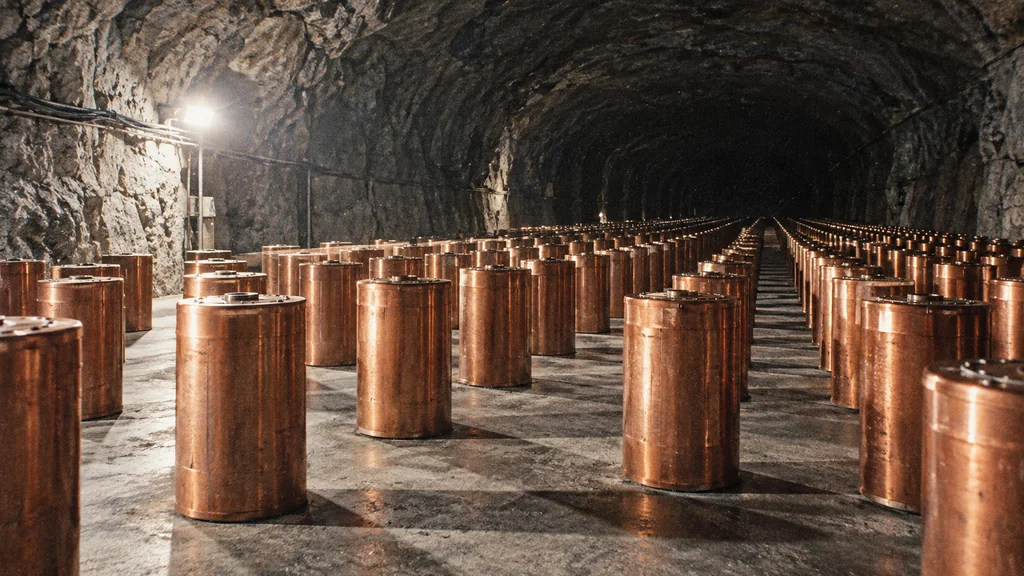
Finland licenses a place for spent fuel that must endure beyond observation.
Image composition · tobriefUsed fuel from nuclear reactors stays dangerous long after it stops producing electricity, so every country with reactors must decide where that fuel ends up. On 22 October 2026, Finland's government licensed the company Posiva to operate a plant that seals the fuel into canisters and a repository that buries them deep in the bedrock at Olkiluoto (Yle, France 24/AFP). Finland's nuclear regulator, STUK, says no geological repository for spent reactor fuel had reached this stage anywhere before (STUK).
Finland handles its spent fuel in two waiting stages. The fuel first cools for about a year in a water pool, then spends around 40 years in interim storage (Yle). Onkalo, as the repository is known, is the planned final stop: a place deep underground meant to keep the fuel isolated after its tunnels are closed.
A journey from the surface to the bedrock
The trip starts above ground at the encapsulation plant, which works like a packing station. There the fuel goes into a canister with a load-bearing iron interior and a copper outer shell, which then travels down to tunnels about 400–450 metres below the surface (STUK).
Each canister goes into its own deposition hole, a pit bored into the rock from the tunnel floor. Workers pack bentonite around it, a natural clay that swells as it absorbs water. As disposal moves forward, clay-based fill and seals close off the tunnels behind it.
Picture a set of nesting containers: metal around the fuel, clay around the metal, hundreds of metres of rock around everything. The layering matters because, deep underground, the slow traveller is groundwater seeping through cracks in the rock. Water is what could eventually reach a canister and carry material back toward the surface.
Trusting a design nobody can watch for millennia
Nobody can observe a sealed repository for thousands of years before trusting it. Instead, the company builds a safety case, a long argument backed by material tests, geology and computer models, and the regulator decides whether it holds up. Posiva says its case examines earthquakes, future ice ages and scenarios in which one or more of the man-made layers fails (Posiva).
Because water is the possible carrier, the assessment also has to ask how the water itself might change as the climate and the rock slowly evolve. As part of Posiva's assessment, Finland's CSC supercomputing centre modelled how the site's groundwater chemistry could shift over at least 100,000 years (CSC). These are projections from the company's own case. STUK reviewed that case and backed the licence (STUK), which is the verdict that matters at this stage.
The "first" is narrow by design. The US Waste Isolation Pilot Plant already buries waste deep underground, but it takes defence waste containing elements heavier than uranium, such as plutonium, rather than spent fuel from power reactors (US Department of Energy).
What stands between licence and burial
The government's licence does not yet let Posiva bury anything. The company must first finish commissioning, testing its equipment and procedures together as one working system, much as a new railway runs empty trains before passengers board. STUK must then inspect the finished facility and decide separately that it is ready to operate (STUK).
Posiva has named no date for the first canister. Its goal is to be ready to start encapsulation by the end of 2026, then invite STUK to inspect (Posiva FAQ). The licence itself runs until 31 December 2070, and any disposal after that would need a new decision (Yle).
Finland has licensed a geological repository for spent reactor fuel, a stage STUK says no other country has reached (STUK). Disposal still awaits the regulator's start-up clearance.
Details about this article
- Model:
- claude-opus-5-5
- Generated:
- 10/22/2026, 7:34:41 PM
- Pipeline run:
- eu_pipeline_20261022_184701
- Watermark:
- SynthID (Google's invisible watermark)
- Human review:
- None before publication