Finland licenses Onkalo; fuel must wait
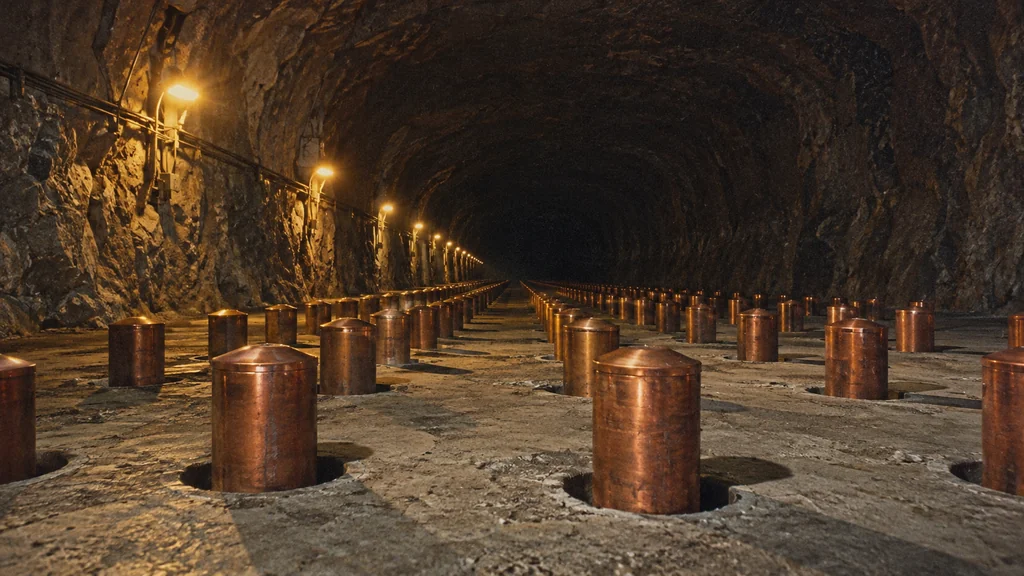
Finland’s repository has its licence, but the first real load awaits clearance.
Image composition · tobriefOn 22 October, Finland's government granted the nuclear-waste company Posiva an operating licence for Onkalo, a repository for spent reactor fuel dug into the bedrock at Olkiluoto (Posiva announcement). In August, the nuclear regulator STUK noted that no such facility anywhere had yet reached the operating-licence stage (STUK). Onkalo has passed its safety review. No spent fuel has been placed underground yet, and STUK must give a second go-ahead before any is.
Used reactor fuel is the awkward leftover of nuclear power. It stays hazardous long after it stops producing electricity, so keeping it away from people and groundwater means planning far beyond the lifespan of any company or government. Sweden, the closest comparison, only began building its own spent-fuel repository at Forsmark in 2025 (American Nuclear Society).
Why one licence is not enough
We covered the decision on the day it was announced (To Brief), and the fine print shows what it actually unlocks. The Ministry of Economic Affairs and Employment prepared the licence after STUK judged that the facility met the safety requirements (Ministry). That review was the big hurdle, and Onkalo has cleared it.
Think of a new building whose design has been approved and whose walls are up. Before anyone moves in, an inspector still has to confirm that the finished building works as promised. STUK said on 3 August that disposal could not begin on the strength of the licence alone. It would first make a separate decision confirming that every requirement for starting operation was met (STUK).
To get there, Posiva must finish commissioning, which means bringing every system into working order. It must also complete its remaining tests and pass a STUK inspection (Posiva announcement). No opening date was given (Yle). Posiva aims to be ready to operate by the end of 2026, but that is a company goal rather than an approved date (Ilta-Sanomat).
The licence itself runs through 31 December 2070 and covers fuel from the two older reactors at Olkiluoto and the two at Loviisa (Yle). Posiva says it has already run trials with canisters that held no real fuel, to check how its machines and crews work together (Posiva). Those were dress rehearsals, and STUK's final check concerns the real thing.
Layers that buy time
The design works like a set of nesting dolls, each layer with its own job. According to STUK's description of the facility, the fuel is dried and sealed inside a canister at the surface. The canister then travels down into tunnels deep in the bedrock and is lowered into a hole bored in the tunnel floor (STUK explainer).
The canister is the first barrier. Posiva describes a cast-iron insert that holds the fuel elements and carries the weight, wrapped in a copper shell chosen to resist corrosion (Posiva technical account). If the iron is the skeleton, the copper is the raincoat.
Next comes bentonite, a clay packed into the space around each canister. STUK describes it as a buffer that slows groundwater on its way to the metal (STUK explainer). The outermost layer is the bedrock itself, which news reports describe as extraordinarily old (CP24/AP).
Old rock is reassuring, but it is not proof. STUK's rules set a minimum period over which the engineered barriers must keep radioactive releases contained. That period is a design requirement, not measured performance (STUK explainer). To test whether the site can meet it, Posiva used the LUMI supercomputer at Finland's CSC computing centre to simulate how the site's groundwater chemistry could change far into the future (CSC).
This is how a safety case for something this long-lived is built. Engineers can watch how canisters, clay and rock behave over years and decades and check those observations against the models. The behaviour over the full span the rules cover can only be projected, so regulators judge the models along with the hardware.
Finland's repository has cleared the licensing safety review, a stage STUK says no comparable facility had reached (STUK). The day spent fuel actually goes underground now depends on STUK, once Posiva shows the finished system works as designed.
Details about this article
- Model:
- claude-opus-5-5
- Generated:
- 10/23/2026, 1:29:20 AM
- Pipeline run:
- eu_pipeline_20261023_005007
- Watermark:
- SynthID (Google's invisible watermark)
- Human review:
- None before publication