Finland’s nuclear waste vault awaits final tests
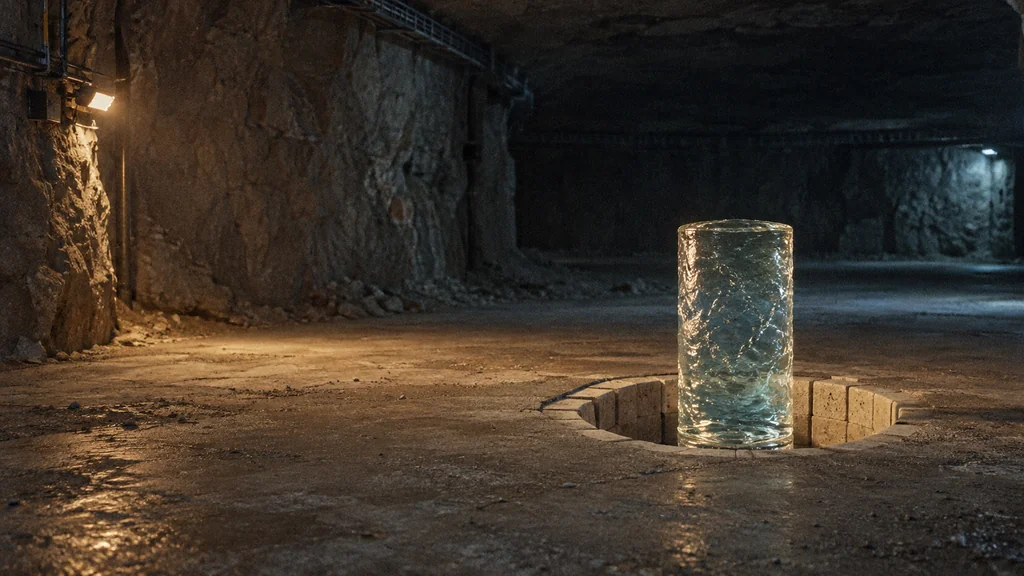
Finland’s deepest safeguard still waits for its first real test.
Image composition · tobriefEvery nuclear power plant leaves behind used fuel that stays dangerous long after it stops making electricity, and almost everywhere that fuel still sits in temporary storage. On 22 October, Finland's government gave the company Posiva an operating licence for Onkalo, a repository at Olkiluoto, to permanently dispose of up to 6,500 tonnes of uranium until the end of 2070 (Finnish government). The first canister is not going underground yet, because the finished plant must still pass its final tests and an inspection by the regulator.
Finland's current routine shows the problem. Fuel leaving a reactor cools for about a year in a water pool, then waits decades in interim storage (Yle). That buys time without ending the problem, and Onkalo is meant to end it. The regulator STUK says no comparable facility for spent fuel from power reactors had reached this stage (STUK). The United States already buries some defence waste at its Waste Isolation Pilot Plant, but not spent fuel from power reactors (US Department of Energy). We covered the decision itself earlier (To Brief). This piece explains how the repository works and what still has to happen before it opens.
Copper, clay and bedrock
Picture a tunnel roughly 400 to 450 metres below the forest at Eurajoki, its floor drilled with holes, one for each canister (STUK). The long-term concern is the water that moves slowly through cracks in deep rock, which is the most plausible way buried material could travel. Each layer of the design sits between the fuel and that water.
The fuel goes into copper canisters, chosen because copper corrodes very slowly. Sweden's nuclear waste company SKB uses the same copper-and-clay design and agreed to weld bottoms onto about 160 Finnish canister tubes over five years (SKB). That shows the hardware is shared across borders.
In its hole, each canister is packed in blocks of bentonite, a clay that swells as it soaks up water. Think of a dry sponge wedged into a jar. Once wet, it presses tight against the canister and the rock and fills the gap between them. Posiva has been testing a dedicated machine that lowers these blocks into a full-size hole (Posiva).
The rock is the outer layer, and its evidence stays local. Germany is still narrowing down 90 possible areas, plans to propose regions for exploration at the end of 2027, and is also weighing salt and clay-rich rock as alternatives to hard bedrock (BGE). Onkalo's safety conclusion applies to Olkiluoto's rock, and each country has to build its own case for its own ground.
Who decides that it is safe
The design rests on a safety case, the body of evidence and computer modelling used to judge whether the layers will keep the fuel isolated over the very long term. In August, after reviewing Posiva's work since 2000, STUK found no safety obstacle to granting a licence (STUK). That verdict judges Posiva's evidence and models, because no one can watch a sealed repository for thousands of years.
Several steps still stand between the licence and the first canister. On licence day, Posiva listed final commissioning, the testing of the completed plant, as still outstanding, along with other tests and inspections, and it gave no date for the first real canister (Posiva). In its 2025 oversight report, STUK noted that equipment and commissioning work had pushed a full underground trial run into 2026 (STUK oversight report).
The law then adds two gates. Under section 20 of the Nuclear Energy Act, STUK must inspect the finished facility and confirm it meets the requirements to start operating, and the ministry must confirm that Posiva's funding for waste management is in order (Nuclear Energy Act).
The licence also has limits. It covers fuel from the Olkiluoto 1 and 2 and Loviisa 1 and 2 reactors, while Olkiluoto 3 needs a later arrangement, Environment Minister Sari Multala said, according to STT. The government expects the full disposal campaign to run into the 2120s. That is decades beyond this licence's 2070 end date, so continuing the work will require another decision (Finnish government).
Finland has licensed the permanent disposal of spent power-reactor fuel deep in bedrock. Emplacement begins only after STUK clears the finished facility. Within ten years, the regulator will also require an updated safety case, judged against the repository as it was actually built (STUK).
Details about this article
- Model:
- claude-opus-5-5
- Generated:
- 10/24/2026, 1:33:07 AM
- Pipeline run:
- eu_pipeline_20261024_005008
- Watermark:
- SynthID (Google's invisible watermark)
- Human review:
- None before publication