A fossil dip, a CO₂ record
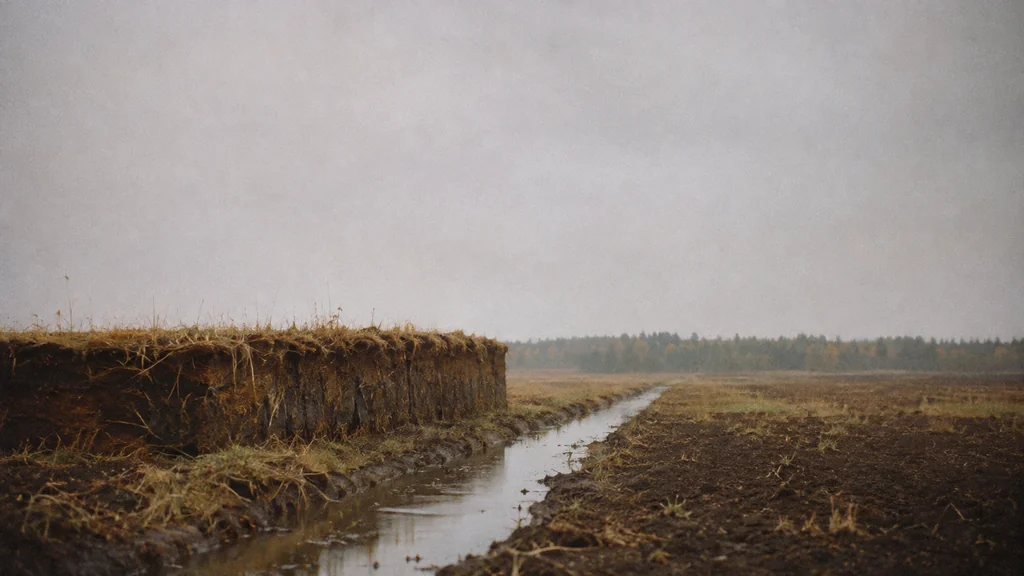
A small fossil fuel dip meets a less certain rise from land.
Image composition · tobriefThe world's fossil-fuel CO₂ emissions are projected to dip slightly in 2026, while total human-caused CO₂ edges up to a new high (Global Carbon Budget preprint). The two fit together because the total also counts emissions from how people use land, and that share is projected to grow. Both shifts are small, and neither yet shows a lasting trend.
Think of humanity's CO₂ as one bill paid from two accounts. The fossil account covers coal, oil, gas and cement. The land account covers what people release by clearing and damaging forests, harvesting wood and draining or burning peat. The carbon that regrowing forests pull back out of the air is subtracted from that account.
This year, spending from the fossil account is projected to fall 0.4%, about 0.15 billion tonnes, leaving 38.2 billion tonnes of CO₂ (Global Carbon Budget preprint). According to the Global Carbon Project, that would be the first annual fossil decline since the pandemic year of 2020. The land account, meanwhile, is projected to grow from about 4.4 to 5.1 billion tonnes. That lifts the combined bill from 42.8 to a record central estimate of 43.3 billion tonnes (Global Carbon Budget preprint).
The figures come from the Global Carbon Budget, a yearly audit of where humanity's CO₂ comes from and where it goes. This year's edition is still a preprint, so other scientists are still checking it. A companion analysis has already passed that check and is published in Nature Climate Change.
Why the land account is harder to read
The fossil account works a bit like reading an electricity meter. Researchers tally it from national statistics on fuel and cement, which record what was sold and burned. The land account has no meter. Researchers rebuild it with computer models of how much carbon plants and soils store and lose, which is more like estimating a forest's weight from aerial photos and growth tables.
Peat shows why this is tricky. It is half-rotted plant matter that piles up in soggy ground, like a compost heap that never finishes breaking down, so it holds a great deal of carbon. When it dries out or burns, that carbon escapes. Pinning down how much escaped in a single year is far harder than counting barrels of oil.
A record inside the error bars
That difference shows up in the error bars, the range within which the true value probably lies. The fossil projection runs from a 1.5% fall to a 0.6% rise (Global Carbon Budget preprint). Even the direction of the fossil change, then, is not settled.
The land side is wobblier still. The 2025 land-use estimate alone carries an uncertainty of ±2.6 billion tonnes, far wider than the roughly 0.7-billion-tonne increase projected for this year (Global Carbon Budget preprint). CICERO, whose scientists contributed to the budget, warns that this uncertainty rules out reading much into the small rise in the total.
It also helps to separate two things that sound alike. These numbers measure emissions, meaning what humanity puts out each year. How much CO₂ actually builds up in the air is a different figure, because land and oceans soak up part of each year's output, and the budget tracks those natural sponges separately. A record in emissions tells you how hard humanity is pushing. The atmosphere's response also depends on how much nature absorbs that year.
The pushing is what counts against the climate target. By the Project's estimate, only about 150 billion tonnes of CO₂ remain if warming is to stay within 1.5°C, less than four years at today's rate (ICOS). This year's forecast shows how a small fossil dip can coexist with a higher total. Neither projected change yet establishes a durable trend, and the next annual audit will be the first chance to see whether the fossil dip holds.
Details about this article
- Model:
- claude-opus-5-5
- Generated:
- 11/11/2026, 2:11:29 AM
- Pipeline run:
- eu_pipeline_20261111_005008
- Watermark:
- SynthID (Google's invisible watermark)
- Human review:
- None before publication