Four EU states split on Ukraine permits
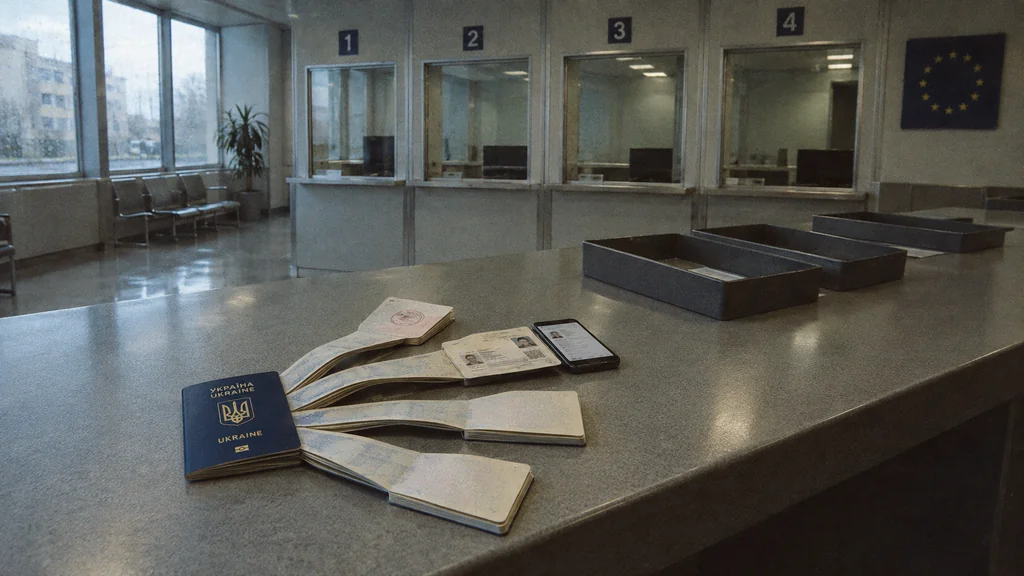
One European promise now demands different proof at every counter.
Image composition · tobriefSince 5 August, Ukrainians applying for a new temporary-protection permit in the EU must show they have met their military obligations under Ukrainian law. The condition does not affect the millions already protected. But the EU text left the details so vague that countries are running different checks, with different age ranges and different accepted documents. Where someone applies now determines what proof counts.
What the EU decided, and what it left open
The Council (where national governments set EU policy) adopted Decision 2026/1912 on 30 July, extending temporary protection to March 2028 while adding the military-compliance condition. The European Commission proposed the measure. The European Parliament had no legislative role. National migration authorities now apply it.
The text requires applicants to show compliance with Ukrainian military obligations "where applicable." It names no sex, no age range and no specific document. Anyone who held continuous protection in the same member state before 31 July is exempt. That covers the vast majority of Ukrainian men in Europe: Eurostat counted 4.43 million temporary-protection beneficiaries overall.
Changing member state, though, could expose an existing beneficiary to the new test. The decision's exemption is tied to continuous residence in one country.
Czechia and Sweden: same rule, different tests
Czechia began screening applicants aged 18–60 from 5 August (Czech IPC/OAMP). Prague set the strictest published check: officials require both a printed record from Ukraine's Reserv+ military-registration system and the applicant's live digital profile for comparison. By early September, Interior Minister Lubomír Metnar said the share of military-age applicants had dropped sharply (Novinky).
Sweden screens men aged 23–65. Its Migration Agency accepts a broader set of documents, including a passport exit stamp no older than 90 days (Migrationsverket). The agency's guidance does not explain the 65-year cutoff.
Germany and Poland: no visible guidance
Germany's residence permits for Ukrainians flow from the binding EU decision, but no public federal instruction specifying age bands or required documents has appeared (§24 Residence Act). Poland's registration guidance makes no mention of military records or the new condition (gov.pl). Unpublished internal instructions may exist, but applicants in two of Europe's largest host countries (Eurostat) have no visible way to know what will be asked of them.
Denmark's separate, harder law
Denmark opted out of the EU's asylum framework by treaty, so the Council decision does not apply there. Copenhagen passed its own law, effective 3 September, covering men aged 23–59 (Berlingske). Its rule goes further than the EU design on one point: Danish authorities can withdraw permits already granted on applications filed since 25 June, even if the holder was approved before the law took effect. Municipal associations and civil-society groups warned this retrospective power risks family separation (KL).
The affected group is still unmeasured
No EU-wide data on post-August refusals exists. Czech officials have reported dozens of daily cases; the Swedish, German and Polish migration agencies reviewed for this article have published no refusal figures. The condition applies only to new grants, so the population encountering it is a fraction of the existing protected population. How large a fraction, and how many are turned away, remains unknown six weeks into the policy.
An untested legal basis
Steve Peers, the EU law scholar who first raised the question, has argued that the Council's power to extend temporary protection does not necessarily permit narrowing who qualifies. The Temporary Protection Directive's own exclusion grounds cover serious crime and security threats, not failure to meet a foreign country's military obligations (Directive 2001/55). The Council's position is that the extension power includes setting updated conditions. No court has tested this. A rejected applicant would first need to challenge the decision in a national court, which could then refer the question to the EU's Court of Justice for review.
With refusal data still incomplete, the measure has produced unequal screening across Europe without a demonstrated contribution to Ukrainian mobilisation.
How was this article?
Help us get better
Help us get better
Details about this article
- Model:
- claude-opus-4-6
- Generated:
- 9/13/2026, 1:47:24 AM
- Pipeline run:
- eu_pipeline_20260913_005005
- Watermark:
- SynthID (Google's invisible watermark)
- Human review:
- None before publication