France’s 2027 budget meets pricier debt
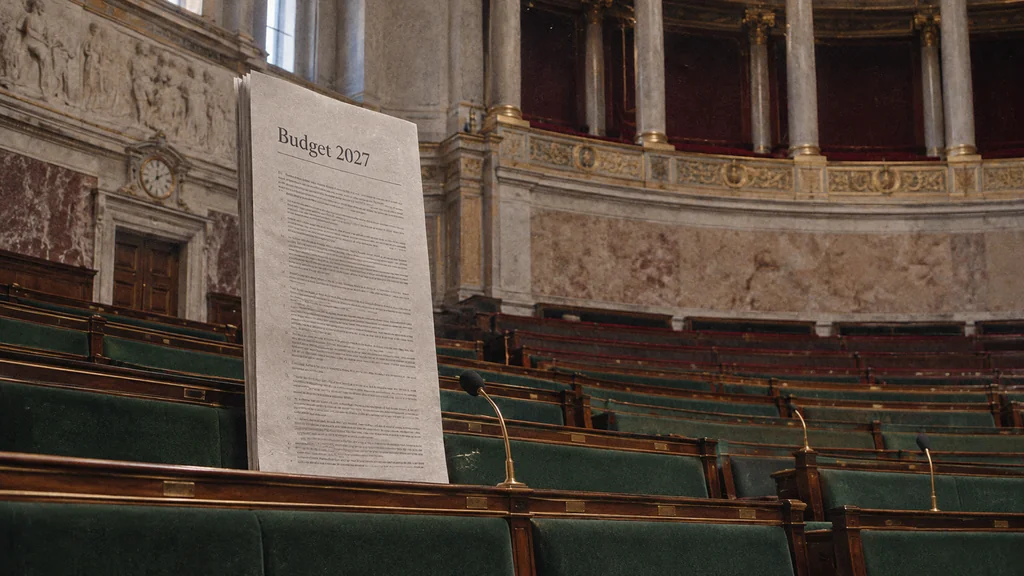
France’s unfinished budget casts a longer shadow over its borrowing costs.
Image composition · tobriefInvestors now want noticeably more to lend to France than to Germany. The gap between the two countries' ten-year borrowing costs was 137.4 basis points at Friday's close, according to Ideal Investisseur, and 151.38 at 18:00 on Tuesday on Teleborsa's figures. The rise followed a weekend of unrest while France's 2027 budget sat unfinished in parliament. If the higher premium lasts, taxpayers will pay for it gradually as the state sells new debt.
What changed between Friday and Tuesday
The gap, known as the spread, is the extra yearly return investors demand for holding a French ten-year government bond instead of a German one. It is counted in basis points, hundredths of a percentage point, so a spread of 150 means roughly 1.5 percentage points more a year (Banca d'Italia). The Friday and Tuesday figures come from different data providers, so the comparison is approximate.
Over the weekend, protests about living costs, fuel prices and public services turned into clashes and looting in Paris and other cities. Invesco's Paul Jackson argued that the riots make spending cuts harder when many people are already under financial pressure (Reuters).
On Tuesday the French ten-year yield (the annual return a buyer locks in at today's price) rose to 4.96%, while Germany's slipped to 3.43%. The gap was still below its early-October peak of 158.67, the highest since November 2011 (Reuters). Providers take their quotes at different moments, which is why these yields do not match Teleborsa's 18:00 spread exactly.
A budget still stuck in parliament
Even on the government's own plan, France would spend more than it raises by 5.0% of GDP in 2027 (draft budget). GDP is the value of everything the economy produces in a year, so the state would still be borrowing heavily every year. The simplest reading of the market move is that investors want proof that even this plan can pass.
So far they have not had it. On Monday, the vote on the budget's revenue half, which had been due Tuesday, was postponed because more than 2,000 amendments were still waiting (LCP). The vote is now scheduled for 3 November (National Assembly).
Bond prices cannot tell us how much of the widening came from the riots and how much from the stalled budget. Both were in view at the same time.
How the cost reaches taxpayers
People who already own French bonds feel it first. A bond's price and its yield move in opposite directions. When yields rise, older bonds paying lower interest lose value for anyone who sells them now.
Taxpayers feel it later and more slowly. France does not reset the interest on bonds it has already sold. A higher rate applies only when the state borrows again, either to fund new deficits or to repay old bonds as they come due. The 2027 plan foresees €340 billion of new longer-dated bonds, separate from short-term bills (draft budget). France's existing debt has an average of eight years and 158 days left to run, so a higher rate takes years to spread through the whole stock (Agence France Trésor).
Investors are still lending. On Monday, after the riots, France sold €7.245 billion of short-term bills. Buyers offered between 2.16 and 2.51 times the amount on sale (Agence France Trésor). Lenders wanted France's short-term debt. What changed was the price they asked to hold its ten-year bonds.
That is the verdict these numbers support. France could still sell short-term debt after the unrest, but investors charged a higher premium for lending to it over ten years. If that premium holds, it will reach the budget one auction and one refinancing at a time. Taxpayers will see it as a rising interest bill, which leaves less room for public services, investment or tax cuts.
Details about this article
- Model:
- claude-opus-5-5
- Generated:
- 10/20/2026, 7:02:37 PM
- Pipeline run:
- eu_pipeline_20261020_180759
- Watermark:
- SynthID (Google's invisible watermark)
- Human review:
- None before publication