France’s 2037 tank deadline outpaces MGCS
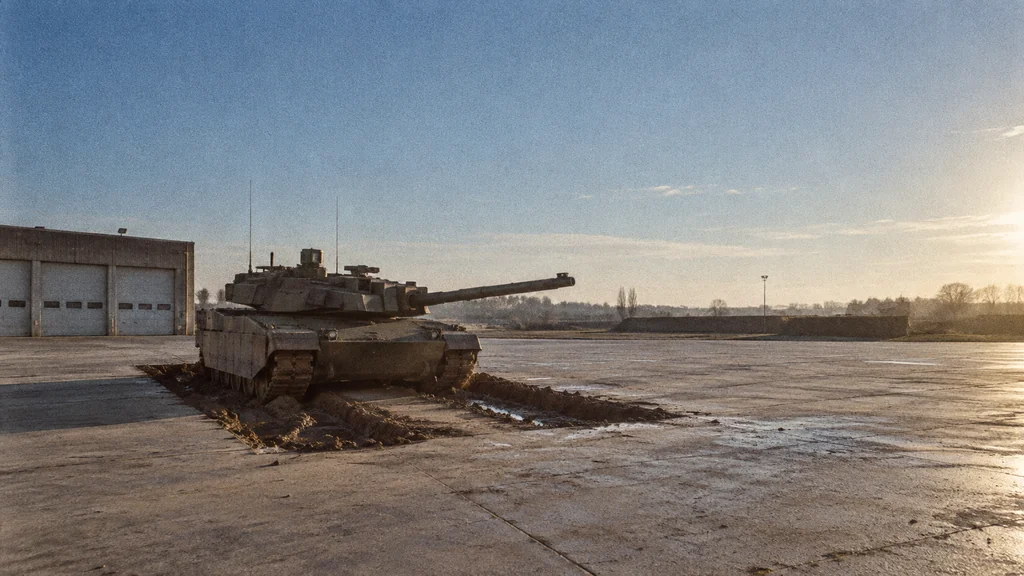
The joint programme continues, while France’s replacement deadline draws nearer.
Image composition · tobriefParis and Berlin still intend to work together on tank technology, but they have not committed to a common tank in time for France's stated need. On 9 October, the French and German defence ministers insisted that their joint future-tank programme was continuing (Reuters, Deutschlandfunk). The day before, France's top general had told parliament that Germany had left it (Assemblée nationale, Franceinfo).
At Le Haillan, near Bordeaux, French minister Catherine Vautrin said the Main Ground Combat System (MGCS) remained current. Her German counterpart, Boris Pistorius, said nobody had stopped it and called it a flagship of Franco-German cooperation (Reuters).
Neither minister said what the programme would produce. Handelsblatt noted that they left open whether the result would be one common tank or separate national vehicles linked by shared technology (Handelsblatt). That gap matters because MGCS is a two-country deal, not an EU programme. Paris and Berlin decide its scope, Germany's procurement office signs its contracts, and each government stays free to fund its own tanks.
What the general said, and what his staff corrected
General Fabien Mandon, France's chief of defence staff, told the National Assembly's defence committee that the results were poor and that the Germans had decided to leave. He called it bad news for industry. He added that it was not a total failure, because the two army chiefs had agreed a document setting out common requirements for a future tank (Franceinfo). We reported his account that day (To Brief).
His staff issued a clarification that same evening. According to AFP, it said MGCS was delayed but continuing, and that an industrial offer submitted in early 2026 could not replace France's existing tanks around 2037 (AFP/Boursorama). That is the deadline that matters for Paris. A jointly built tank, the statement added, would now arrive toward the late 2040s (AFP/Boursorama).
The French staff also said Germany had opted for a national study of a successor to its Leopard 2 tank. That study does not appear in any German record published so far. For now, it rests on the French statement alone.
How the ambition narrowed
The programme's troubles predate this week. In October 2025, France's then procurement chief, Emmanuel Chiva, told senators that the industrial consortium's first offer cost about twice the initial estimate, and that France had refused it (Sénat).
Nine months later, the commitment had shrunk. At their defence council on 17 July 2026, the two governments agreed only to joint research on how armoured vehicles could fight as a connected network, carried as far as a demonstration that the idea works. Their text named no common vehicle, no budget and no date (Élysée). The record shows that sequence, not that the rejected price caused the retreat.
Some engineering work does exist. On 11 March 2026, Germany's procurement office commissioned Rolls-Royce to develop a hybrid engine for MGCS, without disclosing a price (Rolls-Royce).
Each army plans the next decade alone
France is not waiting. The updated military planning law it published on 17 September 2026 provided for 200 Leclerc tanks, 160 of them upgraded, and funded studies for a stopgap tank, with the first expected in service around 2035 (Légifrance). Germany's documented plan is to buy modernised Leopard 2A8s rather than a new design (BMVg).
Beyond the two capitals, the fallout so far is limited. The Netherlands is buying at least 46 Leopard 2A8s through a German-led purchase, with the battalion due complete by 2031, and has applied for observer status in MGCS (Dutch government, Dutch government). That order goes ahead regardless. What Dutch planners lack is a timetable for whatever comes after the Leopard.
Mandon's first claim, that Germany had walked away, went further than his own staff's correction. The ministers, for their part, confirmed that the programme survives but offered no vehicle, money or date to back it. On the public record, the joint programme continues, but no funded common tank is scheduled to meet France's stated replacement need.
Details about this article
- Model:
- claude-opus-5-5
- Generated:
- 10/10/2026, 1:39:26 AM
- Pipeline run:
- eu_pipeline_20261010_005006
- Watermark:
- SynthID (Google's invisible watermark)
- Human review:
- None before publication