France’s €30 Billion Budget Has €24 Billion Missing
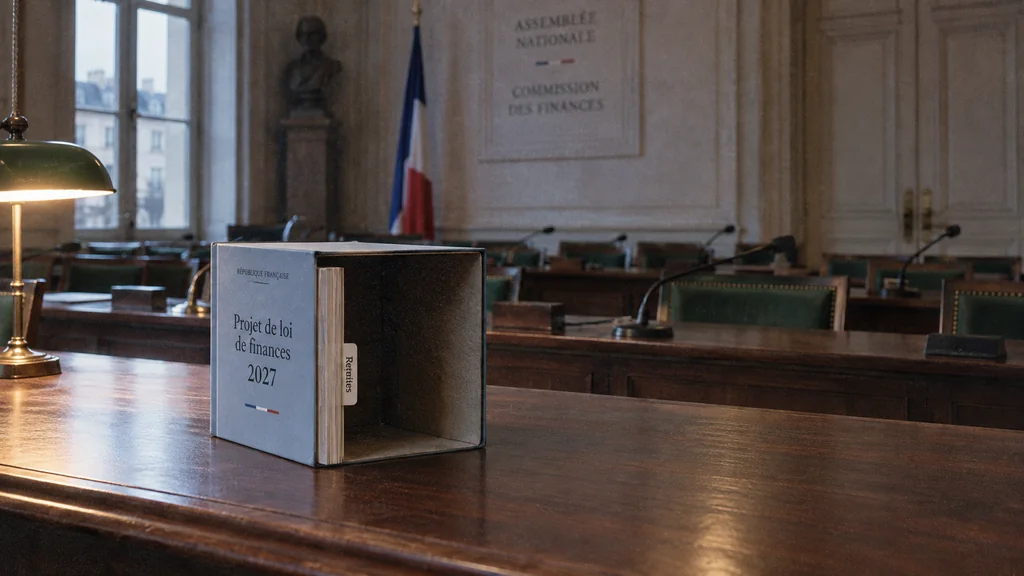
France enters budget season with most of its savings still unwritten.
Image composition · tobriefFrance says it needs roughly €30 billion in budget savings to stop its deficit from growing in 2027 (Bloomberg). Two weeks before the draft bills are due, the government has put forward one large, quantified proposal: a pension change worth about €6 billion (Le Monde). The remaining €24 billion has no published list of policies behind it. It is the gap between a political target and the measures anyone can name (Budget Ministry).
The €30 billion is measured against a moving target
The €30 billion is not a cut to what France spends today. It is measured against what spending and revenue would look like in 2027 if the government changed nothing. Pensions rise with prices, healthcare costs grow with ageing, and defence commitments expand. Without action, the European Commission's May forecast projects the deficit would climb from about 5.1% of GDP in 2026 to 5.7% in 2027.
Prime Minister Sébastien Lecornu acknowledged that cash spending would still rise; the goal is to make it rise more slowly than prices. Even if every euro of the package were delivered, the deficit would fall to roughly 4.75% of GDP, still above the roughly 4% that the EU's agreed deficit-reduction timetable requires (European Commission). France's national audit court, the Cour des comptes, estimates that stabilising France's debt ratio would require a deficit near 2.8%. The full €30 billion would not get halfway there.
This matters for the rest of Europe. The gap between what France and Germany pay to borrow has widened to about 0.94 percentage points, its widest since 2012. When investors doubt a large eurozone government's fiscal plans, they demand higher interest on its debt, and that repricing can push up borrowing costs for other heavily indebted member states whose bonds are compared against the same benchmarks.
Pensioners carry the only visible burden
Budget Minister David Amiel said raising pensions in line with prices would cost more than €6 billion in 2027. The government is weighing two routes. The first: freeze or under-index pensions while reducing pensioners' 10% deduction from taxable pension income. The second: raise pensions fully but abolish that deduction entirely (LCP, TF1-LCI).
The difference is real. Under-indexation cuts every affected pensioner's purchasing power equally. Removing the tax deduction mainly hits pensioners who earn enough to pay income tax, sparing the poorest. Neither option had been chosen by 14 September.
Beyond pensions, the picture thins quickly. Published spending ceilings show defence rising by €6.4 billion and several protected ministries getting increases, while labour, agriculture and health budgets shrink (Budget Ministry). A possible extension of the large-company profit levy and a €300 million reform of training accounts have been floated. Economy Minister Roland Lescure simultaneously defended proposed tax-bracket adjustments and business tax credits that would cost revenue, shrinking the remaining places to find money.
The parliamentary arithmetic is worse than the fiscal arithmetic
Marine Le Pen said the National Rally would reject tax increases and social injustice against working France, and her finance spokesman made protecting pensioners' purchasing power an explicit red line. That collides directly with the government's only quantified saving.
Lecornu can use Article 49.3 of the constitution to push the budget through without a vote: the bill is deemed adopted unless opponents unite 289 deputies for a censure motion. He used this route three times for the 2026 budget and survived. But in December 2024, Michel Barnier tried the same manoeuvre and his government fell.
The draft state and social-security finance bills are due on 30 September. No independent body has scored the package because there is not yet a package to score. The IMF recommends an annual adjustment pace roughly consistent with the €30 billion target. But a target matching the IMF's advice is not a budget. France has an unallocated number and a contested pension proposal heading toward a parliament that has already promised to reject it.
Details about this article
- Model:
- claude-opus-4-6
- Generated:
- 9/15/2026, 1:42:42 AM
- Pipeline run:
- eu_pipeline_20260915_005006
- Watermark:
- SynthID (Google's invisible watermark)
- Human review:
- None before publication