France’s €54bn fix still lifts debt
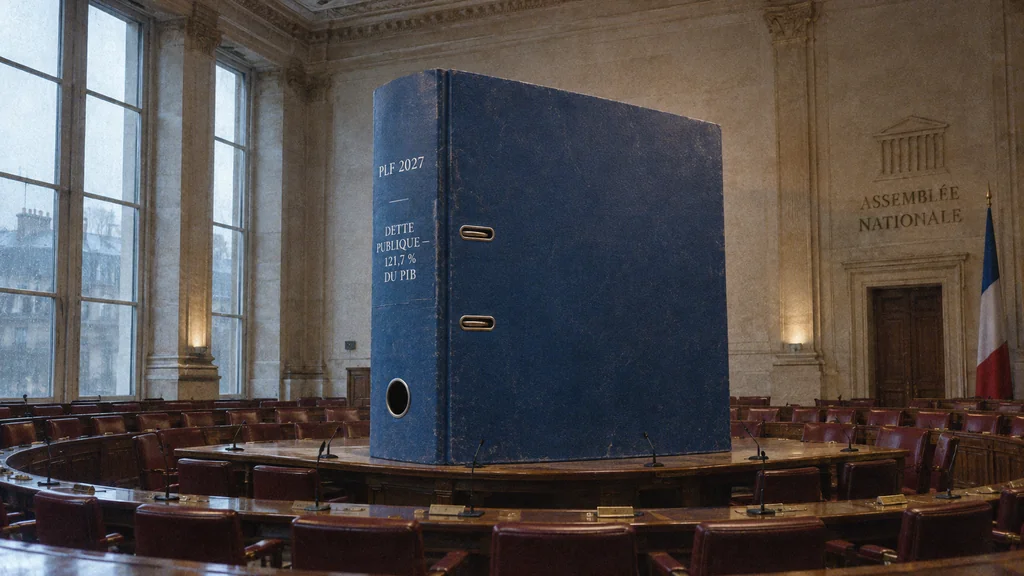
France borrows less, but the weight of its debt keeps growing.
Image composition · tobriefFrance's draft 2027 budget projects the annual deficit falling from 5.4% to 5.0% of GDP. Public debt, however, would climb from 119.3% to a record 121.7% (Les Echos Investir, Le Monde). A smaller deficit is still a deficit. France keeps adding debt, just more slowly. And the economy is not growing fast enough to absorb it.
Why borrowing less still means owing more
A country's debt ratio (debt divided by GDP) can fall even while the government borrows, provided the economy grows faster than the debt pile. Spain demonstrated this in July: its debt stock grew, but nominal growth (growth including price rises) was strong enough to push the ratio below 100% of GDP (Banco de España, El País).
France's problem is the opposite. The Cour des comptes (the institution that audits government accounts) calculated that with debt already near 119% of GDP, France would need to bring its deficit down to about 2.8% to stop the ratio from rising (Cour des comptes). The government's own 2027 target of 5.0% is almost double that threshold.
Interest costs make the gap harder to close. As old bonds issued at low rates mature, France replaces them with new ones at higher rates. According to Tagesschau, interest spending reached €34.5 billion in the first half of 2026, almost 20% more than a year earlier. According to Public Sénat, roughly €10 billion of the improvement the government claims for 2027 would be offset by higher debt-service costs (what the state pays its creditors).
Why €54 billion does not mean €54 billion of cuts
The government says it will deliver €54 billion in savings. That figure measures improvement against a scenario where the government does nothing and the deficit drifts toward 6.5% (European Commission). It is a real fiscal effort, but not a list of €54 billion in specific cuts. An earlier version of the plan cited about €30 billion; the headline grew largely because the no-action baseline got worse.
The government has not published a full bridge from the identified measures to the €54 billion total. What is visible so far suggests the burden falls unevenly.
Pensioners would face either a benefit freeze or a reduced tax allowance, worth roughly €6 billion (LCP). Civil servants would get a pay freeze, saving about €2 billion. With Bercy (France's finance ministry) projecting inflation of 1.8% in 2027 (French Economy Ministry), that freeze is a real-terms pay cut.
Large companies, by contrast, would pay less than they do now. A temporary corporate surtax currently raises €8 billion a year. The budget would keep it but reduce it to roughly €5 billion (French Budget Ministry). Officially this counts as a saving versus full expiry of the tax. In practice, firms gain €3 billion compared with today. An additional €6.4 billion in defence spending partly offsets the tightening elsewhere.
Those identified items do not add up to €54 billion. The gap between named measures and headline adjustment has not been publicly reconciled.
What the fiscal watchdog can and cannot settle
The government sent its budget texts to the Haut Conseil des finances publiques (HCFP), France's independent fiscal council, which assesses whether the growth and revenue assumptions behind the budget are realistic (HCFP). No opinion had been published by 19 September.
Even a favourable HCFP assessment would not prove the budget will work. The council checks forecasts, not legislation. Passing the budget falls to a parliament where no party holds a majority. The government can use Article 49.3 of the constitution to push the budget through without a vote, but that risks a no-confidence motion.
France has been under the EU's excessive-deficit procedure (the formal process requiring a country to cut excessive borrowing) since July 2024 and must bring the deficit below 3% by 2029 (Council of the EU). Its previous plan projected debt peaking at 118.7% in 2027. The new 121.7% figure means that path is already gone (European Commission).
Even full enactment of every measure in the budget would still leave debt rising. Parliament is deciding who pays for a slower deterioration, while the government still owes a complete account of the €54 billion adjustment.
Details about this article
- Model:
- claude-opus-4-6
- Generated:
- 9/20/2026, 1:37:53 AM
- Pipeline run:
- eu_pipeline_20260920_005006
- Watermark:
- SynthID (Google's invisible watermark)
- Human review:
- None before publication