France’s Iran accusation faces an EU vote
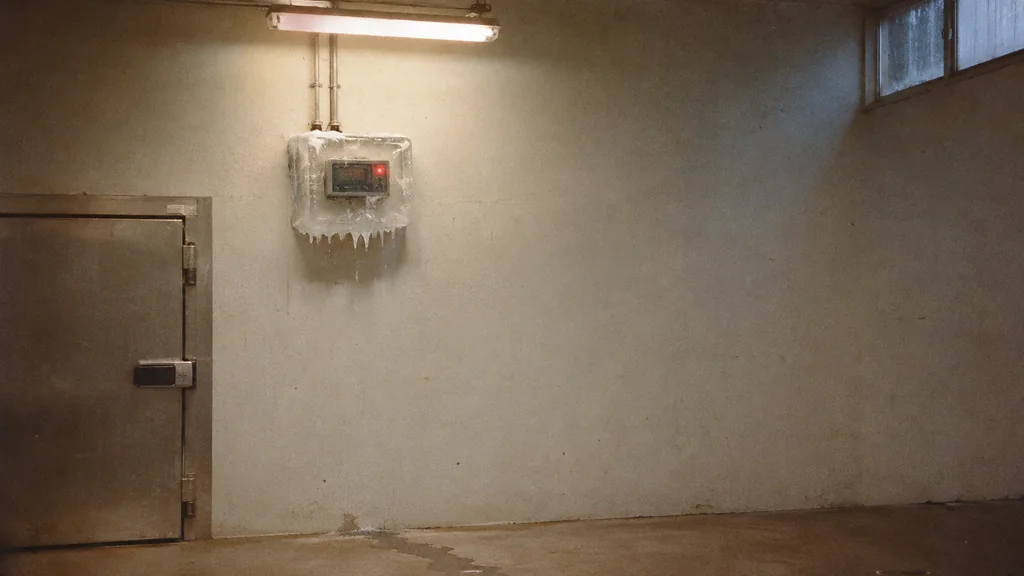
A remote maintenance opening leaves hundreds of French food stores vulnerable.
Image composition · tobriefOn 9 November, France named Shahid Kaveh, a cyber unit of Iran's Islamic Revolutionary Guard Corps (IRGC), as the attacker that seized refrigeration controls at more than 700 French food-distribution sites on the night of 11–12 October, and said it would seek EU sanctions (French Foreign Ministry, The Record). The finding covers October in France only. France has not linked the unit to similar attacks on shops across Europe in November, and EU sanctions need every government's consent.
The attackers forced fridges and freezers into endless defrost cycles and silenced the alarms meant to warn staff. C4, France's cyber-crisis coordination centre, recorded at least 15 fire outbreaks, at large supermarket chains as well as small butchers and an abattoir (C4/CERT-FR report). The foreign ministry put food losses at several tens of millions of euros (French Foreign Ministry).
The way in was mundane. The attackers used the web interfaces of in-store controllers, the boxes that let refrigeration technicians adjust cooling without visiting the shop (C4/CERT-FR report). A convenience for maintenance became the weak point.
What France has shown
The firmest step is judicial. Paris prosecutor Laure Beccuau has requested international arrest warrants for the unit's head and two deputies, though none has yet been issued (Paris prosecutor).
The technical evidence is circumstantial. C4's public report cites Persian-language traces and an account of the attack published on 13 October by an outlet it associates with Shahid Kaveh (C4/CERT-FR report). Prosecutors add IP addresses pointing to terminals in Iran. Each clue points toward Tehran, but none on its own shows who was at the keyboard, because addresses and language traces can be borrowed.
C4 did not publish the raw logs that would let outsiders reproduce its analysis. Partners are therefore looking at a detailed national judgment they cannot check for themselves. That judgment is also tightly drawn: a smaller attack on a different brand of controller the following night still has no named perpetrator (Le Monde).
A European wave with no named author
Overnight into 2 November, 23 ICA stores and seven Coop stores in Sweden were hit (SVT). Cases followed in Italy, Romania, Ireland, Belgium, Estonia and Portugal, and Poland and Greece issued warnings (To Brief).
Who did it remains unclear. Romania's cyber chief, Dan Cîmpean, called his country's six-shop case "semi-amateurish" and said he did not suspect a state actor (AFP). Pro-Russian hacker groups claimed the attacks. When SVT checked one of their "proof" files, 168 of its 171 email addresses had already circulated in older leaks (SVT).
Since 4 November, EU agencies and national incident-response teams have shared advice on securing exposed controllers without naming a culprit (ENISA). C4 does not attribute the November wave to Shahid Kaveh either.
What a sanctions listing needs
Foreign Minister Jean-Noël Barrot wants to use the EU's cyber sanctions regime. It freezes assets and can bar travel for those behind significant cyberattacks, and it requires unanimity, so any single government can block a listing (Council Decision 2019/797). In March the Council, where national governments take these decisions, used it to list Tehran-based Emennet Pasargad over operations against Sweden and France (Council). That listing does not cover the fridge attacks, so France must propose new names with stated reasons.
Those named can challenge the listing in court. In the Fulmen case, the EU's top court upheld the annulment of Iran-related sanctions because the Council could not back its stated reasons with evidence (Council v Fulmen). The same standard would apply here, so France's evidence has to work in front of judges as well as ministers.
EU foreign ministers are due to meet on 16 November (Council forward look). France has given them a case on the October attacks that they can examine but not verify independently. It has given no public basis for treating November's wider wave as the same operation. Governments will also weigh politics and their own intelligence. Paris has not yet said whom it wants listed, and until it does, ministers have nothing to approve or block.
Details about this article
- Model:
- claude-opus-5-5
- Generated:
- 11/10/2026, 1:58:00 AM
- Pipeline run:
- eu_pipeline_20261110_005009
- Watermark:
- SynthID (Google's invisible watermark)
- Human review:
- None before publication