France’s next tank has no German pledge
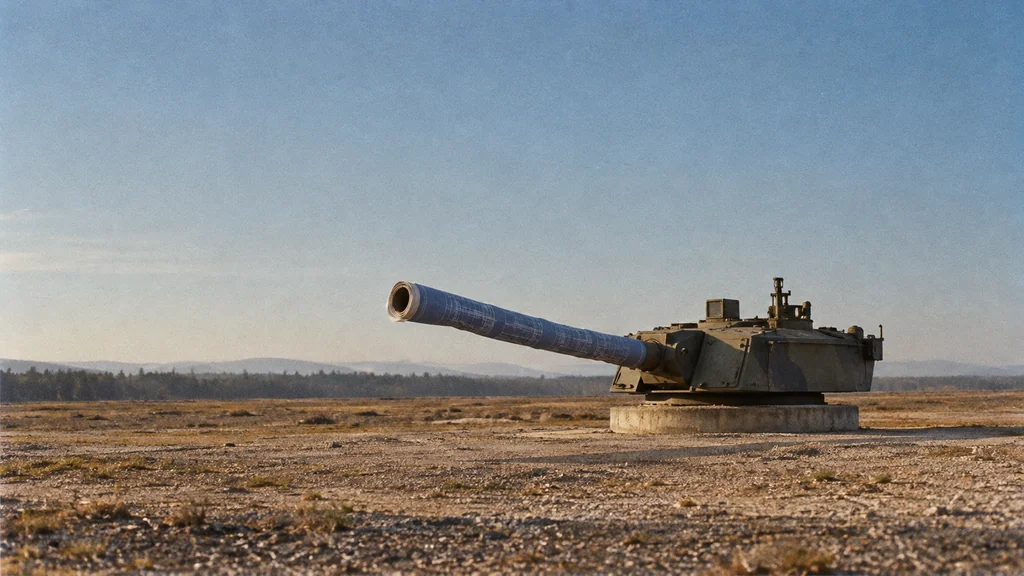
France must begin planning its next tank before Berlin clarifies the partnership.
Image composition · tobriefFrance must plan its next tank without a public Franco-German production plan, and Berlin has yet to say what remains of their shared programme. On 8 October, General Fabien Mandon, France's chief of defence staff, told the National Assembly's defence committee that the results of the programme "ne sont pas bons" (are not good) and that the Germans "have decided to leave the project" (Assembly hearing, BFMTV). His claim goes further than anything the two governments have put in writing.
Mandon also softened his own verdict. He would not call the work a total failure, because the two armies had spent years agreeing on principles for a future tank, though he admitted the outcome was bad news for industry (BFMTV).
What the two governments actually agreed
The programme is called MGCS, short for Main Ground Combat System. It was designed as more than a tank. The plan was a networked family of crewed and uncrewed vehicles, sensors and weapons to replace France's Leclerc and Germany's Leopard 2.
That breadth matters now. Germany could stop work on a common vehicle and still keep researching the systems around it. A German government spokesman made that point on 15 June, when he said that working on technology not tied to a single vehicle did not amount to quitting MGCS as a whole (German government).
At their joint defence council on 17 July, the two governments committed only to research on "collaborative combat" up to a proof of concept, with no renewed pledge to build a common chassis (Élysée). German defence press read that silence as the burial of the shared tank (Behörden Spiegel).
That reading is reasonable, but it remains a reading. The July text dropped the promise of a shared tank without cancelling one. Mandon's statement implies something larger: that Germany has walked away from the remaining research as well. No German reply to him has been published. No termination notice, amended agreement or cancelled contract has surfaced. Until Berlin says otherwise, the wider exit rests on the French general's account.
Why the partnership cracked
General Pierre Schill, France's army chief, told senators in May that the two countries disagreed on how many vehicles they needed and when they needed them (French Senate). They also split over which manufacturer should build them.
That industrial dispute had a concrete shape. When the German arms maker Rheinmetall joined an already delicate balance between national industries, it brought a 130 mm gun that competed with France's 140 mm ASCALON (Ifri). Two rival main guns meant two rival visions of the same tank.
Berlin also had less reason to compromise. Its modernised Leopard 2A8 rolled out in April 2026 (German defence ministry), which gives the German army a fallback that Paris lacks.
France's deadline
Mandon gave the committee dates. France's Leclerc tanks begin retiring progressively in 2038, and studies for their replacement must start in 2027 (Assembly hearing). Schill has said the army needs around 200 tanks or equivalent heavy vehicles. He has also said that France would field a national solution in the 2035–2040 period if multinational plans slip (French Senate).
The published record now holds a research commitment and no shared tank. Nothing the two governments have signed commits them to building a vehicle together before the Leclerc starts to retire. Berlin owes a public answer on which parts of MGCS it is still funding. Paris cannot wait for that answer. Its replacement studies are due to begin in 2027 (Assembly hearing), and Germany already has a modernised tank in service.
Details about this article
- Model:
- claude-opus-5-5
- Generated:
- 10/9/2026, 1:25:56 AM
- Pipeline run:
- eu_pipeline_20261009_005006
- Watermark:
- SynthID (Google's invisible watermark)
- Human review:
- None before publication