France’s protest inquiry tests ultraleft claim
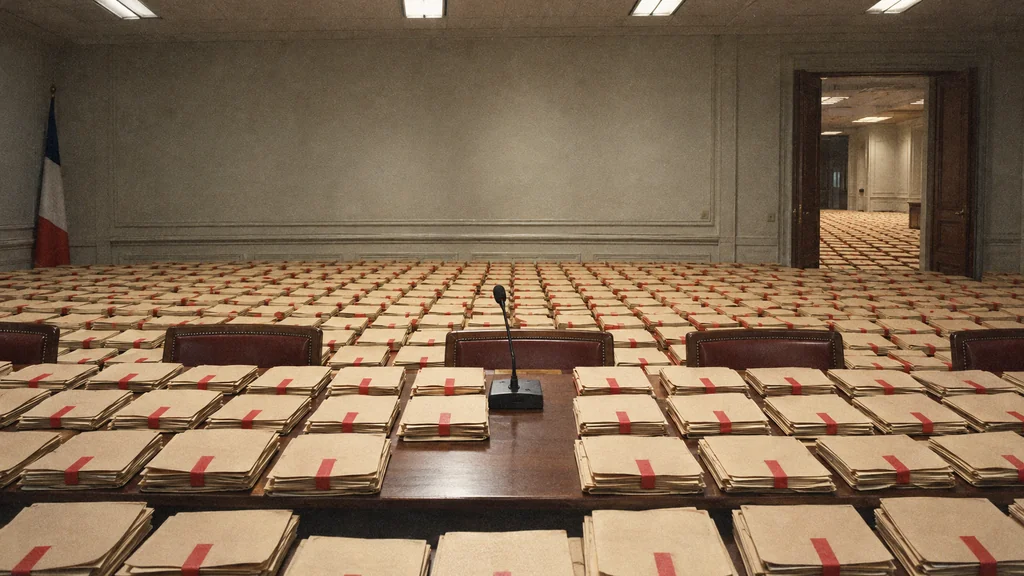
Deputies face a vast record behind a claim still unproved.
Image composition · tobriefFrance's government planned for about 200,000 demonstrators on 17 October. Its own Interior Ministry later counted 550,000, against roughly 60,000 police and gendarmes (LCP). Ministers now concede they planned badly. They also blame an organised ultraleft movement, citing intelligence nobody outside government has seen, and the National Assembly has agreed to investigate.
The marchers were a mixed crowd. School pupils, Yellow Vest veterans and trade unions protested against living costs and stretched public services, and organisers claimed 800,000 people took part (Reuters). Most marches passed peacefully. In some cities shops were looted, and Limoges city hall burned, as we reported on 18 October (To Brief).
What ministers concede
Interior Minister Laurent Nuñez has admitted a "lack of anticipation" (LCP). On 20 October Prime Minister Sébastien Lecornu told deputies that intelligence had seen much "but not everything." He also said the deployment was too static and that officers' leave should have been cancelled (HuffPost). These are admissions about planning. They do not show that every fire could have been prevented.
Interior Ministry figures reported by AFP record 2,397 people detained and 997 police and gendarmes injured, seven seriously (AFP). That toll shows only one side of the harm. Detention does not mean prosecution, and no national count of injured protesters or bystanders has been published. Nobody can yet say how many civilians were hurt.
A culprit named, evidence withheld
Lecornu pairs his planning admission with a political explanation. He says intelligence services warned him of an ultraleft movement seeking sustained disorder until the 2027 presidential election (government transcript). The intelligence behind that warning has not been published.
The only public check so far came from Paris prosecutor Laure Beccuau. Asked whether the people held in the capital were ultraleft, she said that on the information she had about 557 custody cases she could "absolutely not confirm" it (TF1 Info). Her remark covers Paris custody cases only. It does not support Lecornu's broader claim, but it cannot disprove it.
A similar label is now circulating at European level. On 19 October the European Parliament voted to add a debate on violence in France, Italy and Belgium, under a title blaming "radical far-left groups" (ANSA). Such a debate can give a claim a continental audience. It cannot establish responsibility, because policing and prosecution remain national. Only French investigators and courts can do that.
The protests also had separate local causes. Belgian school protests and Italian student marches grew out of domestic grievances. Some Italian students clashed with police in Turin and Bologna on 16 October, the day before the worst French violence (ANSA).
What deputies can demand
National Assembly president Yaël Braun-Pivet proposed an inquiry on 18 October into two questions. One is who committed the destruction. The other is whether intelligence, officer numbers and public-order doctrine were adequate (Assembly presidency). Party leaders agreed on 20 October to go ahead (LCP).
The work would fall to the Law Committee, the Assembly body that scrutinises legislation and the government's handling of justice and policing. If it is granted inquiry powers for up to six months, it can hold sworn hearings with ministers and police commanders and demand documents. It cannot convict rioters or discipline officers (Assembly procedure guide).
The operational half of the inquiry starts with its conclusion already conceded, because ministers have described their planning failures in public. The attribution half is open. The evidence for an organised ultraleft campaign remains unpublished. With inquiry powers, deputies can ask for the intelligence assessments behind Lecornu's warning and compare them with what prosecutors are finding in their case files. Until someone makes that comparison, the prime minister's explanation of who caused the violence remains a claim, not a finding.
Details about this article
- Model:
- claude-opus-5-5
- Generated:
- 10/20/2026, 7:00:57 PM
- Pipeline run:
- eu_pipeline_20261020_180759
- Watermark:
- SynthID (Google's invisible watermark)
- Human review:
- None before publication