Germany risks €2.5bn on fuel relief
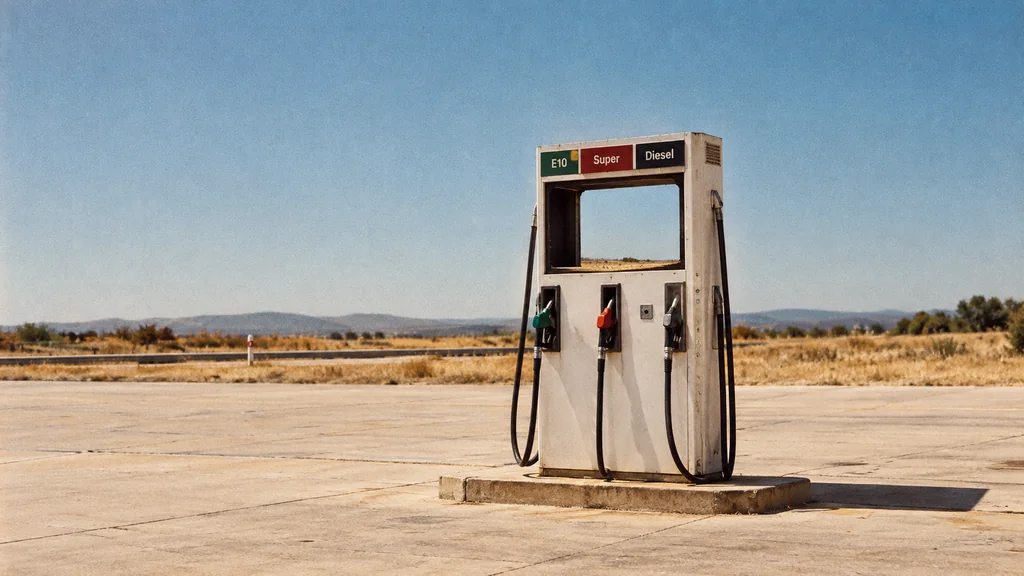
Berlin bears the full cost; the benefit may vanish before delivery.
Image composition · tobriefA German driver filling 50 litres of petrol could save at most €8.50 per tank. That is the ceiling, not the floor. On 18 September, the federal government and all 16 state governments agreed to cut the Energiesteuer (the fixed excise tax on every litre of fuel) by 14 cents (Bundesregierung, ZDF). Because VAT is charged on the excise-inclusive price, the combined saving comes to roughly 17 cents per litre.
The bill for the public purse: an estimated €2.5 billion in lost revenue, split evenly between Berlin and the states (Bundesregierung, ZDF). But the agreement is political, not legal. No bill has passed the Bundestag, no vote is scheduled, and the stated 1 October start date remains an aspiration (Bundestag).
The government pays the full tab; drivers may not get the full discount
Even once enacted, the full 17 cents may not reach the pump. When Germany ran a larger excise cut in summer 2022, the ifo Institute found that filling stations passed on only part of the reduction (ifo Institute). Fuel costs, currency movements and retailer margins also shift day to day, so nobody can observe the tax cut in isolation. Germany's Bundeskartellamt (the competition authority that monitors fuel pricing) has said as much (Bundeskartellamt).
This creates the package's sharpest problem. The government surrenders the full €2.5 billion regardless. If filling stations absorb part of the cut through wider margins, motorists receive less relief while taxpayers still finance the entire measure. Whoever keeps the unpassed portion gains; the public budget bears the cost either way.
Per-litre relief is also proportional to consumption. Fleet operators, multi-car households and long-distance commuters capture the most euros. Non-drivers get nothing. France's Cour des comptes (the national audit office) examined a similar universal fuel rebate costing €7.6–8 billion and concluded it was poorly targeted, with higher-consuming households capturing more of the total (Cour des comptes).
A rigid cap can make imports disappear
The more ambitious half of the package barely exists on paper. Berlin has a mandate to negotiate a temporary price cap with the oil industry, loosely modelled on Belgium or Luxembourg, by January 2027. No maximum price, formula or enforcement authority has been defined (Bundesregierung, BR).
The design matters enormously. A tax cut leaves suppliers free to charge what the fuel costs; the government simply collects less. A price cap changes that equation. If the ceiling falls below what a station must pay to obtain the next litre, every sale creates a loss, and importers redirect cargoes to uncapped markets.
Hungary tried the fixed-cap approach. In November 2021 it froze petrol and diesel at 480 forints per litre, which at the 2022 price peak saved drivers roughly 200–300 forints per litre (ECB, AP). But imports became not worth selling at a loss. Litre limits, station closures and queues followed. Hungary scrapped the cap on 6 December 2022 and prices jumped immediately.
Belgium's model is less dangerous because it recalculates its maximum price from the regional wholesale benchmark daily, preserving distribution margins while limiting retail markups (Le Monde). The ceiling rises when wholesale costs rise, which is exactly when households want protection most.
Cheaper German fuel pulls purchases across the border
If the cut does reach the pump, neighbours will feel it. Dutch diesel sat at roughly €2.81 per litre on 18–19 September, against about €2.47 in Germany (NRC). Dutch border-station owners have already warned of customer losses (Gelderland). Every litre bought across the border moves excise and sales-tax revenue with it.
The package carries a definite fiscal cost and offers motorists an uncertain saving. The price cap that dominated political debate has no formula. And the strongest finding may be the simplest: Germany will lose €2.5 billion whether or not drivers see the full benefit at the pump.
Details about this article
- Model:
- claude-opus-4-6
- Generated:
- 9/20/2026, 1:38:32 AM
- Pipeline run:
- eu_pipeline_20260920_005006
- Watermark:
- SynthID (Google's invisible watermark)
- Human review:
- None before publication