Germany’s €11 Billion Defence Borrowing Gap
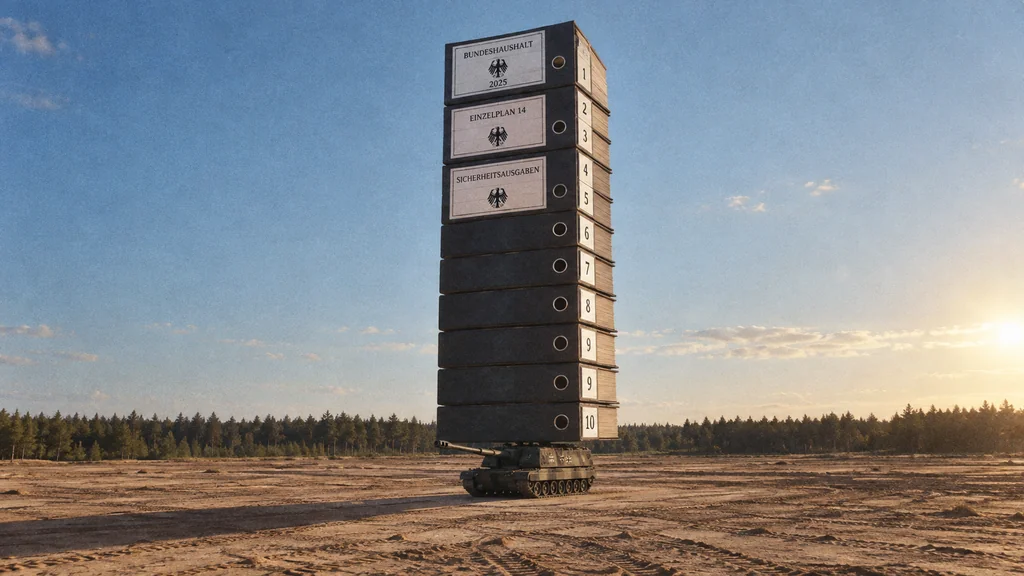
Germany’s borrowing towers over the forces it has yet to deliver.
Image composition · tobriefGermany's constitutional amendment for defence borrowing worked exactly as written. That is the problem. In 2025, Berlin borrowed €28.6 billion exempt from its debt brake (the rule capping annual federal borrowing), while qualifying security spending rose by only €17.6 billion over the previous year (FAZ, Die Zeit). The Ifo Institute, a leading German economic research body, estimates that the roughly €11 billion gap represents old spending newly made eligible for borrowing, freeing tax revenue for other budget needs. The Bundesbank reached a similar conclusion independently: borrowing under the new defence and infrastructure rules exceeded genuinely additional expenditure and helped close general budget gaps (Bundesbank).
No one has traced borrowed euros out of defence accounts. The finding is fiscal substitution, not diversion.
How the baseline creates a windfall
The March 2025 constitutional amendment exempts federal security spending above 1% of GDP from Germany's debt brake. Five categories qualify: defence, civil protection, intelligence, cybersecurity and aid to countries under armed attack (Bundestag).
The threshold was set below what Germany already spent on those categories. So Berlin could immediately borrow against pre-existing expenditure without adding a single euro of new military capability. The Finance Ministry's position is legally correct: every euro borrowed met the constitutional formula. Ifo's argument is different. It holds that borrowed euros should produce additional security output, not substitute for tax revenue that previously covered the same spending (Ifo).
Both can be right at the same time. The borrowing complied with the law. It also did not, by roughly 38.5% of the exempt total, buy anything new for defence (FAZ).
Lithuania as the delivery test
Germany can point to real procurement gains. Military procurement spending rose by €4.53 billion in 2025, including €2.32 billion more for ammunition (Die Zeit). Spending from the older €100 billion special fund (a one-off borrowing package created in 2022 to modernise the Bundeswehr) improved from 3.5% disbursed in 2022 to 84% in 2024 (French Treasury).
The sharpest test of whether borrowed money turns into staffed, equipped units is Germany's 45th Armoured Brigade in Lithuania, Berlin's flagship commitment to NATO's eastern defence. About 1,700 personnel serve under the brigade, but that total includes a pre-existing NATO battlegroup of over 1,000 rotating troops, so it cannot be read as 1,700 newly deployed soldiers (Bundeswehr, LRT). The heavy tank and mechanised battalions are scheduled to move from Germany only in 2027. By August 2026, just 60% of the brigade's final posts had been filled by volunteers (Lrytas).
Lithuania, for its part, is spending €1.33 billion on base infrastructure to receive the full brigade (Lithuanian Defence Ministry).
The fiscal substitution finding and the brigade's staffing shortfall exist side by side, but the evidence does not show that one caused the other. Recruitment, procurement timelines and industrial bottlenecks each have their own explanations. What the parallel does show is a gap between Germany's constitutional room to borrow and its demonstrated ability to spend that money on combat-ready forces.
Why allies cannot look away
German delivery matters beyond Germany. All three Dutch combat brigades are integrated into German divisions. During the Fighter Lion 2026 exercise, over 7,000 German and Dutch troops trained in combined operations (Defensie Dichtbij, Bundeswehr). The coordination works on exercise ground. Whether Dutch brigades can count on the German command and logistics backbone they need in sustained combat remains untested.
As we reported last week, federal auditors warned that German public debt could reach at least €3 trillion by 2030, with annual interest payments hitting €80.7 billion (Bundestag). The fiscal room is not infinite, and interest costs will eventually compete with defence spending for the same budget space.
Germany has shown that its borrowing complies with the constitution. It has not yet shown that all the new fiscal room produced additional staffed and equipped military capacity. The government, the Defence Ministry, the Bundeswehr's procurement office and the Bundestag's budget committee (which approves annual spending and oversees execution) each own a piece of that answer. The €11 billion is Ifo's estimate of substitution, not a traced loss. But allies building their defence plans around German commitments need more than legal compliance. They need battalions.
Details about this article
- Model:
- claude-opus-4-6
- Generated:
- 9/10/2026, 2:10:51 AM
- Pipeline run:
- eu_pipeline_20260910_005006
- Watermark:
- SynthID (Google's invisible watermark)
- Human review:
- None before publication