Germany’s €500 billion fund yields little new investment
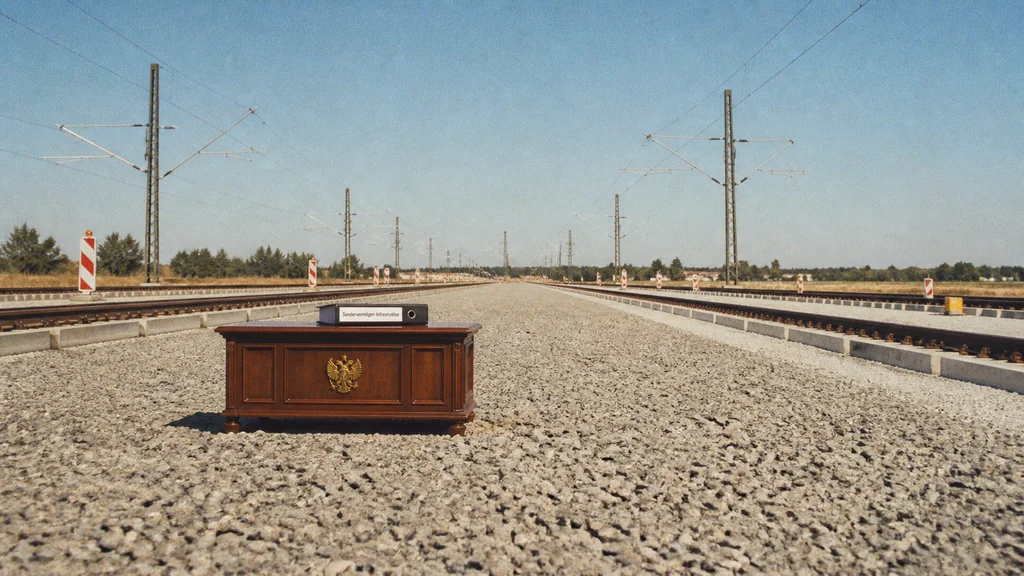
Germany’s borrowing apparatus arrives before the infrastructure it promised.
Image composition · tobriefGermany's €500 billion infrastructure fund is not a pot of cash sitting in a vault. It is a borrowing ceiling, written into the constitution in March 2025, allowing the federal government to take on debt for roads, rails, hospitals and climate projects over twelve years. The debt sits outside Germany's normal borrowing limits, known as the debt brake, which caps the federal structural deficit at 0.35% of GDP (Bundestag WD 4-032-26). The federal budget carries the interest. Repayment starts no earlier than 2044.
The allocation: €300 billion for federal investment, €100 billion for state and local governments, and €100 billion for the Climate and Transformation Fund (BMF FAQ, Bundesregierung). The headline is enormous. The first year's results are not.
Borrowed Money That Replaced Old Spending
In 2025, the government borrowed €24.3 billion through the fund. But federal investment rose by only €1.3 billion compared with the previous year (ifo). The ifo Institute concluded that 95% of the new debt did not pay for extra infrastructure. It replaced spending that was already in the ordinary budget. The IW economic institute, using a different method, put the figure at 86%, finding about €12 billion simply substituted for items the regular budget used to cover (Tagesschau).
The mechanism is straightforward. The law requires that the ordinary budget keep its investment share above 10% before fund money can flow. For 2026, the government reports 10.5%, just over the line (BMF Sollbericht 2026). But the Bundesbank pointed out the problem: that ratio was already above 10% before the fund existed (Bundesbank). So the government passes its own legal test while moving old spending into the new vehicle and freeing up room in the regular budget for other things.
The Finance Ministry disputes this reading. Its April 2026 analysis claims €168.3 billion in planned fund investments between 2025 and 2028 are genuinely additional, roughly 95% of the total (BMF April 2026). But the ministry is counting planned allocations. The critics are counting what actually changed in the real economy. Germany's federal auditor, the Bundesrechnungshof, sided with the critics, flagging roughly €16 billion in rail construction grants for 2026 as a prominent case of relabelling: spending that was already happening, now reclassified under the fund (Handelsblatt).
By late July 2026, €51.1 billion had been disbursed, about a tenth of the total envelope (Zeit).
Why the Rest of Europe Is Watching
If the fund eventually produces real construction orders, Germany's neighbours benefit. About 28% of Polish exports go to Germany, mostly industrial components, so a genuine building push would pull Polish suppliers along (Rzeczpospolita). The Bundesbank estimates the combined infrastructure and defence spending could add around 1.3 percentage points to German GDP over 2025–2028 (Bundesbank).
But the sharper cross-border tension is political. Germany built a constitutional route around its own fiscal rules while remaining the loudest voice against loosening EU-wide ones. France cannot copy the move. It is already in the EU's excessive-deficit procedure, paying 4.10% on ten-year bonds against Germany's 3.25%, with a public-debt gap exceeding 50 percentage points of GDP (Le Monde, Sénat). Italy's finance minister Giancarlo Giorgetti made the asymmetry explicit: if the EU allows borrowing flexibility for defence, the same logic should cover energy security (ANSA). Germany can borrow cheaply for priorities it defines as strategic. Higher-debt countries that try the same thing pay more, because investors charge them higher interest rates.
The fund is real law with real constitutional backing. What remains unproven is whether it produces genuinely new investment at the scale the debt implies. In 2025, €24 billion in borrowing yielded roughly €1–2 billion in extra spending. If 2026 follows the same pattern, Germany will have built an elaborate legal structure to borrow at scale while its actual roads, bridges and railways grow at a fraction of the pace the debt suggests.
Details about this article
- Model:
- claude-opus-4-6
- Generated:
- 8/24/2026, 1:50:46 AM
- Pipeline run:
- eu_pipeline_20260824_005006
- Watermark:
- SynthID (Google's invisible watermark)
- Human review:
- None before publication