Hera closes in on DART’s missing number
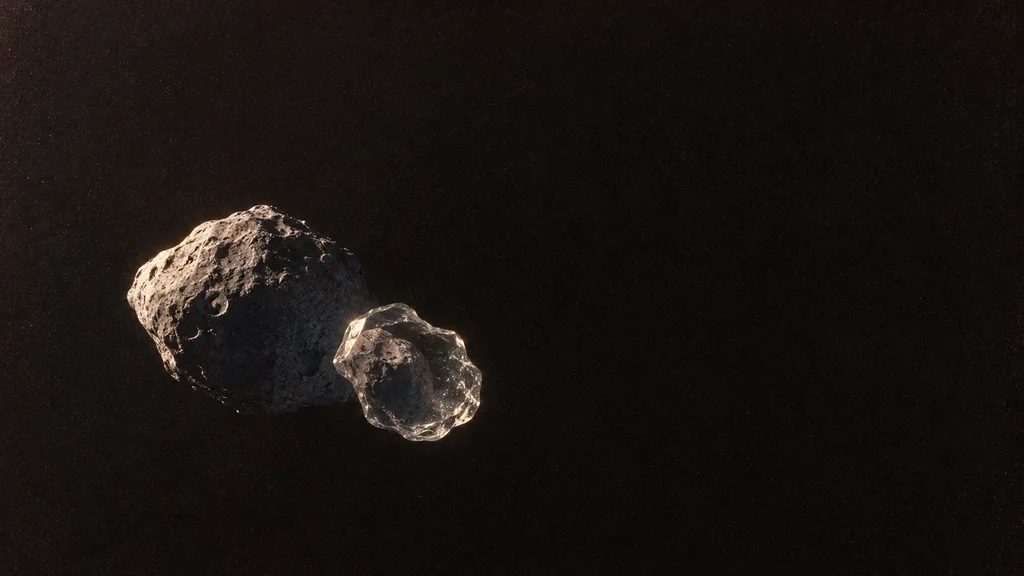
Hera closes in on the moonlet whose weight could explain DART’s extra push.
Image composition · tobriefIn 2022 NASA crashed a spacecraft into Dimorphos, a small moon of the asteroid Didymos, and shortened its orbit by 33 minutes (Nature). ESA's Hera mission is now closing in to measure what telescopes on Earth cannot, starting with how much the moonlet weighs. That number would show how much of the shove came from the spacecraft and how much from the debris the crash threw off. Anyone who ever has to push a dangerous asteroid aside will want that answer.
Hera sent back its first sign that it is getting close in an image taken on 18 October from about 1,280 kilometres away. The pair, which had always looked like one point of light, split into two, with Dimorphos a speck roughly one pixel wide (ESA). A pixel shows no craters or boulders, but it proves the spacecraft has found both targets and can tell them apart. The rendezvous is still scheduled for November, and ESA has promised the first detailed images of the moonlet for 25 November (ESA).
A clock in the sky
Dimorphos circles Didymos, and that arrangement hands scientists a natural clock. Before NASA's DART spacecraft hit it on 26 September 2022 at about 6.1 kilometres per second, each lap took about 11 hours 55 minutes (PMC). Reading that clock needed no close-ups. From Earth, the moonlet keeps passing in front of and behind its partner, and each crossing dims their combined light, like a moth drifting across a porch lamp.
Timing those dips before and after the crash showed that every lap had shortened by 33.0 ± 1.0 minutes (Nature). The push behind it was gentle, a change in speed along the orbit of about 2.70 millimetres per second (Cheng et al.). That nudge altered the moonlet's path around Didymos, and the pair was never a threat to Earth (NASA).
Where the extra push came from
The orbit changed more than DART's own momentum could explain. The crash blasted rock off Dimorphos, and material flying one way pushes the remaining body the other way. It is the same recoil that drives a rocket, or that shoves you backwards when you throw a heavy bag off a skateboard.
Scientists capture that bonus in a multiplier called beta. To pin it down, you need the moonlet's mass, and nobody has measured it. A 2023 analysis therefore had to assume a range of densities. Depending on the choice, the total push came out between about 2.2 and 4.9 times what the spacecraft alone would have delivered (Cheng et al.).
Hera is designed to narrow that range. ESA plans to weigh Dimorphos by tracking the slight wobble it imposes on Didymos as both circle a shared balance point, much as a dog on a leash tugs its owner off a straight line (ESA). Combine that mass with a volume measured from images and you get density. That is a clue to whether this roughly 160-metre body is solid rock or loosely packed rubble (NASA).
The survey will build up in stages. ESA's 7 October flight plan has Hera taking a first look from about 25 to 30 kilometres in November and December. It then releases two small companion satellites in early 2027 (ESA). Hera's own cameras are expected to map the impact region at better than 10 centimetres per pixel, sharp enough to pick out individual boulders. One of the companions, Juventas, carries a radar meant to see beneath the surface and into the moonlet's interior (ESA, ESA).
All this care matters because a real deflection would leave little room for guesswork. NASA researchers say it needs several years of warning at minimum, preferably decades, so that a small nudge has time to grow into a safe miss (NASA). DART showed that a spacecraft can move a small world (Nature). If Hera delivers its planned measurements, the models built on that result will rest on a weighed, mapped target instead of an assumed density. Those models are what engineers would trust the next time an asteroid needs moving.
Details about this article
- Model:
- claude-opus-5-5
- Generated:
- 11/2/2026, 1:40:53 AM
- Pipeline run:
- eu_pipeline_20261102_005008
- Watermark:
- SynthID (Google's invisible watermark)
- Human review:
- None before publication