Hormuz ship attacks leave escorts waiting
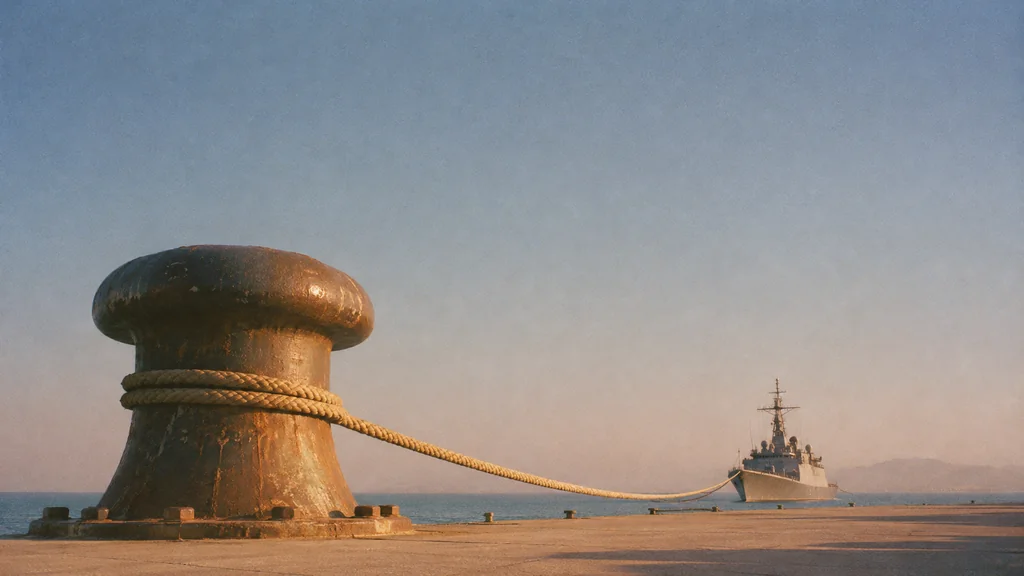
Europe’s escort ship remains at berth while merchant crews face danger.
Image composition · tobriefA US fighter jet struck a Revolutionary Guards missile-launch site on Iran's Qeshm Island on 17 November, according to a US military official (AP). The strike came hours after Iran claimed its drones had hit a US radar in Bahrain. Bahrain and Washington say those drones were shot down. For Europe, the fighting beside the Strait of Hormuz sharpens a bind: ships need more protection there, but the escort mission planned for them sails only once the waters calm down.
One night, two accounts
Iran's Islamic Revolutionary Guards Corps (IRGC) said its combat drones had struck a US-operated radar at Sheikh Isa Air Base. It called the attack retaliation for US drone incursions into Iranian airspace (Le Monde). No independent reporting has confirmed those incursions.
Bahrain's General Command said its air defences destroyed several Iranian aerial attacks before they reached their targets. Its statement did not mention a radar (Bahrain News Agency). US Central Command reported intercepting multiple one-way attack drones, which are built to crash into their target. It reported no damage and no injuries (ABC). These are official accounts from parties to the conflict. Only Iran says the radar was hit.
Journalists heard blasts in Manama, and residents received phone alerts telling them to seek safety. It was the third attack on US military assets in Bahrain within five days (AP). Bahrain hosts the US Fifth Fleet, the navy command responsible for Gulf waters, including the strait. Iran is now striking at the force that answers for the waterway.
Washington answered within hours. The official called the Qeshm strike self-defence against IRGC aggression, adding to the standoff over the strait (To Brief). Iran's IRNA agency reported five or six explosions on the island. A provincial deputy governor, Ahmad Nafisi, said homes, businesses and public infrastructure were undamaged (The News, carrying Reuters). Neither side has said what happened to the missile site itself.
Ships hit, attackers unnamed
Merchant shipping was struck over the same days. UK Maritime Trade Operations (UKMTO) is a UK-run service that collects and relays security reports from vessels. It recorded that an outbound tanker was hit by an unknown projectile on 16 November. The crew were accounted for (UKMTO Warning 207-26).
The Panama-flagged gas carrier Tara Gas was disabled north of Khasab in Oman and then struck again. India's Foreign Ministry said two of the 24 Indians aboard were hospitalised and one is missing (Indian Express). Neither record names an attacker or links either ship to the Bahrain-Qeshm exchange.
What would let Europe's escorts sail
In May, France and the UK announced planning for a multinational Hormuz mission. Paris describes it as strictly defensive, possibly escorting civilian ships and clearing mines, and active only when conditions allow (French defence ministry). The Dutch frigate Evertsen is already in the region as the mission's flagship, the ship that would carry its command staff (Dutch defence ministry).
The Dutch government told MPs on 5 November that it could activate the mission only in a "permissive environment" (parliamentary record). In military terms, that means waters where forces do not expect to come under fire. The government also said it still lacked an operational framework, meaning agreed rules on who commands and what escorting ships may do.
Italy's defence minister, Guido Crosetto, has set similar conditions: a genuine truce, a legal basis and a vote in parliament (Italian Chamber). These conditions, not any doubt about what the strikes hit, explain why the mission has not launched. Governments promised their parliaments a defensive operation in calm waters. An active exchange of fire is the situation those promises were designed to rule out.
Diplomacy is still moving. Oman's and Iran's foreign ministers discussed safeguarding maritime corridors on 17 November (Reuters). Any truce Crosetto would accept is more likely to come from talks like these than from Brussels.
The decision runs through national governments and, in several cases, their parliaments. Italy's minister wants a vote. In the Netherlands, Article 100 of the constitution requires the government to inform parliament before any deployment, which is notice rather than a vote (Tweede Kamer).
The ship attacks, with one seafarer still missing, strengthen the case for escorts, even though nobody has identified who fired on the vessels. The past week's exchange has also moved the strait further from the truce and safe waters that the mission's backers require. Until governments in Paris, London, The Hague and Rome agree to sail in harsher conditions, the proposed escort mission consists of a command staff aboard a Dutch frigate.
Details about this article
- Model:
- claude-opus-5-5
- Generated:
- 11/18/2026, 2:03:06 AM
- Pipeline run:
- eu_pipeline_20261118_005010
- Watermark:
- SynthID (Google's invisible watermark)
- Human review:
- None before publication