Hormuz traffic stalls at five crossings
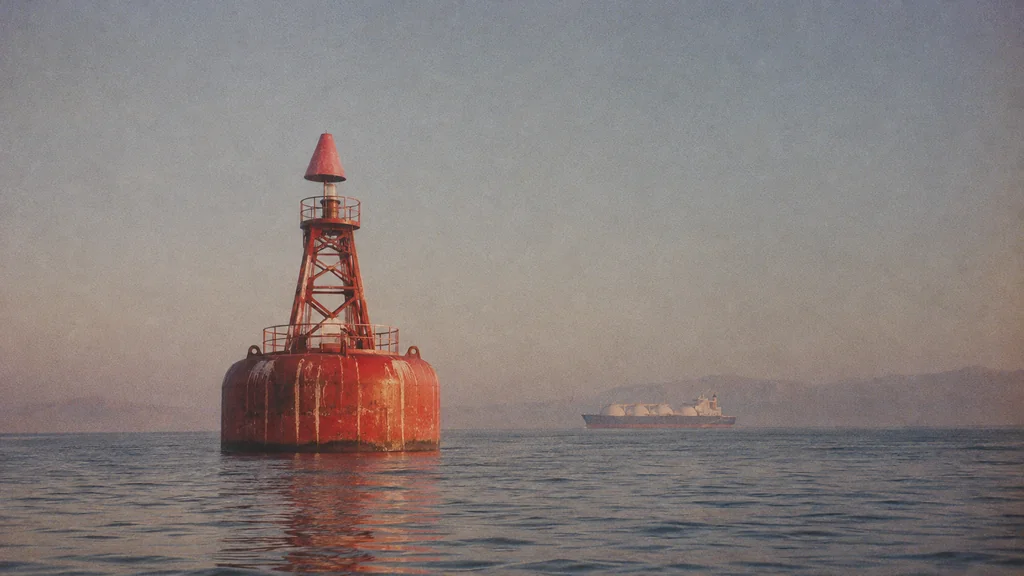
One crossing is possible; a dependable passage remains out of reach.
Image composition · tobriefA ship tracker counted five commercial crossings of the Strait of Hormuz on 4 November, against a pre-crisis average of 84.8 a day (hormuz.now). Iran says it will lift its restrictions only after Washington fully addresses and implements seven Iranian conditions, and it calls the latest American answer unconvincing (Rezaei on X). European buyers of Qatari gas need regular voyages that insurers will cover, and the bargain that would restore them is being negotiated between Washington and Tehran.
What Tehran wants first
The demand came on 3 November from Mohsen Rezaei, secretary of Iran's Supreme National Security Council, the body that coordinates the country's security and foreign policy. From that office, a public post signals the state's position. He did not list the seven conditions. He also announced no new barrier and did not withdraw Iran's earlier offer to reopen within two days of a deal (To Brief).
The sequence described during talks in Doha runs one way. The US would end its naval blockade of Iranian ports, waive limits on Iranian oil sales and cancel newer sanctions. Iran would then reopen the strait, and nuclear talks would follow (Reuters). Restricting the strait is Tehran's strongest card, and it wants relief in hand before it gives that card up.
Washington's counterproposal remains confidential, and no American official has publicly defended it. The likely risk for the US, on our reading, is that paying first would give up its pressure before safe passage is proven. It would also push talks on Iran's nuclear programme to the back of the queue.
Qatar, the main mediator, reports contact without a result. Its foreign ministry spokesman, Majed al-Ansari, said Qatari envoys met Iranian counterparts in Tehran for about three hours on 3 November, with no specific breakthrough (Qatar News Agency).
Why one tanker does not make a sea lane
A deal on paper would not by itself bring traffic back. The UN's International Maritime Organization counted 128 confirmed incidents in Hormuz and the wider region, and 24 seafarer deaths, as of 3 November (IMO). A single crossing needs a shipowner, a crew and an insurer to accept that risk once. Regular traffic needs all three to accept it every day.
Poland shows the difference. Orlen, the country's largest energy company, is expecting a Qatari tanker, the Al Kharsaah. Its chief executive, Ireneusz Fąfara, called the voyage an exception and said Orlen had no notice that regular deliveries were restarting (WNP).
Who absorbs the cost
Italy's Edison makes the cost concrete. QatarEnergy declared force majeure on gas due to Edison, invoking the contract clause that excuses a supplier when exceptional events prevent delivery. The declaration covers 38 scheduled cargoes from April to December, and by 27 October Edison had bought replacements for 27 of them (Edison). Edison says its customers are covered. That cover depends on cargoes bought elsewhere, which is how the standoff reaches a European importer.
The wider picture is strained rather than critical. Germany's gas storage stood at 60.8% on 4 November, and its energy regulator still described supply as stable (Bundesnetzagentur). The International Energy Agency modelled a harder case, in which a cold winter combined with continued Hormuz disruption could drain EU storage below 10% by late March 2027 (IEA). That risk is conditional, and it grows the longer the strait stays restricted.
Europe's own role is limited to stating terms. The Council of the EU, where member governments sit, insists that any settlement protect freedom of navigation and leave the strait's governance unchanged (EU Council). In plain terms, Europe wants no deal that gives Iran a new say over which ships pass, or on what conditions. Europe has stated that demand, but Washington and Tehran are the ones negotiating, with Qatar carrying messages between them.
The record supports a narrow conclusion. European importers can keep customers supplied by paying for replacement cargoes, while Washington and Tehran control the immediate negotiation. Even a signed agreement would only begin the slower work of convincing owners, crews and insurers that the crossing is safe enough to make every day.
Details about this article
- Model:
- claude-opus-5-5
- Generated:
- 11/5/2026, 2:01:45 AM
- Pipeline run:
- eu_pipeline_20261105_005007
- Watermark:
- SynthID (Google's invisible watermark)
- Human review:
- None before publication