Hungary freezes Ukraine’s single-market talks
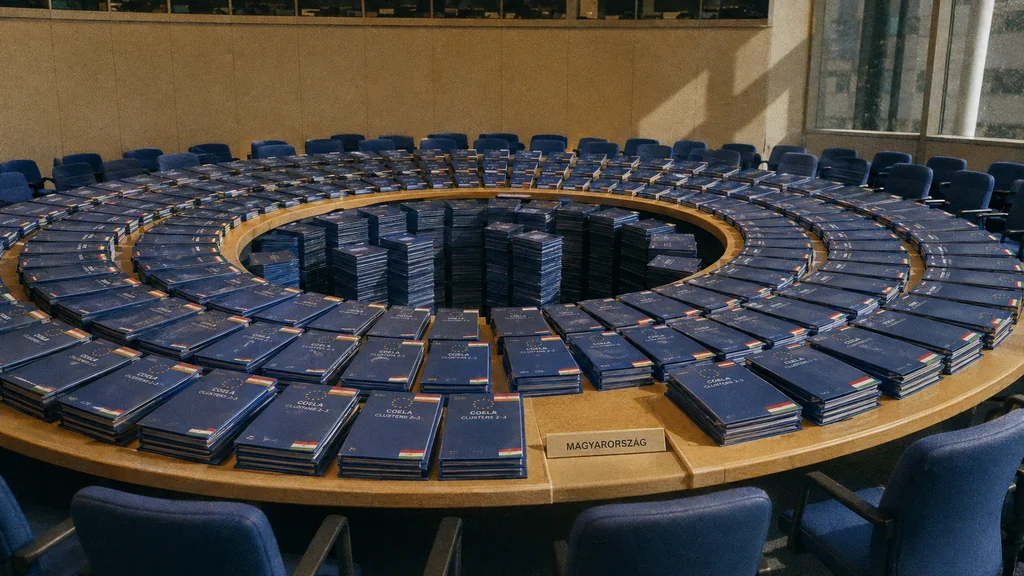
Hungary’s repeated reservation buries Ukraine’s cleared negotiations beneath procedure.
Image composition · tobriefHungary stopped the EU Council from advancing two major negotiation packages for Ukraine on 1 September. The block did not reject Ukraine's EU bid. It did something more precise: it prevented the Council from turning the European Commission's technical approval into actual talks on the EU's single-market rules (European Pravda, Euronews Germany).
Ukraine cleared the technical stage. Hungary stopped the political one.
The Gate That Requires Every Government to Say Yes
EU membership is not a single vote. It is a years-long chain of gates, each requiring unanimous agreement among all 27 member states. Ukraine applied in February 2022, received candidate status that June, and opened its first cluster of EU law (a thematic package grouping dozens of rules countries must adopt) in June 2026. A second cluster followed in July.
Before any cluster can open, diplomats from all member states must approve the Commission's screening work. That approval happens inside a Council working party called COELA. The Commission completed Ukraine's screening in September 2025 and judged Ukraine technically ready to advance. But the Commission cannot open clusters alone. Every government must agree. Hungary refused. By 2 September, Ukraine and Moldova had reportedly been pulled from the next COELA agenda.
The blocked clusters are not minor. Cluster 2 covers the internal market: free movement of goods, workers, services and capital, plus competition and financial-services rules. Cluster 3 covers taxation, social policy, education and customs union (EUR-Lex). Together, they represent the practical single-market alignment that would prepare Ukraine for membership.
Budapest's Condition — and Romania's Alternative
Hungary's stated reason is minority rights. Budapest wants Ukraine to show visible progress on a bilateral deal struck in June 2026 covering education, language use and political representation for roughly 100,000 ethnic Hungarians in Transcarpathia (444, Budapest Times). Ukraine's ambassador said Kyiv would begin implementing the first tranche in September, with other points running to May 2027 (ua.news).
The concern is not invented. Ukraine's 2017 education law restricted minority-language schooling, and the Venice Commission (the Council of Europe's constitutional advisory body) acknowledged progress in subsequent reforms while calling for further safeguards. But Hungary shifted the standard: from obtaining commitments to requiring visible implementation before any new cluster opens.
Romania exposes the selectivity. Bucharest has its own minority-rights dispute with Kyiv over Romanian-language education. But Romania chose a different instrument: it pressed Kyiv through a bilateral strategic partnership and a relaunched joint minority commission, without blocking the EU accession track (Agerpres, DW România). Same kind of grievance, different choice. Romania shows Budapest had another option: push Kyiv bilaterally while allowing the EU track to move.
Hungary also tried to advance Moldova's cluster while keeping Ukraine's blocked, a split most member states rejected (European Pravda). That selective treatment undercuts any claim that Budapest is applying a uniform standard.
No Bypass, No Fix
No legal workaround exists. Article 49 of the EU Treaty (the accession clause) gives member states central control, and no verified mechanism allows 26 governments to open Ukraine's clusters over Hungary's objection (Article 49 TEU). Germany's foreign minister has pushed to reduce unanimity requirements in the EU, but that reform effort targets foreign and security policy decisions, not enlargement (Tagesschau). Lithuania treats the block as a geopolitical delay that benefits Moscow (LRT). Poland supports strict accession conditionality but opposes one country converting bilateral demands into a Union-wide stop (RMF24).
The block also lands while Budapest is negotiating its own EU funds, claiming on 31 August it has met all conditions to unlock roughly €10 billion in frozen recovery money. No public evidence ties the accession block to a funds-for-veto trade. But every diplomat in the room can see both files open on the same table.
Minority rights belong in accession talks. The EU's problem is structural: its treaty design still offers no answer when one government turns that legitimate standard into a veto over the pace of a wartime candidate's integration.
Details about this article
- Model:
- claude-opus-4-6
- Generated:
- 9/3/2026, 2:03:51 AM
- Pipeline run:
- eu_pipeline_20260903_005007
- Watermark:
- SynthID (Google's invisible watermark)
- Human review:
- None before publication