Hungary’s consent advances two EU bids
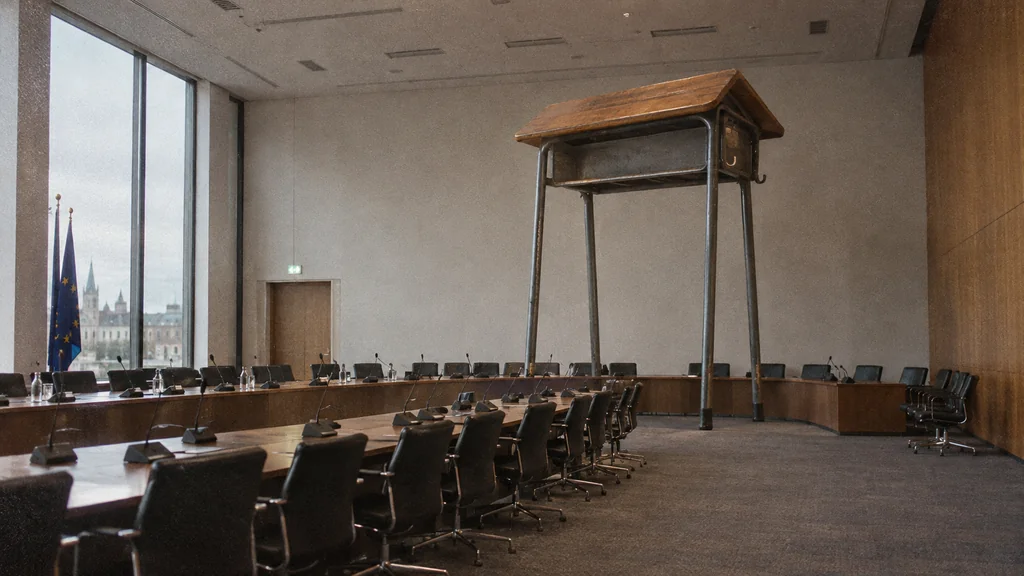
A vote on schooling opens the next stage of Ukraine’s EU talks.
Image composition · tobriefAll 27 EU governments agreed on 12 October to open two more blocks of membership talks with Ukraine and Moldova, covering the single market and economic competitiveness (Byrne's announcement, DPA). Hungary had made its consent depend on Ukraine's parliament passing a law on minority-language schooling, and that vote came the same day. The talks formally open today in Luxembourg.
Thomas Byrne, Ireland's European affairs minister, announced the agreement. Ireland currently holds the Council presidency, the rotating job of chairing meetings of national governments.
How a school law bought Hungary's consent
Every step in Ukraine's talks requires unanimity. Each EU government must agree before a cluster, a themed bundle of negotiating chapters, can open (negotiating framework). That hands any single capital a veto, and Hungary used it again in September to stall Ukraine's progress (Euronews).
Budapest's complaint has a real history. In 2017 the Venice Commission, the Council of Europe's panel of legal experts, criticised Ukrainian education changes that cut secondary schooling in minority languages (Venice Commission).
Early this month Hungary welcomed a draft bill from Kyiv but said it would consent only after parliament voted (Reuters). We described a step that week as Hungary lifting its veto (To Brief); in fact, EU ambassadors on 7 October only invited both candidates to submit negotiating positions (Kyiv Independent).
On 12 October the Verkhovna Rada, Ukraine's parliament, passed the bill with 266 votes (Rada plenary record). The law gives special status to schools where more than half of pupils study in an EU-language minority tongue, such as Hungarian or Romanian, and protects that teaching when schools are reorganised (Interfax-Ukraine).
Hungarian foreign minister Anita Orbán said the vote allowed Budapest to consent. She added that implementation mattered, and that Hungary would monitor it alongside minority organisations in Transcarpathia, the western Ukrainian region home to its Hungarian community (Telex).
Moldova waited on a quarrel it was not part of
Moldova had no role in the schools dispute. It negotiates on its own track, with its own positions. Cristina Gherasimov, its deputy prime minister for European integration, confirmed on 7 October that her government had been invited to submit those positions (MOLDPRES).
The timing is what stands out. Moldova was invited on the same day as Ukraine, cleared on the same day, and opens on the same day. The simplest explanation is that EU governments preferred not to move Moldova ahead while Ukraine was blocked, which would mean a dispute between Budapest and Kyiv set a third country's calendar. That remains an inference, because neither Chișinău nor Bucharest has published a reason for keeping the two timetables together.
What opens today, and what stays shut
Today's meetings are accession conferences, the formal sessions where EU governments table their agreed position, held separately for each candidate (Council: Ukraine, Council: Moldova); for Ukraine, they follow the rule-of-law cluster opened in June and the foreign-relations cluster opened in July (Council).
Two clusters will then still be waiting to open: the green agenda, and the one covering agriculture, regional funds and the budget. That second one is where membership starts moving money toward farmers and poorer regions. EU governments have not yet negotiated their common position on farm measures (Agra).
On 6 October the Commission proposed deciding such intermediate steps by qualified majority, while keeping unanimity for final admission (Commission Q&A). That majority means at least 15 of 27 states representing 65% of the EU population (EU Treaty). The governments that hold the veto today would have to accept the change. During the Dutch Senate's European affairs debate on 29 September, speakers argued for keeping unanimity on important accession decisions (Eerste Kamer record).
The record supports a precise conclusion. Hungary named its price, a vote in a neighbouring parliament, and gave its consent the same day that price was met, while keeping a role in watching how the law is applied. Under current rules, the two clusters still closed need every government's agreement (negotiating framework), and even the Commission's plan keeps a veto over final membership. The record does not show who decided that Moldova should wait alongside Ukraine. Chișinău and the EU governments that hold the veto owe that explanation.
Details about this article
- Model:
- claude-opus-5-5
- Generated:
- 10/13/2026, 1:43:17 AM
- Pipeline run:
- eu_pipeline_20261013_005007
- Watermark:
- SynthID (Google's invisible watermark)
- Human review:
- None before publication