Iran claims three tanker fires without names
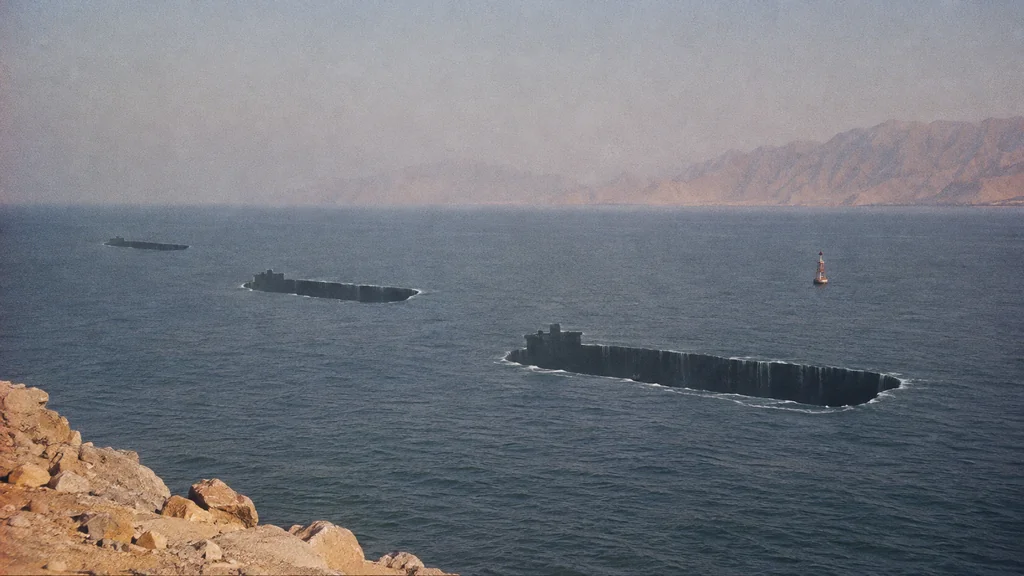
Three tankers are reported burning; none has been identified.
Image composition · tobriefIran's Revolutionary Guards said on Sunday that three oil tankers caught fire in the Strait of Hormuz after hitting mines, accusing the ships of switching off their tracking systems and calling them "non-compliant" (Nour News, Arab News). The statement named no vessel, flag, operator or position for any of the three, and Reuters said it could not independently verify the account. On a waterway already moving a fraction of its normal traffic, the announcement is a tally without a single identifiable ship.
A tally with no ship, a route with no traffic
The fires that do appear in official warnings happened on Saturday, the day before the Guards' count. The UK Maritime Trade Operations, the official warning service for merchant shipping, published two separate alerts: one of a tanker burning about eight nautical miles northwest of Khasab, Oman, with its crew evacuated, and another of an outbound tanker struck by an unknown projectile (UKMTO warning 199-26, UKMTO warning 200-26). Neither alert names a vessel or a cause. The Joint Maritime Information Center, a threat-warning hub that has rated the strait severe, keeps the Saturday incidents listed separately and connects neither to Sunday's announced tally (JMIC update 112). Two ships in documented trouble on Saturday cannot be matched to three claimed on Sunday.
The collapse in traffic predates the statement. A public tracking site, which counts commercial ships that broadcast their position, recorded five visible crossings on Saturday and four on Sunday, against about 85 a day before the crisis (Hormuz.now, 7 November, 8 November). Ships that switch off their transponders drop out of that count, so the real figure is higher by an unknown margin. The fall had already happened before the Guards spoke, so the announcement shows no demonstrated change in traffic.
Who pays, who decides
European companies have been booking the cost for days. Maersk, the Danish shipping line, paused new bookings for two UAE ports on 30 October and by 6 November was charging $1,000 per container for Gulf transits, a surcharge it says covers insurance and crew risk (Maersk). QatarEnergy has declared force majeure, the clause a company invokes when events beyond its control stop it meeting obligations; Italy's Edison says the declaration covers 38 scheduled LNG cargoes through December, 27 of which it has replaced (Edison).
The dispute behind the announcement is who may direct traffic through the strait. The Guards call the ships they say burned "non-compliant" for using what they describe as an unauthorised route. That wording asserts an Iranian power to say how and where vessels pass, while the UN Convention on the Law of the Sea, the treaty governing such waterways, obliges states on their shores not to hinder or suspend ships' passage (UNCLOS). A strait that sits nearly empty, whatever the cause, is the outcome that rule exists to prevent. Nothing in the record shows who caused any fire; the mines and the "non-compliant" label come from Tehran alone.
The decision chain that matters is private. Warning centres can alert merchants to danger; shipowners and masters choose whether to sail; war-risk insurers set the price of the choice, as Maersk's surcharge shows. For insurers the statement reads as a warning regardless of its accuracy: ships that pass by a route Iran has not authorised are, in Tehran's telling, on their own. Iran has offered no verifiable account of three tanker fires, and the documented danger and disruption were already there before it spoke. Whether the announcement changed any individual sailing decision cannot be settled while ships travel with transponders off.
Details about this article
- Model:
- deepseek-v4-pro
- Generated:
- 11/9/2026, 2:02:43 AM
- Pipeline run:
- eu_pipeline_20261109_005008
- Watermark:
- SynthID (Google's invisible watermark)
- Human review:
- None before publication