Iran’s seven-ship claim meets EU escort gap
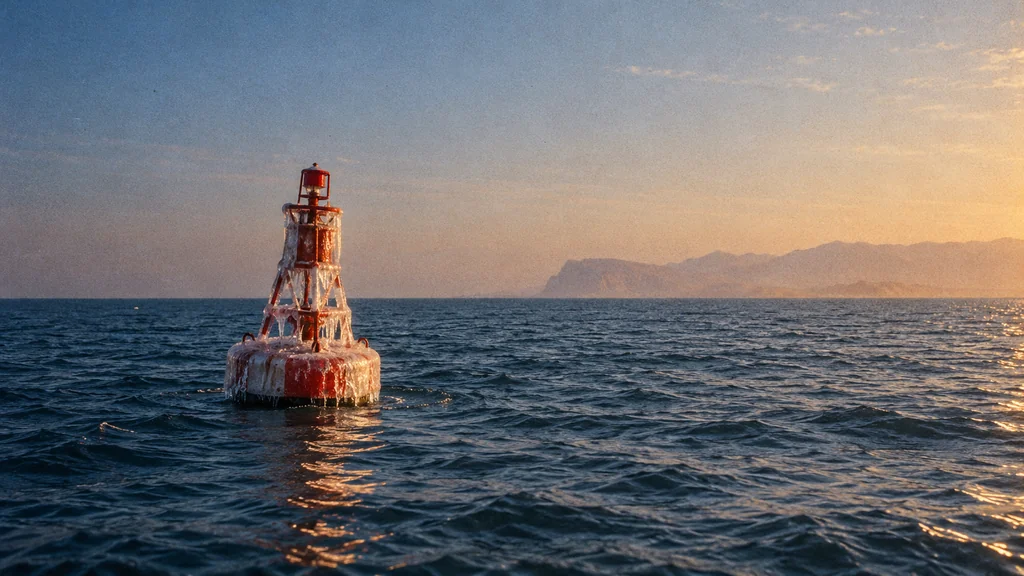
Ships keep crossing Hormuz as attacks mount and escorts remain out of reach.
Image composition · tobriefIran's Revolutionary Guard navy said on 22 October that it had struck four vessels transferring oil in the northern Gulf, and that three more had hit mines west of the Strait of Hormuz overnight. It named none of them, and Associated Press could not confirm any of the seven (AP). The tally is unproven, but the danger around the strait is documented and expensive. The EU's naval mission in the region cannot currently escort ships through it.
A real strike, an unproven tally
The confirmed record looks different from Tehran's account. UK Maritime Trade Operations, the British navy's shipping-alert service, logged a tanker hit by an unknown projectile at 01:45 UTC on 21 October. The ship caught fire 11 nautical miles west of Bukha, Oman (UKMTO). India's shipping minister named it as the Kuwait-flagged AL DASMA and said its 21 Indian seafarers were safe (Moneycontrol).
AL DASMA is one of several named projectile incidents on record. None of them backs the Guard's account. It was hit by a projectile, not a mine, and nothing ties it to Iran's overnight count. The International Maritime Organization, the UN shipping agency, lists the tanker as damaged without pollution and shows no seven new entries matching the Guard's statement (IMO).
Missing entries do not disprove the claim either. Lloyd's List Intelligence, a shipping-data firm, counted at least 28 attacks or security incidents in and around the strait in October, and notes that some targeted ships never report (Lloyd's List Intelligence). That shows how dangerous the water is. A monthly count still cannot confirm what happened on one night.
The Guard paired its tally with a warning. If Washington keeps helping ships use passages Tehran calls illegal, Iran says it could widen its response to US bases in the region (AP). The simplest reading is that the count is meant to deter shipowners and the United States. It does that job whether or not every hit happened.
Why the EU mission stops at the strait
Aspides is the EU's naval mission against attacks on merchant shipping. On 30 September, Germany's defence ministry said Hormuz lies inside the mission's area of operations, but that its mandate to protect ships does not extend to the strait (German government). The area marks where the mission's warships may sail and keep watch. The mandate sets what they may do there, and escorting tankers through Hormuz is not part of it.
Changing that is a political choice for EU governments. They set mission mandates together in the Council, where national ministers decide and military missions need unanimity, so any one capital can block. A wider mandate would still need warships. EU foreign-policy chief Kaja Kallas has said the mission only works if member states supply them (EEAS via GlobalSecurity).
Ships keep sailing, at a steep price
Operators still active in the Gulf show little sign of retreating, according to Lloyd's List Intelligence. Staying costs them. Chartering a tanker to carry two million barrels to China now costs near $1.4 million a day, more than 12 times the pre-war rate (Reuters).
That China run is the standard route for the giant tankers that carry Gulf crude. European buyers hire from the same pool of ships, so the rate is a fair gauge of what moving oil costs everyone. Insurance has climbed as well. Cargo cover now runs near 10% of cargo value, against about 3% before the war (Reuters).
Brent crude rose above $111 a barrel (Euronext). Traders were also weighing Houthi drone strikes on Saudi Arabia, including at the Shaybah oil field (ICIS). That means the move cannot be pinned on Iran's announcement.
For European drivers, the effect is still unclear. In September, before this claim, EU fuel and lubricant prices were 31.4% higher than a year earlier (Eurostat). Italian diesel averaged €2.260 a litre on 22 October, a tenth of a cent above the day before (ANSA). That is one country on one day. The ECB says crude moves generally reach retail fuel within one to two months (ECB). That describes the usual delay, not where prices will go this time.
Nobody can yet say how much of this week's oil move came from the Guard's claim rather than the strikes on Saudi Arabia. The rest of the record is clearer. The Guard has not proved its seven-ship tally. Operators already face documented attacks and far higher shipping costs. The EU's escort mission cannot take them through Hormuz unless member governments agree a new mandate and supply the ships to carry it out.
Details about this article
- Model:
- claude-opus-5-5
- Generated:
- 10/22/2026, 7:35:14 PM
- Pipeline run:
- eu_pipeline_20261022_184701
- Watermark:
- SynthID (Google's invisible watermark)
- Human review:
- None before publication