Iran’s tanker claim lacks ship names
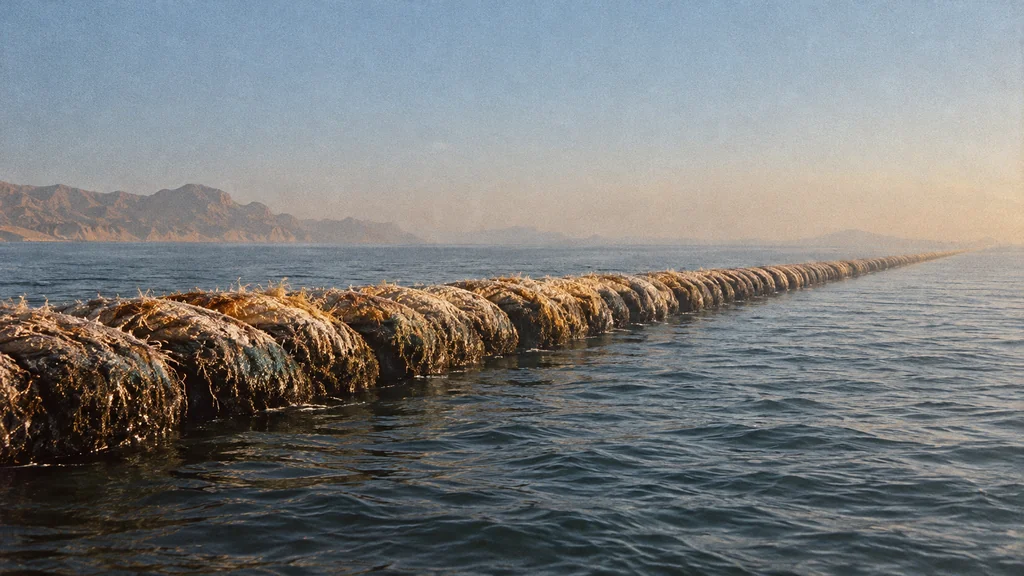
An unverified mine warning weighs on an already depleted shipping route.
Image composition · tobriefIran's Revolutionary Guard said on Tuesday that mines laid by its navy exploded in the southern passage of the Strait of Hormuz, setting two tankers on fire and stopping them (Sepah News). The statement gives no way to check that. Even so, a mine warning can still shape decisions on a route that carries part of Europe's gas.
A claim with nothing to trace
Every merchant ship carries an IMO number, a permanent identifier that lets insurers, ports and reporters follow it. The Guard's statement gives no IMO number, no ship name, no flag, no owner and no position. Reuters noted that it did not even say when the tankers were hit (A News).
That gap has already produced errors. German-language wire copy described the fires as overnight (ORF, dpa-AFX). In the Iranian text, however, the overnight timing belongs to a separate claim about a US drone.
The ships may not even be new. The Guard announced two supertanker mine strikes on 17 October (gCaptain), which we covered at the time (To Brief), and claimed another late on 18 October (Sepah News). Nothing in the record shows whether Tuesday's pair are additional ships or earlier claims repeated.
What independent checks found
The main shipping-security monitor for the region found "no substantiation" for the 17 October claims (JMIC). That monitor, the US Navy-led Joint Maritime Information Center, compiled its update before Tuesday's statement. It says nothing about the newest pair.
The same update also warns mariners to watch for attempted mining. The danger it describes is real, even if these particular strikes remain unconfirmed.
A US Central Command spokesman called Tuesday's claim false and said international waterways had been cleared, according to Newsquawk. That denial is second-hand. To Brief could not locate the original American statement.
A route already under strain
Shipping had pulled back well before Tuesday. The strait saw 254 passages in the week to 14 October, roughly 70% below pre-conflict levels (Anadolu). On 19 October the Swedish Club, a Nordic marine insurer, advised members to defer nonessential voyages (Swedish Club).
Both figures predate the new claim. They show a route under pressure. They do not show that Tuesday's statement changed any shipowner's decision, and no such evidence has yet appeared.
Europe's exposure also predates it. The IEA estimated that roughly 7% of Europe's 2025 LNG imports crossed Hormuz (IEA). Edison, an Italian gas importer, said by 28 September that it had missed 35 Qatari cargoes and replaced only 23 (Edison).
Tehran adds pressure by calling the southern route illegal and threatening companies that use it. That warning targets the operators carrying cargo bound for Europe.
Who could clear mines
If mines are present, the EU's own naval mission cannot remove them. Aspides, the mission that protects merchant shipping in the region, is authorized for surveillance and escort in Hormuz but not for mine clearance (EUR-Lex).
EU leaders did not change that at their 15–16 October summit. They called for reinforcing Aspides without authorizing mine clearance (Council).
A separate British-French mission plans clearance only once conditions are safe (GOV.UK). A Dutch government letter said it had not been activated as of 2 October (Tweede Kamer). No more recent status appears in the record.
Tuesday's statement does not establish that more tankers were hit, though it does not rule out a strike. Settling the question requires a ship name, an IMO number, a position and a time. Those details must come from the Guard, which says it laid the mines. Otherwise they must come from the operators of the ships it says were hit, or from their flag states, the countries where those ships are registered.
Details about this article
- Model:
- claude-opus-5-5
- Generated:
- 10/20/2026, 7:01:10 PM
- Pipeline run:
- eu_pipeline_20261020_180759
- Watermark:
- SynthID (Google's invisible watermark)
- Human review:
- None before publication