Ireland’s €141bn EU proposal squeezes security
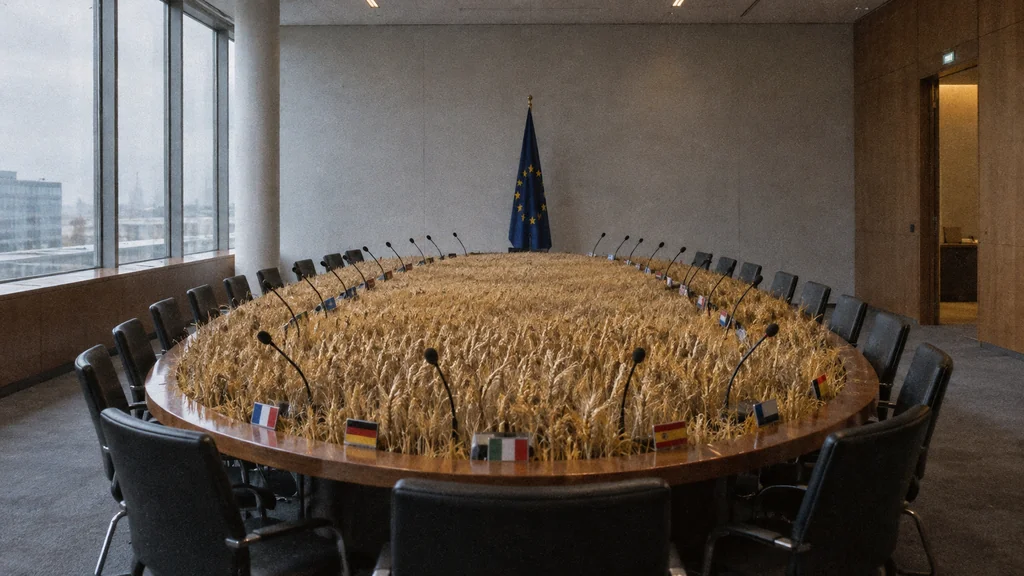
Europe protects farm spending while its security ambitions compete for less.
Image composition · tobriefIreland's proposal for the EU's 2028–34 budget cut €141.045 billion, about 8%, from the European Commission's plan (Council negotiating box). National leaders first discussed it on 15 October and ended without agreement (Euronews). The paper exposed a collision. The governments demanding a smaller budget also want more money for security, and a large bloc of other governments is defending the spending that would have to shrink to pay for it.
Ireland holds the Council presidency, the rotating six-month job of chairing meetings of national ministers. On 10 October it circulated a "negotiating box", a bargaining paper of totals and allocations that enacts nothing. It proposed €1,622.011 billion in spending commitments over seven years at 2025 prices, against the Commission's €1,763.056 billion (Council negotiating box).
No vote rejected the paper. Leaders found it could not bring them closer and invited António Costa, who chairs the European Council (the summit of national leaders), to seek "a timely agreement" (Euronews).
The payers want less, but not less security
Six of the governments that pay most into the EU budget, including Germany, the Netherlands and Sweden, wrote to Ireland on 28 September demanding cuts of several hundred billion euros (RTÉ). At the summit, Chancellor Friedrich Merz called the Irish cut a step in the right direction that still fell far short of Germany's demand (German government). Sweden's Ulf Kristersson said his country would reject the paper as still too large (Reuters).
The same camp, however, wants Brussels to do more on security. Dutch Prime Minister Rob Jetten told parliament that the Irish cuts land on competitiveness, innovation and defence, the things he wants the EU to strengthen (Tweede Kamer).
He is describing the paper accurately. Ireland cut lightly where farmers and poorer regions get their money, and deeply where the EU funds industry, defence and foreign policy. The heading holding farm and regional funds lost 3.4%, against 12.8% for competitiveness and security and 17.4% for external action (Council negotiating box).
The European Parliament, which must consent to the final budget, objects from the opposite side. Its four lead negotiators said the 8% cut would leave the EU less able to invest in defence or support partners abroad (European Parliament). For frontline states the loss is concrete. Lithuania's president, Gitanas Nausėda, opposed the cut to military mobility, the money for roads and railways that move troops (15min).
The defenders of farm and regional money
Italy and Romania have gathered 17 governments as the "Friends of Cohesion", named after the EU's funding for poorer regions (Italian government). They want that money protected in size and in the rules that govern how it is spent. They also want to end rebates, the discounts that shrink some richer countries' contributions, which puts them in direct conflict with several of the payers.
Ireland kept each country's headline amount but folded the funds into a single national plan per country (Council negotiating box). That moves control toward national capitals. Regions that have long dealt with Brussels directly fear losing their say, which is why the cohesion group insists on keeping the spending rules as well as the sums (Italian government).
A veto for every capital, and no cliff
The seven-year framework needs unanimity among national governments, meaning any one can block it, plus Parliament's consent (EUR-Lex). That gives both camps the power to stall. The calendar adds little pressure. If no framework is adopted by 1 January 2028, the treaty carries forward the final-year spending ceilings of the current one (EUR-Lex).
The record supports a narrow verdict. As written, Ireland's draft cannot satisfy demands for both a lower total and more security spending, because the cuts that produced the savings fell hardest on security. A deal therefore needs someone to give ground. The payers could accept a larger total, the cohesion bloc could accept deeper cuts to farm and regional money, or both could move some way. Costa can draft that compromise, but he cannot impose it on governments that each hold a veto. Merz, Jetten and Kristersson owe him a figure they would accept in exchange for the security money they say they want. The Friends of Cohesion owe him an answer on whether any of their money can move.
Details about this article
- Model:
- claude-opus-5-5
- Generated:
- 10/16/2026, 1:33:54 AM
- Pipeline run:
- eu_pipeline_20261016_005006
- Watermark:
- SynthID (Google's invisible watermark)
- Human review:
- None before publication