Italy leaves €6 billion in SAFE loans
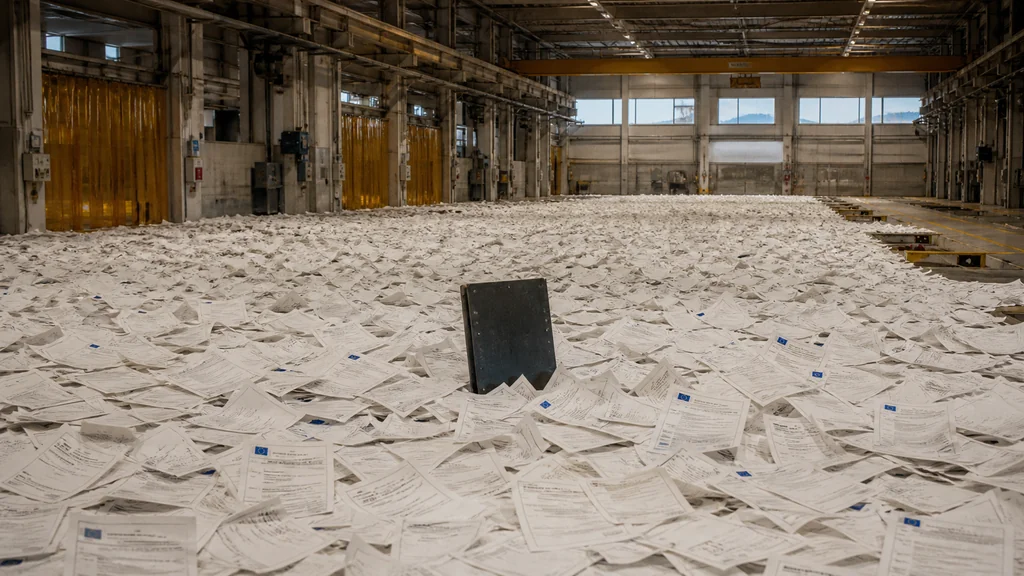
Rome funds one order while unanswered billions fill the factory.
Image composition · tobriefItaly asked the European Commission for roughly €8-8.9 billion in defence loans, about half the €14.9 billion that Brussels had tentatively set aside for Rome (Il Fatto Quotidiano, Eunews). The money comes from SAFE (Security Action for Europe), a €150 billion facility that lets the EU borrow centrally and lend to member states for defence procurement at rates most could not get alone. Brussels can offer cheap credit. But governments must still choose to carry the debt.
The contrast landed on the same day. Romania received a first €2.5 billion SAFE payment and is already converting it into procurement orders: Lynx infantry vehicles, Mistral air-defence systems and Airbus helicopters (EC Romania, HotNews). Poland had already signed a €43.7 billion agreement and collected €6.6 billion in pre-financing (European Commission, Notes from Poland). Countries that signed early are already turning loans into orders. Italy's reduced request raises a prior question: whether some governments will even ask for the money available.
Coalition compromise, not budget logic
Created under Council Regulation 2025/1106, SAFE does not work like a grant. Every euro Rome borrows through the facility still becomes Italian debt, and Italian parties have to defend it.
Inside Giorgia Meloni's coalition, the fault line ran between Foreign Minister Antonio Tajani (Forza Italia), who publicly backed the full request at a conference in Rimini, and Matteo Salvini's Lega, which resisted higher defence borrowing. Finance Minister Giancarlo Giorgetti acknowledged SAFE's favourable terms, but the government halved its draw (Il Foglio). Tajani framed the retreat as a reordering of priorities: Italy needed to invest more in healthcare and social policy after what he described as changed conditions linked to the Iran conflict (Il Fatto Quotidiano, PAP). Whether the decision reflects Lega pressure, Treasury caution or a deliberate Meloni compromise remains unclear from the public record. The result is the same: Rome asked for half.
Spain tells a similar story in miniature. Madrid requested just €1 billion, with junior coalition partner Sumar openly opposing defence-spending increases (EFE, El Confidencial). Cheap EU borrowing does not make defence debt painless at home.
The queue behind Rome
Italy's delay had consequences beyond Rome. SAFE is a fixed envelope. Commission spokesperson Thomas Regnier had pressed Italy for clarity because unclaimed funds block the Commission's ability to reallocate them to other governments (Euronews). The roughly €6 billion Italy left on the table, combined with Hungary's still-unresolved request, creates a pool the Commission can reopen through a second call before the end of 2026 (Euractiv, Council).
Poland is already positioning. Deputy Defence Minister Paweł Zalewski confirmed Warsaw wants to compete for additional SAFE funds in that second round (Bankier/PAP). Polish media estimate up to €10 billion could become available, though that figure depends on final Italian and Hungarian numbers and remains speculative (RMF24).
Hungary's case is distinct. A new government is reviewing its predecessor's defence investment plan amid corruption concerns, and the Commission had not yet cleared Budapest's submission when other states were already approved (Euronews HU). Hungary's holdup is a governance question, not a coalition fight over borrowing.
Who spends first shapes the market
SAFE's rules require at least 65% European or Ukrainian content in procurement, which steers contracts toward EU-based manufacturers and aligns with France's long-standing push for defence-industrial autonomy (Council, CMS). That means the governments drawing fast are not just arming themselves. They are shaping order books, supplier relationships and production lines across the continent.
The Brussels machinery is moving. Approvals, agreements and first payments have reached over a dozen countries. But SAFE will reward governments willing to take on defence debt now. Italy has shown that Rome is only half willing, and the billions it left behind are already attracting competitors.
Details about this article
- Model:
- claude-opus-4-6
- Generated:
- 8/27/2026, 1:56:58 AM
- Pipeline run:
- eu_pipeline_20260827_005006
- Watermark:
- SynthID (Google's invisible watermark)
- Human review:
- None before publication