Italy’s pension and interest bills rise €21.54bn
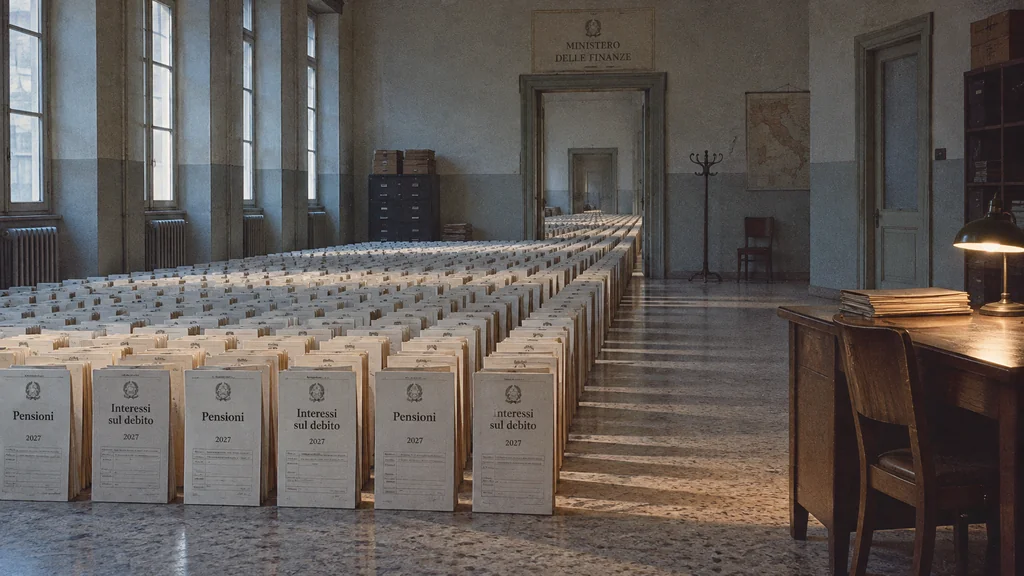
Italy’s next budget begins with bills already growing on their own.
Image composition · tobriefItaly's pension and interest bills are forecast to grow by a combined €21.54 billion next year, before the government has written a single new budget measure (Repubblica, Il Fatto Quotidiano). Prices and past borrowing drive both increases. The rest of the 2027 budget, from tax cuts to family support, will be built around them.
Two bills that grow on their own
The figures come from a multiyear fiscal plan the cabinet approved on 2 October. It frames the coming budget law but does not spend anything itself (ANSA). The numbers so far come from consistent press accounts, not a ministry table checked line by line. We reported earlier that the plan expects interest costs to keep climbing for years (To Brief).
Interest on the public debt is forecast to rise from €96.9 billion to €103.7 billion (Il Fatto Quotidiano). That bill moves slowly. Fixed-rate bonds already sold keep paying the interest agreed at issue, so a new rate bites only when the Treasury sells fresh debt or replaces a maturing bond.
At the end of 2025, Italian debt had an average of 7.9 years left to run, according to the Parliamentary Budget Office (UPB). The plan blames inflation for part of next year's rise and higher bond yields (the return investors demand to lend to the state) for later years (AGI).
Those yields are partly set across the whole euro area. An analysis the ECB (the European Central Bank) published this year found that most of a rise in euro-area ten-year yields came from markets changing their bets on future ECB rates (ECB). The finding covers the euro area, not Italy alone. It still makes a narrower point: when rate expectations shift for everyone, a government with more debt to refinance pays more in euros.
Pensions follow a different rule. They rise with prices, and each increase joins the base, so it carries into every later payment. The part of a pension up to four times the minimum gets the full price adjustment, while slices above it get less (Il Messaggero). For smaller pensions the budget carries the full cost of inflation. Retirees with larger ones absorb part of it, because their money buys less.
The state accounting office reportedly puts next year's price adjustment above €10 billion, assuming provisional inflation of 2.9% (Il Messaggero). Total pension spending is forecast to rise from €351.8 billion to €366.54 billion (Repubblica). The two figures answer different questions. The first is what it costs to raise existing pensions in line with prices. The second also moves with the number of pensioners, new awards and retirement patterns, and no published figure splits it between inflation and those other causes.
Extra borrowing, with strings attached
The cabinet also asked to borrow roughly €14 billion a year in 2027 and 2028 beyond the spending path Italy agreed with the EU (Teleborsa, Primapagina News). Finance Minister Giancarlo Giorgetti called the plan prudent in a difficult environment (AGI). The extra room is split evenly, 0.3% of GDP (the economy's annual output) for energy and the same for defence (Teleborsa).
The request needs an absolute majority in both chambers of Parliament (Senate). That vote is expected on 13 October, with the budget bill due around 20 October (Corriere).
The energy half comes with conditions. Commission guidance counts only investment such as building renovation and energy efficiency, not rebates on household bills (European Commission). Whatever the EU rules exempt, the extra borrowing and the interest on it still land in Italy's accounts.
The borrowing is tied to qualifying energy and defence spending, so it is not designed to pay pensions or interest. That does not mean the rest of the budget is locked, because the government can still cut elsewhere, raise revenue or shift money between lines. The two rising bills are not a deficit forecast either. They show which costs arrive before any political choice is made. How much room remains for tax cuts and family measures is the figure Giorgetti owes Parliament when the budget bill arrives around 20 October (Corriere).
Details about this article
- Model:
- claude-opus-5-5
- Generated:
- 10/5/2026, 11:47:11 AM
- Pipeline run:
- eu_pipeline_20261005_005007
- Watermark:
- SynthID (Google's invisible watermark)
- Human review:
- None before publication