Italy Turns Asylum Deadlines Against Germany
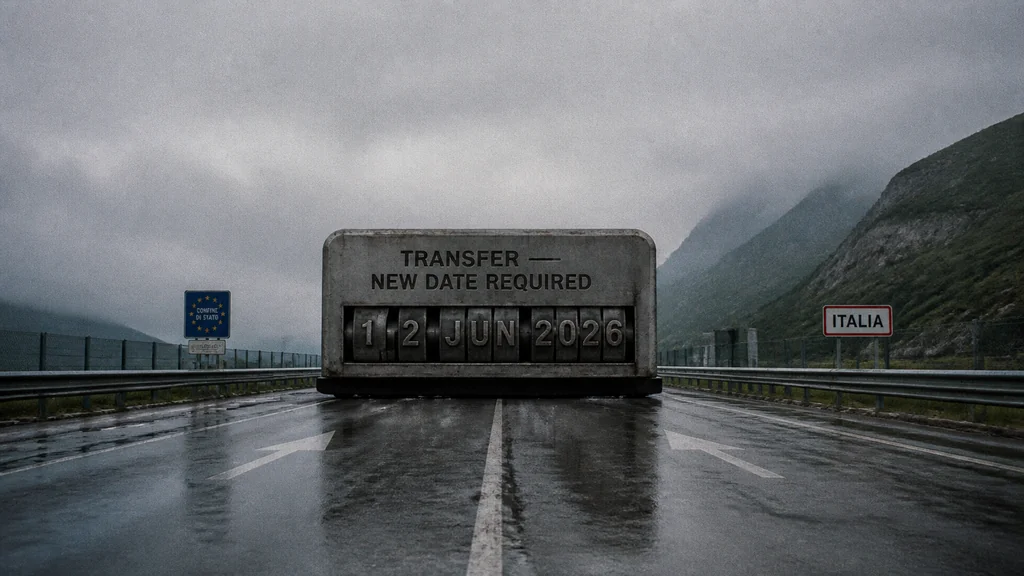
Europe assigns responsibility, but Italy controls when the road opens.
Image composition · tobriefMatteo Salvini told a League party rally on 22 August that Germany had "no right" to send back "even one irregular immigrant" while German NGO ships were landing people on Italian shores (ANSA). The line was designed to provoke. But the power to accept or refuse asylum transfers does not sit in Salvini's transport ministry. It sits with Interior Minister Matteo Piantedosi, whose department has been quietly rejecting German transfer requests since mid-August (Il Messaggero). Salvini supplies the rhetoric. Piantedosi runs the blockade.
The distinction matters because underneath the political theatre sits an administrative confrontation with the EU's new asylum system, barely two months after it started applying.
Which rulebook applies
The fight between Berlin and Rome turns on a single date: 12 June 2026. That is when the EU's new Asylum and Migration Management Regulation began applying, replacing the old Dublin system (EUR-Lex). Under both systems, the country where an asylum seeker first arrives or is registered usually bears responsibility for their claim.
Germany wants to send people back to Italy under the new rules. Italy's Interior Ministry says people who arrived before 12 June fall under older arrangements and cannot be reopened as new cases (Sky TG24). Three planned German transfers were formally rejected by Rome in mid-August. One involved a 22-year-old Somali woman who had reached Germany in March. She entered church protection in Nuremberg before the scheduled transfer date, and the case collapsed before it could test the new rules (EU Perspectives).
Piantedosi framed the dispute as overblown. He told ANSA on 21 August that Italy had received about 50 requests since 12 June but only three people had actually arrived, calling the controversy "sterile" (ANSA). The numbers are small. But Rome's refusal to accept even those is the problem Berlin and the European Commission are trying to solve.
Who is pushing, who is holding back
The pressure on Rome is no longer bilateral. Austria has completed four transfers to Italy since the pact started, using cooperative cases travelling by train or bus (ORF, Die Presse). Finland is preparing individual transfers without confirmed completions (Helsingin Sanomat). The Netherlands says it has started the process (Adnkronos).
France and Spain are holding back. Madrid, itself a first-entry country, prefers handling transfers through the pact's solidarity instruments (a system where countries can choose between accepting relocated people or paying into a common fund) rather than bilateral expulsions (Euronews). Spain's caution is self-interested: any precedent that normalises unlimited first-entry returns can be turned against Madrid next.
The Commission's own first assessment, covering 12 June to 7 July, found that eight member states submitted requests involving 12 transfers to Italy. Italy rejected all of them. The Commission said a receiving state cannot simply refuse and must propose an alternative date. That instruction was meant to prevent refusal-by-delay, but it did not itself produce a single transfer (European Commission, 2EU Brussels).
Rome can say no today; Brussels can punish later
Germany's legal position may be correct, but its enforcement tools are slow. The Commission can open infringement proceedings (the formal process for forcing a country to follow EU law). Germany could theoretically bring a state-to-state case before the Court of Justice, though no member state has done so on migration because it poisons bilateral relations for years. Financial penalties come only after a judgment and continued defiance (Article 258 TFEU). None of this moves a person across a border next week.
And time is Italy's real weapon. If a transfer is not executed within the legal deadline, responsibility shifts back to the sending state, as the Court of Justice ruled in its 2017 Shiri judgment (CJEU, C-201/16). Reject, dispute the classification, insist on rescheduling, link cooperation to the NGO-ship question. EU asylum law does not make Germany responsible for a claim simply because a rescue vessel flies a German flag (EUR-Lex AMMR). But Salvini's argument does not need to be legally correct to be politically effective. It buys Rome time while northern states burn through deadlines.
Austria's four completed transfers prove the system can work. They also prove its scale: four people, by bus, in two months. The old Dublin system generated 24,152 transfer requests to Italy in 2025 alone, while Germany executed only 5,377 transfers to all destinations combined (Eurostat via Sky TG24). The gap between paperwork and physical movement was Dublin's chronic failure. For now, Italy has found the new pact's version of the same weak point: the law can assign responsibility faster than Brussels can force compliance.
Details about this article
- Model:
- claude-opus-4-6
- Generated:
- 8/23/2026, 1:54:39 AM
- Pipeline run:
- eu_pipeline_20260823_005006
- Watermark:
- SynthID (Google's invisible watermark)
- Human review:
- None before publication