Kyiv struck hours after Putin offers talks
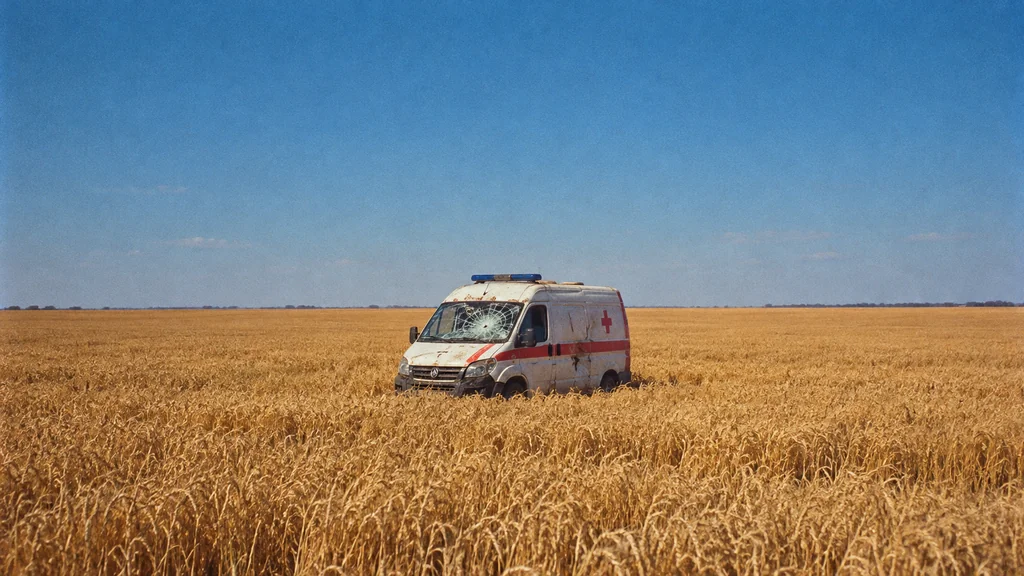
Kyiv’s ambulances bear damage while the proposed talks offer no pause.
Image composition · tobriefRussia struck Kyiv overnight on 21–22 October, killing one man and injuring 24 people, 16 of whom were taken to hospital, according to the city's military administration (Hromadske Radio). The attack came hours after Vladimir Putin agreed in principle to resume three-way talks with Ukraine and the United States after 10 November (AP). Nobody agreed to stop firing in the meantime. The proposed format also has no announced place for the European governments that help pay for Ukraine's defence.
President Volodymyr Zelenskyy said Russia fired ballistic missiles at the capital in three waves (Reuters). Ballistic missiles fly fast and leave residents little time to reach shelter.
Police said the man was killed in the Dniprovskyi district. A hypermarket and a university were among the buildings damaged (Kyiv police via Glavcom).
A city split at the river
Emergency crews recorded fires and damage in six districts, and in Pecherskyi an ambulance station and six ambulances were hit (DSNS Kyiv). The official lists do not say whether each site took a direct hit or was struck by falling debris.
Many residents will feel the damage on their way to work. A strike on the Southern Bridge split the metro's green line in two. Trains kept running on each side of the Dnipro but could no longer carry passengers across the river (Kyiv Metro). In a city divided by the river, that leaves commuters looking for other ways across.
Electricity went too. Power company DTEK imposed emergency cuts at about 05:00 and returned the capital to scheduled rationing by 12:58 (DTEK). Scheduled cuts are a managed shortage, not a return to normal supply.
Talks on offer, no pause agreed
Putin made his offer to US envoy Steve Witkoff in St Petersburg. His aide Yuri Ushakov floated Abu Dhabi as a venue (Deutschlandfunk).
The two sides disagree on what should come first. Zelenskyy wants talks sooner and has proposed freezing the current front line as a first step. Moscow wants the core questions of a settlement resolved before any halt in fighting. Zelenskyy said the overnight strikes showed that Russia had not changed its behaviour.
That order of events matters for Kyiv. Under Ukraine's proposal, the shooting would stop first and the bargaining would follow. Under Russia's, the shooting continues until the bargaining is done. Nothing Putin agreed to this week says which order will apply. He offered no ceasefire, no list of protected targets such as power plants, and no way to check whether either side keeps its word.
Europe pays, but has no announced seat
The format Putin accepted has three parties: Russia, Ukraine and the United States (AP). No European government and no EU institution has been announced as a participant.
Europe's role is mostly financial. EU leaders are due to discuss how to fund Ukraine at an extraordinary summit, a meeting called outside the bloc's regular calendar, on 26–27 November (Euronews). That summit is a discussion. No budget has been agreed.
The two tracks connect, even though the reporting does not tie them together directly. How long the fighting lasts, and what is destroyed in the meantime, affects how much Europe will be asked to spend on air defence and reconstruction. European governments carry much of that cost. Under the arrangement announced so far, they have no seat at the talks that will shape it.
Moscow has offered to talk while it keeps striking Ukraine's capital, and no ceasefire has been agreed. The talks themselves remain an outline. Beyond a start no earlier than 10 November (AP), there is no fixed date, venue or agenda.
Details about this article
- Model:
- claude-opus-5-5
- Generated:
- 10/22/2026, 7:34:35 PM
- Pipeline run:
- eu_pipeline_20261022_184701
- Watermark:
- SynthID (Google's invisible watermark)
- Human review:
- None before publication