Government: “There is a problem” in schools, target of 2,000 renovations
AI Daily Synthesis
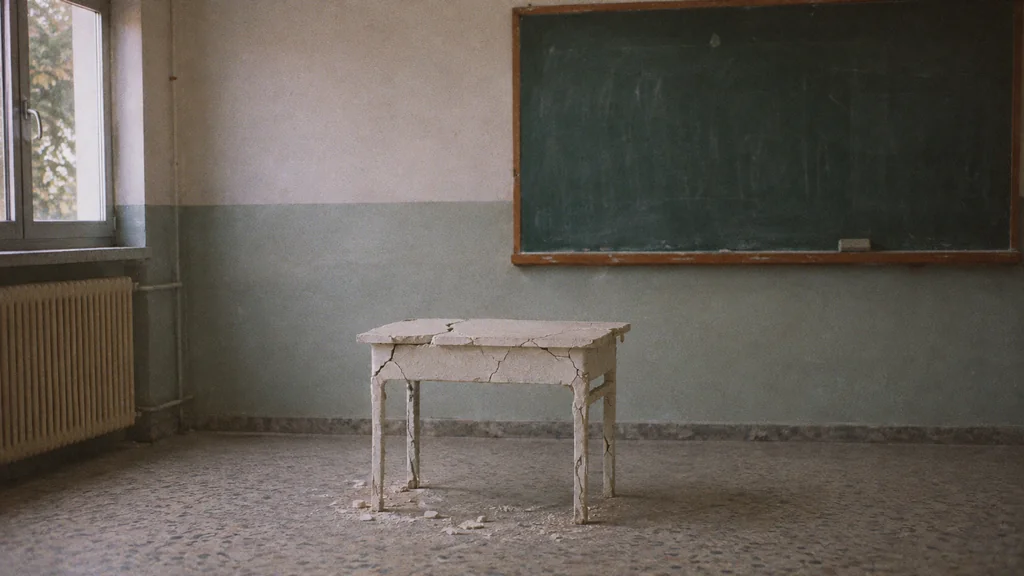
Image composition · tobriefGovernment spokesperson Pavlos Marinakis acknowledged today that there is “clearly a problem” with school buildings and said the government was not glossing over the situation (Government briefing). He was responding to a report by the Greek newspaper Proto Thema documenting plaster fallen onto desks, classrooms where water leaks in, and rodents at a special education school. Marinakis said the “Marietta Giannakou” renovation programme has upgraded 669 schools since 2024–25 and set a target of 2,000 by summer 2028 (Government briefing). Proto Thema compared the 669 with a total of 12,690 state schools (Proto Thema). The figure of 669 counts renovations under the programme, not repairs carried out by municipalities.
What the report found
At the 5th Lower Secondary School in Ilioupoli, an Athens suburb, photos and videos of the toilets were made public a few days earlier, and work then began. Stamatis Varsakis, vice-president of the parents’ association, said the work was unfinished, problems remained and the municipality had pledged to continue (Proto Thema, Real Voice 995). At the 23rd Primary School in Acharnes, north of Athens, desks were moved during October’s rains because water was coming through the windows. The gaps were sealed with silicone, a fix that the report said would last through one or two rainfalls (Real Voice 995).
In Thessaloniki, according to the same report, plaster fell onto desks at the 6th Kindergarten in Kalamaria, a suburb of the city, while the school was closed, and it shut for three days. Last Friday, plaster also fell in the canteen area of Thessaloniki’s 4th Upper Secondary School (Real Voice 995). The report says the Education Ministry refers responsibility for maintenance to municipalities, while mayors cite insufficient funding (Proto Thema). Education Minister Sofia Zacharaki had publicly acknowledged the age of school facilities on 21 October, saying that a major wave of investment was under way with contributions from banks (Alfavita).
At the 1st Special Education Primary School and Kindergarten in Acharnes, teachers and parents reported rodents and a strong foul smell. The “Socrates” teachers’ association said the problem had lasted more than a month and traps had not solved it. Mayor Spyros Vrettos ordered both schools to close from 18 to 20 November (MEGA). The municipality said it had carried out rodent control, that an inspection of all areas and wider measures would follow, and that it aimed to reopen the schools today (Dnews).
In Piraeus, on 13 November, plaster fell in a first-year class at Ralleio Primary School. No one was injured. The parents’ association said it had repeatedly warned municipal services and deputy mayors, verbally and in writing. It asked Mayor Giannis Moralis for a technical inspection and for classes to be suspended until the building was confirmed safe to use (in.gr). The Piraeus Directorate of Primary Education sent an urgent letter on 19 November, made public today, to the technical departments of 14 municipalities stretching from Piraeus to the islands of Hydra and Kythira. It asks them to give “particular attention” to the safety of school premises, carry out repairs promptly and keep the directorate informed of their progress (Proto Thema, Alfavita).
Who makes repairs and what has been done
By law, the relevant municipality is responsible for repairing and maintaining school buildings. The Education Ministry sets standards, according to a parliamentary reply citing laws 3463/2006 and 3852/2010 (Hellenic Parliament). Municipal repair funds come from Interior Ministry grants (Hellenic Parliament). Pre-earthquake inspections of school buildings are also under way separately. Their first stage ranks buildings according to which need further investigation (Hellenic Parliament).
The Greek Primary Teachers’ Federation (DOE) surveyed schools from January to March 2026. It received complete responses from 697 of 8,936 kindergartens and primary schools, a response rate of 7.79%, according to the federation. Only 18% said their building needed no work. Some 76% said they had no automatic fire alert system, and 43% said their electrical wiring needed repair or replacement (DOE).
The “Marietta Giannakou” programme covered more than 430 schools in its first phase. The contract for the second phase, covering 238 schools in 132 municipalities, was signed on 7 May 2026. It is funded by a €100 million donation from Alpha Bank, Eurobank, National Bank of Greece and Piraeus Bank, and covers work on toilets, accessibility, painting and insulation (Education Ministry). According to the ministry, the four banks will contribute a total of €400 million when the programme is fully rolled out. Media reports put the overall plan at €650 million, including €250 million from the Public Investment Programme (Reporter.gr).
To reach 2,000, the government needs to complete another 1,331 schools in about 19 months, or around 70 a month. Realnews reports an interim target of up to 300 renovations in summer 2027 (Real.gr). Zacharaki announced on 7 November that a list of 500 schools would be published by January 2027, but these are schools that will enter the planning stage (Education Ministry).
The next concrete step is that list, due in January. Until then, when plaster falls in a classroom, the municipality is responsible for the repair, using funds that, according to the report, mayors say are insufficient.
Details about this article
- Model:
- claude-opus-5-5
- Generated:
- 11/23/2026, 5:20:18 PM
- Pipeline run:
- incremental_20261123_163012
- Watermark:
- SynthID (Google's invisible watermark)
- Human review:
- None before publication