Larissa: Man dies after ambulance did not take him to hospital
AI Daily Synthesis
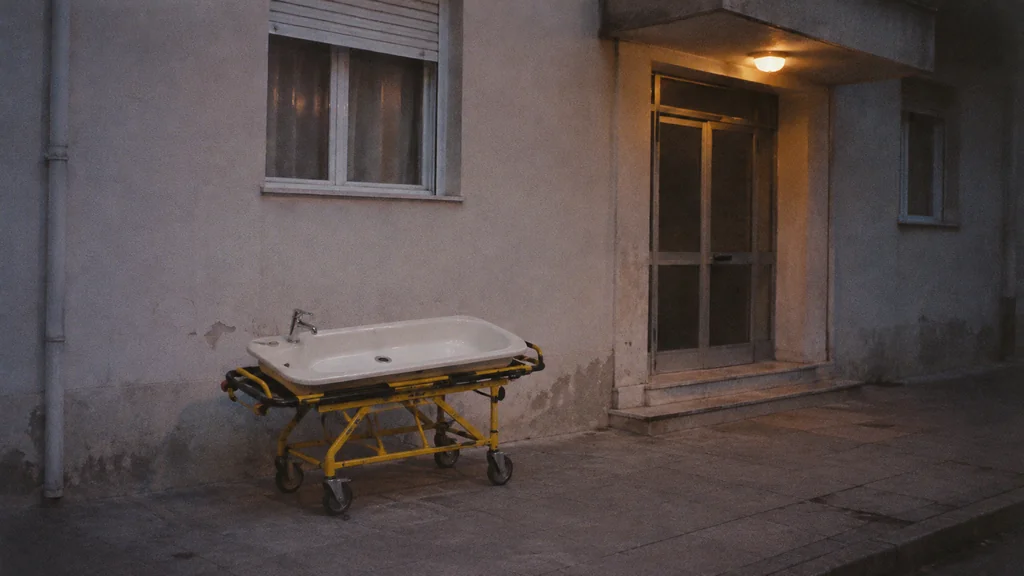
Image composition · tobriefA man aged 59, or 60 according to the National Centre for Emergency Care (EKAB), died in Larissa, a city in central Greece, on the evening of 20 November, according to his family. A few hours earlier, an ambulance crew had gone to his home and left without taking him to hospital (MEGA, SKAI). His family alleges that the paramedics refused to take him because he was soiled. EKAB says the patient himself refused transport, followed by his relative, and its president has ordered a preliminary inquiry.
What the family says
The man’s aunt gave MEGA the family’s account. She was not present when the crew arrived; she repeated what his brother had told her. According to that account, the brother found him unwell and called EKAB. When the crew arrived, the man soiled himself, and the paramedics said, “We won’t take him while he’s soiled.” They asked the family to call again after cleaning him (MEGA).
His brother could not lift and clean him alone because of his weight, the aunt said. A nephew cared for him until late. The man died that same evening (MEGA), “a few hours later”, as CNN Greece also reported (CNN Greece). Reports give cardiac arrest as the cause of death.
EKAB’s response
EKAB issued a statement on 23 November giving a fuller sequence of events. According to the statement, the relative had already called twice to ask whether the man could be taken to hospital. He had said the patient was not eating, had a psychiatric history and refused to go to hospital. EKAB says it advised him to contact the relevant authorities for a prosecutor’s order and call again (Larissanet).
At 14:07, according to EKAB, the relative called again: the man was lethargic, and the process of obtaining the order had begun (The Press Project). At the house, the statement says, the patient “did not appear lethargic”, would not let the crew check his vital signs and said he did not want to be taken to hospital (LiFO). His vital signs were therefore not recorded.
The crew then told the relative that the man needed “personal hygiene care beforehand”, citing hygiene and infection prevention protocols, EKAB says. After that, the relative “stated” that he did not want the man taken to hospital (BusinessDaily). EKAB cites its coordination centre’s records for the calls.
The two accounts agree on one point: EKAB itself says the crew made cleaning the man a condition of taking him to hospital. They differ over who ultimately said “no”. The family says the paramedics refused to take him. EKAB says the patient refused first, followed by his relative.
Consent and a prosecutor’s order
According to EKAB, the relative had begun the process of obtaining a prosecutor’s order because the man refused to go to hospital. That order starts the special procedure for involuntary psychiatric assessment or hospitalisation set out in Articles 95 to 100 of Law 2071/1992, as Greece’s Ministry of Health explains (Ministry of Health). Under that procedure, a person can be taken to a psychiatrist against their wishes.
For any other medical procedure, Greece’s Code of Medical Ethics requires the patient’s consent. An exception applies only when consent cannot be obtained and there is an “immediate, absolute and urgent need to provide medical care” (e-nomothesia). A psychiatric history alone does not take away someone’s right to refuse. The question is whether the man could make a decision for himself at the time. According to EKAB, the crew judged at the scene that he was not lethargic, while he refused to have his vital signs checked.
Who is investigating
EKAB’s president instructed the director of its Larissa branch to investigate the “overall handling” of the incident and verify the operational records (NEWS 24/7). Initial reports said a sworn administrative inquiry, a procedure used to establish responsibility, had been ordered. EKAB sources later clarified that “no sworn administrative inquiry has been ordered” (NEWS 24/7). The preliminary inquiry comes first: it gathers evidence to determine whether there are grounds for disciplinary proceedings (Law 3528/2007).
There is also a discrepancy over the complaint. MEGA reported on the morning of 23 November that the family had requested an investigation “with a formal complaint to EKAB’s management” (MEGA). Later the same day, EKAB said that “as of today, no formal complaint has been submitted to EKAB through official channels” (The Press Project).
In September, after a 15-year-old died in Karitsa, a village in central Greece, the question for EKAB’s Larissa branch was how long the ambulance took to arrive: more than an hour according to the boy’s father, and 45 minutes according to EKAB and Greece’s 5th Regional Health Authority. In this case, the ambulance arrived. The branch director must now establish whether the crew left because the man or his relative said no, or because no one could clean him.
Details about this article
- Model:
- claude-opus-5-5
- Generated:
- 11/24/2026, 4:20:25 AM
- Pipeline run:
- incremental_20261124_033011
- Watermark:
- SynthID (Google's invisible watermark)
- Human review:
- None before publication