Latvia’s border cameras vanish as crossings climb
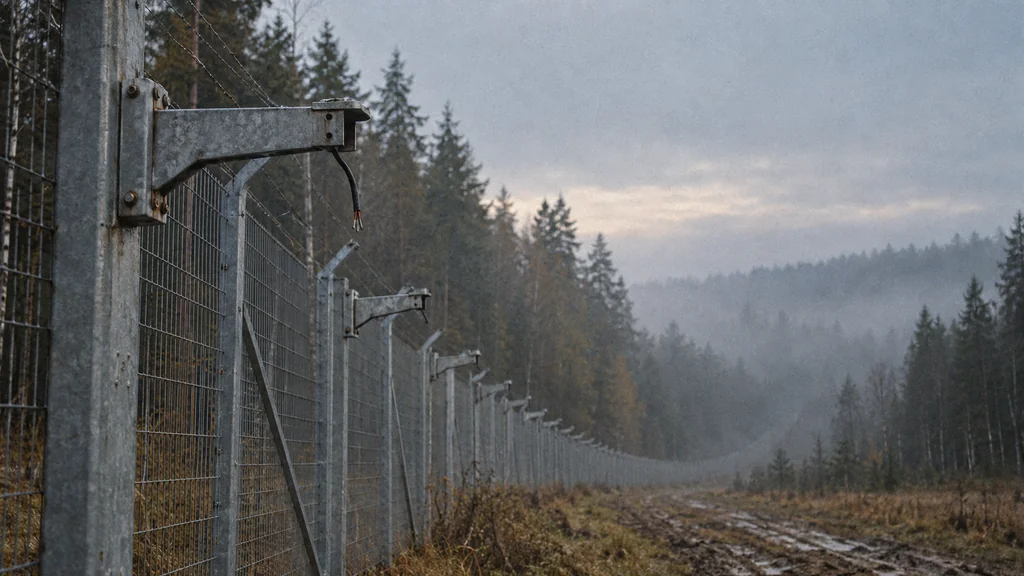
As border pressure rises, missing cameras leave Latvia with unanswered questions.
Image composition · tobriefLatvia's army says armed, masked escorts on the Belarusian side of the border threatened its soldiers on 5 October while pushing migrants toward Latvia (TVNET). Later that night, masked intruders crossed into Latvia and removed surveillance cameras. Officials describe rising pressure on the border, but they have not shown who directed the escorts or whether the same people took the cameras.
What happened on the border
According to Latvia's National Armed Forces, three masked, armed people drove a group of at least 20 migrants toward the border and threatened the soldiers guarding it (TVNET, LSM). Both reports relay the army's own account. The escorts stayed on Belarusian soil.
Latvian soldiers stopped the crossing. The army has not said what weapons the escorts carried, what threats they made, or where the migrants went afterwards.
That last gap carries legal weight. In a case over Lithuania's emergency border rules, the EU Court of Justice ruled that entering irregularly cannot by itself deny someone an effective chance to seek asylum (CJEU). Published accounts do not say whether anyone in the group asked for protection.
The second incident followed hours later. Interior Minister Jānis Dombrava said masked people entered Latvian territory, damaged an electrical cabinet, took cameras and returned to Belarus before a patrol arrived. Border Guard chief Guntis Pujāts confirmed that two cameras were taken (Suspilne).
No suspect, footage or forensic account has been released. No official has publicly tied the intruders to the armed escorts.
Officials disagree about who the escorts were
The army called the episode hybrid pressure on the EU and NATO border. The term describes a state using migrants and harassment, rather than open force, to strain a neighbour. EU leaders applied it to Belarus in October 2021, when they called Minsk's use of migration pressure a hybrid attack (European Council).
Pujāts offered a messier reading. He suggested the masked men might be organised criminals working with the tolerance or help of Belarusian services, rather than Belarusian officers themselves. On his version, Minsk's role could range from looking away to active support, and nothing published so far settles which.
Cameras keep disappearing
Pujāts says sabotage of cameras and other border electronics has grown while damage to the fence has fallen. The public reporting does not include figures for that shift.
Border official Artūrs Zīle gave concrete signs of it. He said cameras had recently been dismantled or stolen again, pressure had climbed over the previous two weeks, and four suspected organisers had been detained in four weeks (Apollo).
The crossing figures show the scale. Guards had stopped 11,925 attempted crossings since January, close to the 12,046 recorded in all of last year. On 6 October the government extended Vilkatis, its special operation against illegal crossings, to 31 December (LSM). Neither report details what new powers, if any, the extension gives guards.
The pressure falls unevenly along the EU's frontier with Belarus. By mid-September Latvia had logged 10,807 attempted entries from Belarus, against 1,477 in Lithuania. Since July, Lithuania has kept 67 of its own officers, including dog handlers, helping guard Latvia's Silene sector near Daugavpils (VSAT).
That deployment is the clearest cross-border element of the story. One EU state is lending patrol capacity to another on a shared external frontier. It adds people on the Latvian side, but it cannot answer the question of who is organising the pushes from the Belarusian side.
The reporting establishes a narrower finding than the army's framing implies. Latvian officials have documented repeated damage to border surveillance at a time of renewed crossing pressure. Their public account has not yet identified who directed the armed escorts or connected them to the camera theft. Dombrava's ministry and Latvia's security services owe that answer, along with an account of what happened to the people the soldiers turned back.
Details about this article
- Model:
- claude-opus-5-5
- Generated:
- 10/7/2026, 1:40:17 AM
- Pipeline run:
- eu_pipeline_20261007_005007
- Watermark:
- SynthID (Google's invisible watermark)
- Human review:
- None before publication