Latvia veto puts 2,600 sanctions at risk
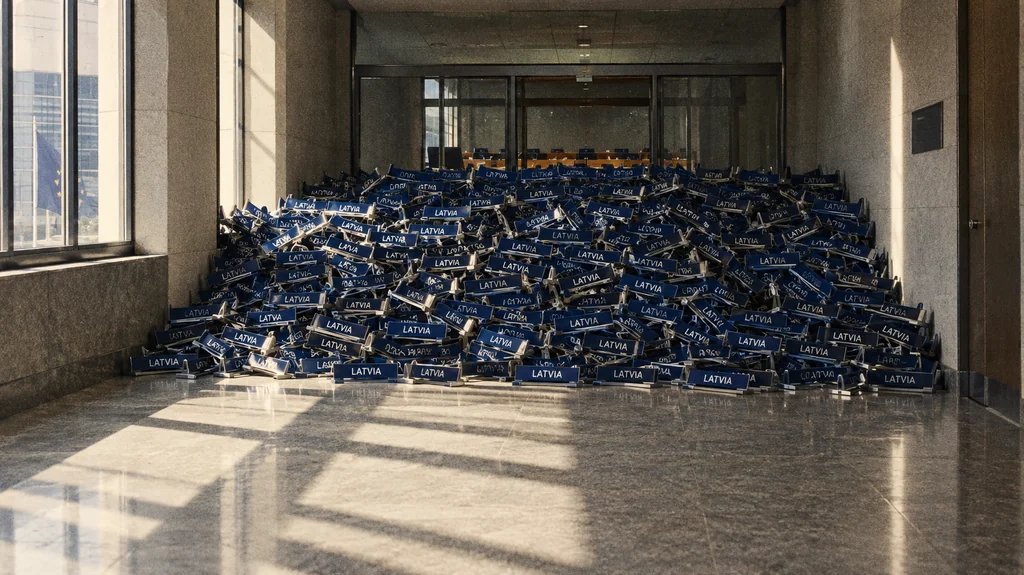
One veto multiplies until Europe’s sanctions machinery can move no further.
Image composition · tobriefThe emergency extension keeping roughly 2,600 Russian-linked sanctions listings alive expires at midnight on 22 September. A proposed deal to save them collapsed on 21 September evening when Latvia refused to approve it, leaving EU ambassadors racing to reconvene hours before the deadline (Kyiv Independent, BB.lv).
As we reported last week, France and Slovakia had blocked the routine six-month renewal in early September, forcing a seven-day bridge extension through 22 September (Euronews, The Straits Times). That was supposed to buy time for a compromise. The compromise came. Then Latvia vetoed it.
The proposed exchange
The deal on the table would have removed billionaires Mikhail Fridman and Alisher Usmanov from the sanctions list. In return, the remaining designations would be extended for 36 months instead of the usual six (Kyiv Independent, Euronews). Most ambassadors in Coreper (the committee where member-state ambassadors prepare Council decisions) backed the text, and the Irish presidency, which chairs the member-state negotiations, circulated it for approval through a written procedure (BB.lv).
Latvia's prime minister's office objected (BB.lv). One objection was enough. Sanctions fall under the EU's common foreign and security policy, where every government must agree under Article 31 TEU. The same unanimity rule that France and Slovakia had used to extract the delistings gave Latvia the power to stop them.
How the veto bargaining escalated
The deadlock began on 4 September, when Slovakia withheld consent for a longer renewal cycle (TA3). Bratislava's public position was that it wanted to keep the six-month review rhythm. Slovak outlets reported that the underlying demand was the removal of both Fridman and Usmanov (Pravda). By 11 September, France had joined, citing undisclosed national-security grounds (Euronews).
The tactic is now transferable: condition your consent for a list covering thousands of people on the treatment of one or two names. Any government willing to hold out at the right moment can reshape the outcome.
The courts drew a line between the two men
Bundling both removals as a single concession ignores a legal distinction the EU's own court established. In February 2024, the General Court (the EU's lower court for administrative disputes) upheld Usmanov's listing, accepting that he operated in sectors generating substantial revenue for the Russian state (CURIA, T-237/22).
Fridman's case went the other way. In April 2024, the same court annulled his designation, ruling that wealth and business connections alone did not prove the required support for Russian decision-makers (CURIA, T-301/22). The Council relisted him in subsequent renewals. The publicly available renewal notices do not show fresh evidence addressing the court's objections (EEAS), though the full Council record may contain material not yet public.
Keeping Usmanov listed has judicial backing. Keeping Fridman listed without new public evidence carries litigation risk. Treating the two as interchangeable weakens the case for either outcome.
What the deadline means
If the bridge expires without a replacement, travel restrictions tied to the underlying foreign-policy decision would lose their EU legal basis. The asset freeze rests on a separate instrument, Regulation 269/2014, which does not expire on the same schedule. But it implements the expiring decision, which would leave it exposed to legal challenge.
The proposed three-year term would have postponed the next opportunity for one government to block the entire list. That trade-off carries its own risk: a longer renewal without binding periodic review could leave weak listings untested for years. No published version of the diplomatic package confirmed such a safeguard existed (Decision 2014/145/CFSP).
France and Slovakia used unanimity to force the bargain. Latvia used unanimity to stop it. A last-minute renewal may still preserve the list, but it will leave every government able to reopen the same fight at the next expiry.
Details about this article
- Model:
- claude-opus-4-6
- Generated:
- 9/22/2026, 2:14:42 AM
- Pipeline run:
- eu_pipeline_20260922_005006
- Watermark:
- SynthID (Google's invisible watermark)
- Human review:
- None before publication