Macron and Merz seek EU market bans
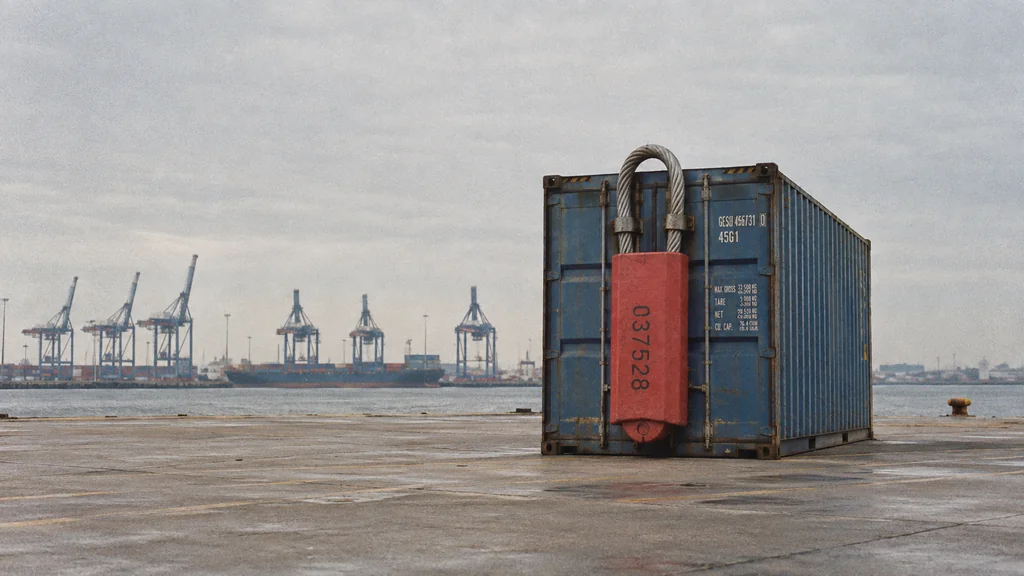
Paris and Berlin propose a trade power whose limits remain unwritten.
Image composition · tobriefEmmanuel Macron and Friedrich Merz have asked the European Commission for a power to answer foreign practices that distort competition in Europe, up to cutting a country's firms off from the single market (Reuters, Franco-German non-paper). The proposal leaves open the two questions that matter most: what would trigger action, and what exactly Brussels could block. No country is named, but coverage frames the tool as a response to China (Euronews).
The timing is pointed. EU trade chief Maroš Šefčovič holds talks with Beijing on 8–9 October (Politico).
A wider reach, a familiar vote
The two leaders sent Commission President Ursula von der Leyen a signed letter and a non-binding paper. At its centre is a response tool for cases where another country distorts the EU market on a large scale. Take a simple case. A foreign government pays its factories to produce more than its home market can absorb. Those factories can then sell in Europe below the price a European rival needs to cover its costs, and the European plant loses orders.
According to the Franco-German non-paper, the Commission would decide on a response. Its decision would stand unless at least 15 governments representing 65% of the EU's population voted it down. Opponents would need to build a large blocking coalition, which is much harder than a few capitals quietly keeping a measure off the agenda.
That voting method is not new. It already applies to trade-defence cases, the investigations the EU runs into imports sold below cost or propped up by foreign subsidies. What is new is the reach. The tool could cover a whole sector rather than one product, and it could end in exclusion rather than an extra tariff.
Today's slower route
The 2024 electric-car case shows how the existing system works. After an investigation into Chinese subsidies, Brussels set company-specific duties of 7.8% to 35.3% on Chinese-made battery cars in October 2024 (European Commission). Those were countervailing duties, extra tariffs sized to cancel out a subsidy. The whole procedure dealt with one product only.
Macron and Merz argue that this pace is too slow when one country dominates an entire production chain (Reuters). They want the Commission to open cases on its own initiative, examine whole sectors and move faster.
Who pays if Brussels uses it
Every exclusion has two sides. Shutting out a cheap supplier helps the European firms that compete with it. It also raises costs for the European factories and households that were buying from it. Then comes the risk of retaliation, which the authors acknowledge by proposing a map of what Chinese countermeasures would cost each member state (non-paper).
German business shows the split. In a chamber-of-commerce survey, 60% of firms wanted fewer dependencies on China, but only 36% backed restricting market access (DIHK). Most companies want less exposure, and far fewer want Brussels closing doors to get there. The industry federation BDI also prefers targeted use of the tools the EU already has (BDI).
Some governments are actively courting Chinese capital. Planned Spanish battery plants with Chinese participation add up to almost €15 billion of proposed investment (Expansión). That figure is not a loss. It measures how much planned investment a trade fight could put at risk, and it gives Madrid different incentives from Paris.
None of this is law yet. Under Article 207 of the EU treaty, a trade regulation needs a Commission proposal and then approval by both the European Parliament and national governments (EUR-Lex). The Commission called the papers a "valuable contribution," and EU leaders will discuss them at their 15–16 October summit (Euronews).
The signed texts set no evidence threshold for what counts as "systematic" distortion. They also give no list of what Brussels could block (non-paper). Paris and Berlin have proposed a potentially sweeping power and left its trigger and its limits for the Commission to write. Those two choices will decide whether firms that buy Chinese inputs, and governments hoping for Chinese factories, can accept it.
Details about this article
- Model:
- claude-opus-5-5
- Generated:
- 10/6/2026, 1:59:48 AM
- Pipeline run:
- eu_pipeline_20261006_005006
- Watermark:
- SynthID (Google's invisible watermark)
- Human review:
- None before publication