Melanoma vaccine lowers recurrence, survival unproven
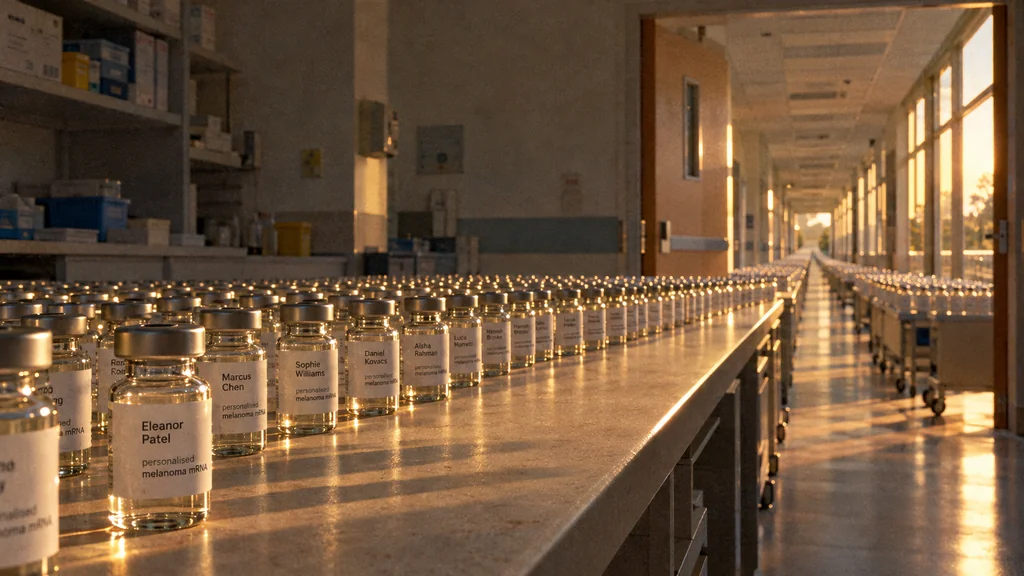
A treatment made patient by patient reduces recurrence; its survival benefit remains uncertain.
Image composition · tobriefAdding a personalised mRNA treatment to the immunotherapy Keytruda after melanoma surgery left 82.2% of patients alive and free of recurrence at two years, against 70.0% on Keytruda alone (ESMO). Lead investigator Georgina Long presented the INTerpath-001 results at the European Society for Medical Oncology congress in Madrid on 24 October (Melanoma Institute Australia). The full paper has been accepted by The New England Journal of Medicine, with publication expected around mid-November (Medscape). The trial has not shown that patients live longer, whatever some headlines this week suggested.
We explained the data on the day of the presentation (To Brief), and independent UK specialists, commenting on the abstract, called the result an important advance (Science Media Centre). Hungarian coverage on 26 October then repeated the figures with a twist. One headline turned them into a 42% fall in the risk of death, while the 24.hu report's own text correctly spoke of "death or recurrence" (24.hu).
What the 42% actually counts
Start with who was compared. The trial enrolled 1,137 adults whose high-risk melanoma had been completely removed, and every one of them received Keytruda. Of those, 757 also got the personalised injections and 380 got placebo injections (Merck and Moderna).
Next, what was counted. The main measure, called recurrence-free survival, logs a patient as having an "event" the first time either of two things happens. The cancer comes back, or the patient dies from any cause.
Only then does the famous percentage make sense. Researchers compared how often those events struck each group over time, a figure called the hazard ratio, where 1 means no difference. For the combined outcome it was 0.58, the source of the widely reported 42% relative reduction (ESMO).
Think of that measure as one bin that collects two kinds of bad news. A lighter bin is genuinely good news, but it cannot tell you that each kind shrank by the same amount. Deaths need their own count.
The survival count is still running
That separate count is overall survival, and the data are still immature. The hazard ratio was 0.77, but its 95% confidence interval, the range of values the data can plausibly support, ran from 0.45 to 1.31 (CancerNetwork). Because that range includes 1, the point of no difference at all, the result is not statistically significant. Merck and Moderna describe a "favorable trend" and say the trial will keep following survival (Merck and Moderna).
The trial also tracked a second, narrower bin: the cancer spreading to distant organs, or death. At two years, 88.5% of patients on the combination were alive without distant metastasis, against 80.2% on Keytruda alone (CancerNetwork). That matters because distant spread is what makes melanoma so dangerous.
The treatment itself, called intismeran autogene, is made separately for each patient. Developers read the mutations in the removed tumour and write a selection of them into mRNA, a set of instructions the body's cells use to produce matching protein fragments (KEYNOTE-942 study). The idea is to hand the immune system a precise description of what that person's cancer looks like, so it can hunt down cells surgery left behind. That is the design. What INTerpath-001 measured was whether the cancer came back, not whether those hidden cells were found and destroyed.
Nor is the treatment about to reach clinics. The companies call it investigational, and UK specialists noted it is not available through the NHS and has no confirmed timeline for routine access (Science Media Centre).
After surgery for high-risk melanoma, a vaccine built from each patient's own tumour, added to Keytruda, left more people alive without recurrence and without distant spread at two years. Overall survival was measured too, and so far that result is inconclusive. The trial has not shown 42% fewer deaths.
Details about this article
- Model:
- claude-opus-5-5
- Generated:
- 10/27/2026, 1:31:41 AM
- Pipeline run:
- eu_pipeline_20261027_005007
- Watermark:
- SynthID (Google's invisible watermark)
- Human review:
- None before publication