Mercedes freezes German plants’ next chapter
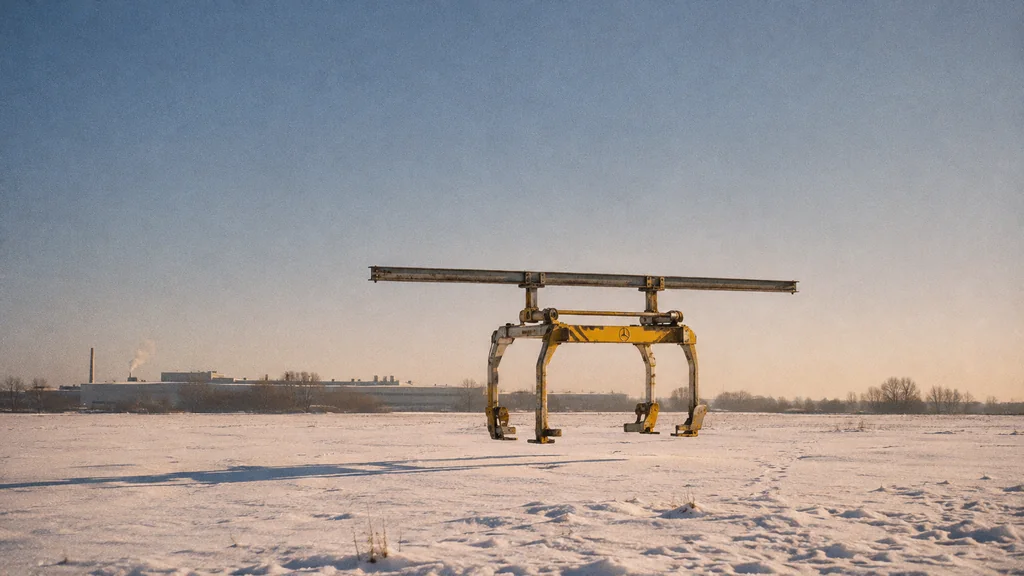
Mercedes plants can keep building today’s cars without receiving their successors.
Image composition · tobriefMercedes-Benz has stopped "all further investments" in its German factories. Production chief Michael Schiebe told staff in a 12 November intranet interview that the board sees no route to a deal on labour costs (Handelsblatt, WirtschaftsWoche). Management wants the standard working week raised from 35 to 40 hours with no extra pay (Tagesschau).
The pay demand works simply. If employees work 40 hours for the money they now earn in 35, Mercedes pays less for every hour of work it gets. No payslip shrinks, but each hour on the line gets cheaper for the company.
A job guarantee does not come with a next car
Mercedes has frozen spending. It has not decided to shut anything. Personnel chief Britta Seeger said the board wants to avoid closures but must now examine them more concretely. Schiebe had earlier warned that one vehicle assembly plant and one powertrain plant (a factory making engines, gearboxes and other drive parts) could go, arguing that a production hour in Germany can cost up to five times one at an Eastern European site (WirtschaftsWoche). Mercedes has named neither plant.
The production calendar poses the nearer threat. A car factory cannot start a new model overnight. It needs tooling (machines and moulds built for one specific car), supplier contracts and staff trained on the new line, all arranged years before the first car rolls off.
Those decisions are being made now. Schiebe says Mercedes is assigning its successor models at this stage, and that if talks fail it could place them only at plants abroad (Handelsblatt). A German factory that misses out keeps building its current model until demand for it fades, then has little left to make.
Workers' protection does not reach that far. The general works council says its ZuSi 2035 agreement rules out dismissals for operational reasons until 31 December 2034 (Mercedes-Benz works council). That limits how people can lose their jobs, but its public wording promises no factory a successor model. IG Metall, the metalworkers' union, said about 33,000 Mercedes employees protested in July against unpaid longer hours and benefit cuts, demanding guarantees for sites and investment as well as jobs (IG Metall).
What the board has shown, and what it hasn't
Mercedes' car division is under strain. In the third quarter of 2026, adjusted operating profit (earnings from the core business, stripped of one-off items) at Mercedes-Benz Cars fell to €560 million from €1.139 billion a year earlier, and its return on sales (profit per euro of revenue) dropped from 4.8% to 2.5% (Mercedes-Benz). Schiebe's cost comparison, by contrast, comes from internal plant figures, and Mercedes has not published how it was calculated.
The sales picture shows where demand is weakening. Mercedes car sales in China fell by about 31% in the quarter (manager magazin). Sales rose 5% in Europe and 13% in Germany over the same period (Mercedes-Benz results). Mercedes has not broken down how much of the profit fall comes from China, but cheaper hours in German plants would not sell more cars there.
Moving a model abroad has precedent. In January 2026, months before the freeze, Mercedes said A-Class production would move from Rastatt to Kecskemét in Hungary (HVG). The reports on the freeze do not identify any model newly assigned abroad since it was announced.
Cost pressure and bargaining leverage can both be real here, and the evidence supports both. Mercedes has a genuine profit problem in cars, and it is using decisions about future production to press its German workforce for longer hours. Those workers are protected against dismissal, but their plants' next models are not. Mercedes has not published, for any threatened site, the savings it expects or what building the same car abroad would cost, and those are the figures that would justify sending future production out of Germany. So far, no new model has gone anywhere. Once the successor models are assigned, though, the job guarantee cannot bring them back.
Details about this article
- Model:
- claude-opus-5-5
- Generated:
- 11/13/2026, 1:44:40 AM
- Pipeline run:
- eu_pipeline_20261113_005009
- Watermark:
- SynthID (Google's invisible watermark)
- Human review:
- None before publication