Merz puts Ukraine bill before EU budget
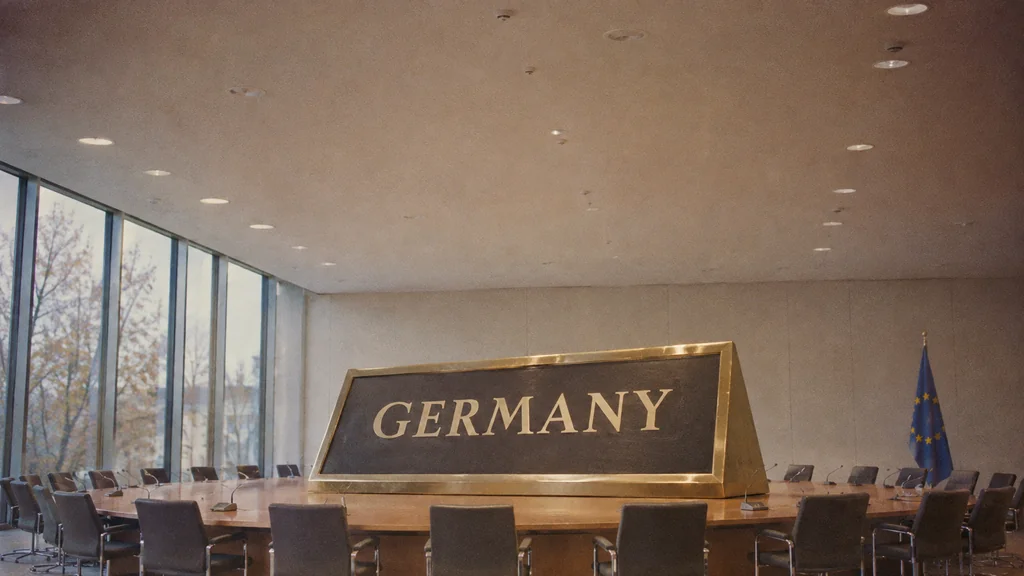
Germany’s budget condition gives one seat the power to delay twenty-seven.
Image composition · tobrief- 10/11/2026Magyar rejects new EU debt as Merz defends the budget linkAt a joint appearance in Berlin, Hungary’s Péter Magyar opposed taking on fresh EU debt because of Hungary’…
- 10/11/2026Radev rejects a new Ukraine credit line for BulgariaBulgarian Prime Minister Rumen Radev cited his country’s deficit in opposing participation in further lendi…
- 10/11/2026Costa sets a later debate on both financing and the budgetCosta replied that leaders would discuss the two issues at their special summit after the Commission presen…
German Chancellor Friedrich Merz has told EU leaders that their next long-term budget cannot be agreed until every member state, "without exception," pays a fair share of Ukraine's funding needs for 2027 (Financial Times, F.A.Z.). He has vetoed nothing. Because the budget needs every government's approval, though, his condition turns Germany's vote into leverage, and capitals wary of new Ukraine borrowing are already answering.
The letter went to António Costa, President of the European Council (who chairs EU leaders' summits). At a 10 November press conference, Merz said that agreement on Ukraine's financing was a precondition for concluding the budget. He also rejected a repeat of the current Ukraine loan, which 24 governments joined while three stayed out (German government transcript). We covered the letter's first fallout yesterday (To Brief).
The money actually at stake
Two pots of money matter here, and they are easy to confuse. The first already exists: a loan of up to €90 billion for 2026 and 2027, written into EU law (EUR-Lex). It went ahead with 24 participating governments, which shows the EU can fund Ukraine without everyone on board (Council).
The second is the fight. Ukraine needs about €70 billion beyond existing plans (European Pravda). That gap is the immediate stake. Economy Commissioner Valdis Dombrovskis said the EU is weighing a share of roughly €45 billion. The Commission, the EU's executive arm, has not yet presented options.
The next budget will not fill that hole in time. Its dedicated Ukraine Reserve only starts in 2028 (EUR-Lex).
Who can block whom
Every government must approve the next long-term budget, which sets EU spending limits for 2028 to 2034 (EUR-Lex). So Germany can hold it up, and so can anyone else. A stalemate would not shut the EU down, because the treaty rolls the final year's limits forward until a deal arrives.
Slovakia's Robert Fico used that symmetry. He called Merz's move "blackmail" and said that if Germany blocked the budget to force everyone into a Ukraine loan, Slovakia would block it too (TASR). His threat depends on Berlin acting first, and neither side has cast anything.
Bulgaria's Rumen Radev took the opposite route. He declined new lending but said Bulgaria would not stop others from going ahead (Bulgarian National Radio). He pointed to the help Sofia already gives, through electricity supplies and support for Ukrainian families.
Czechia and Hungary sit between those poles. Czech Prime Minister Andrej Babiš backed long-term EU support for Ukraine but opposed making the budget depend on a Ukraine deal first (Czech government). Hungary's Péter Magyar, standing beside Merz in Berlin, accepted humanitarian aid but refused new Hungarian borrowing or guarantees (HVG). Neither threatened a veto, and neither committed to paying.
Doubts also come from Ukraine's friends. Poland's deputy Europe minister, Ignacy Niemczycki, warned that tying the two negotiations together could make agreement harder (Euronews Polska). Warsaw wants Ukraine funded. It questions whether holding the budget hostage gets there faster.
Costa is trying to keep the two tracks apart. He has allowed a broad Ukraine discussion in Dublin on 13 November but pushed detailed financing talks to a special summit on 26–27 November (Euronews, Council).
What Merz can and cannot force
Merz can delay the next EU budget for as long as he is willing to absorb the political cost, and every other capital knows it. That leverage stops short of making each government sign up for a loan. The existing €90 billion arrangement shows that EU law lets a willing group lend while others stay out, so his insistence on every single country rests on politics alone.
One qualification limits both sides. Until the Commission tables its plan for the extra 2027 money, no capital knows what a "fair share" would cost it. The real bargaining starts there, and Merz has already set the price of walking away.
Details about this article
- Model:
- claude-opus-5-5
- Generated:
- 11/11/2026, 2:07:26 AM
- Pipeline run:
- eu_pipeline_20261111_005008
- Watermark:
- SynthID (Google's invisible watermark)
- Human review:
- None before publication