Merz ties EU budget to Ukraine’s €70bn gap
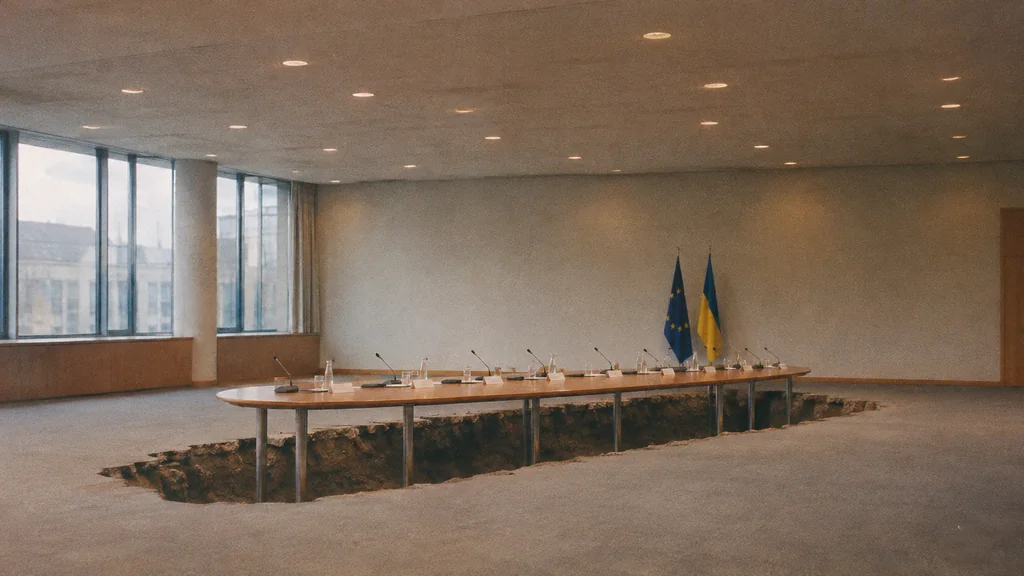
Europe’s next budget waits on a Ukraine bill no government has divided.
Image composition · tobriefChancellor Friedrich Merz has made Germany's support for the EU's 2028–2034 budget conditional on every member state helping to pay for Ukraine, the Financial Times reported on 9 November. He set out the condition in a letter dated 6 November to António Costa, who chairs the summits where EU leaders strike their deals (Rapporteur). The letter links two separate negotiations: a hole in Ukraine's money for 2027, and the EU's next seven-year budget, which any single government can block.
What the letter says, and what it doesn't
In the published excerpts, Merz asks for a commitment from "all of us, without exception" to help close Ukraine's 2027 shortfall (Rapporteur, Kyiv Independent). He makes that commitment a precondition for any other talks that involve spending.
The excerpts contain no ultimatum, according to the Kyiv Independent, which also saw the letter. The blocking threat comes from an unnamed German official. That official told the Financial Times that support from all member states is essential to conclude the budget negotiations.
The threat carries weight because of how the budget is approved. It needs the unanimous agreement of governments plus the consent of the European Parliament (Article 312 TFEU). Germany can withhold its approval, and so can each of the other 26 governments (Council guide). Costa can broker a compromise, but he cannot overrule a refusal.
A veto would cost Berlin too. EU spending would not stop, because the treaty carries the previous budget's spending limits forward until a new one is adopted (Article 312 TFEU). New priorities would stall, though, including the defence and competitiveness money that Germany and five other governments demanded when they called for a smaller overall budget (German government). Berlin is therefore asking partners to pay more for Ukraine while asking the EU to spend less in total.
The gap nobody has divided up
Two pots of money are easy to confuse. In February, EU governments agreed their position on the legal framework for a loan of up to €90 billion covering 2026 and 2027 (Council of the EU). Beyond that, Ukraine and the EU have identified a further gap of about €70 billion for 2027 (European Commission). The published excerpts say neither how much each country should pay nor how the money would be raised.
Getting every government to sign up will be hard. Bulgarian Prime Minister Rumen Radev has said his country cannot be part of the €70 billion package (Bulgarian government). Czechia, Hungary and Slovakia were exempted from the financial obligations of the existing loan, and Merz's demand asks them to take on new ones.
The budget itself already divides governments. Countries that pay more into the EU budget than they receive want it smaller, while others, such as Portugal, are defending regional and farm money (To Brief). Merz's condition adds a second fight to a table that has not yet settled the first.
Even Kyiv's allies doubt the tactic. On 6 November, before the letter became public, Polish Deputy Foreign Minister Ignacy Niemczycki warned that merging the Ukraine and budget talks could make agreement harder (Euronews). Merz cannot assume that governments sympathetic to Ukraine will back his method.
Frozen Russian state assets are often floated as a way to spare national treasuries. Belgium, however, wants other governments to share the risk of that route through guarantees they could not later withdraw (Belgian Chamber). In practice, that brings the question back to national money and to who stands behind it.
For later years, the Commission's draft budget proposes a Ukraine Reserve capped at €88.9 billion in 2025 prices (draft regulation). That money would start in 2028, so it cannot fill the 2027 gap. The published excerpts do not say whether Merz considers it enough for the years after.
Merz has turned Ukraine's funding from a shared goal into a condition for the budget deal. He backs that condition with a veto he could credibly use, even though using it would also delay spending Berlin wants. He has not said who pays what. Until someone does, the additional €70 billion (European Commission) remains a demand with no bill attached.
Details about this article
- Model:
- claude-opus-5-5
- Generated:
- 11/10/2026, 1:58:11 AM
- Pipeline run:
- eu_pipeline_20261110_005009
- Watermark:
- SynthID (Google's invisible watermark)
- Human review:
- None before publication