Microsoft outage sends Irish prescriptions to paper
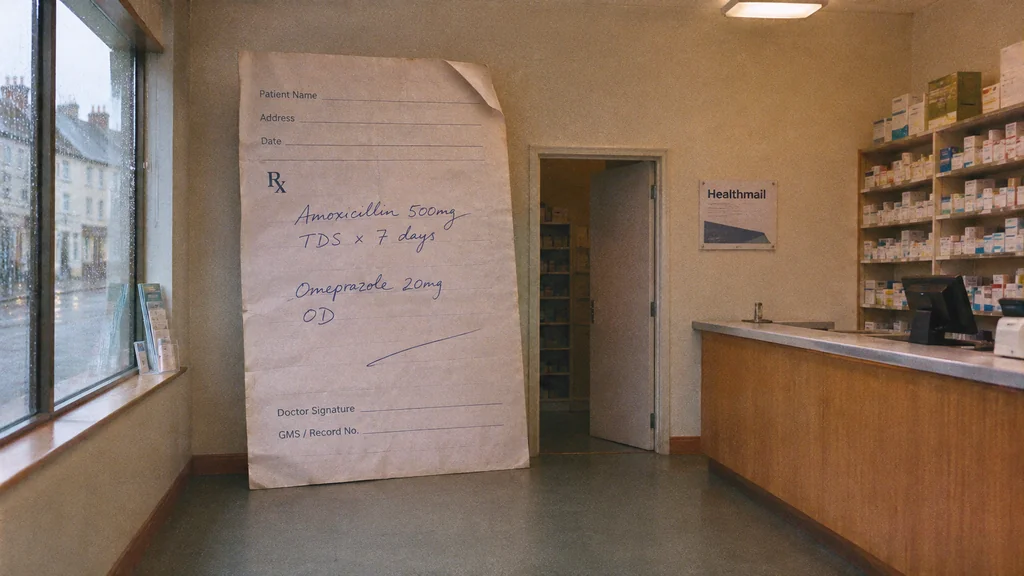
When Healthmail stalls, Irish doctors return to paper prescriptions.
Image composition · tobriefOn Friday, Irish family doctors and pharmacists were told they could write prescriptions on ordinary paper instead of the usual special stationery (Irish College of GPs). Healthmail, the secure email route that normally carries those prescriptions, was caught in a Microsoft 365 outage that began on 12 November (ABC News). The episode shows how one shared email system can interrupt public services in different ways, and how a phone line or a paper form keeps some of that work moving.
Healthmail depends directly on Microsoft. Procurement documents from the Health Service Executive (HSE), Ireland's public health service, describe it as a dedicated Microsoft Office 365 service (HSE procurement notice). When it failed, the HSE agreed alternative prescription routes with GP and pharmacy bodies, and a mental-health service moved its referrals to the phone (The Journal).
One sorting office, many front doors
Exchange Online is Microsoft's hosted email service. For every organisation that uses it, think of a central sorting office: a hospital, a council and a university each run their own business, but their letters pass through the same building. Microsoft's status updates, reproduced on a University of Pennsylvania IT page, listed the basic failures as mailboxes that would not open reliably and mail that was not being delivered (Microsoft status text via UPenn).
The trouble then travelled along the pipes connected to that building. Teams, Microsoft's chat and video app, runs calls itself but borrows Exchange mailboxes for calendars and meeting invitations (Microsoft documentation). That explains why the damage looked patchy: at 09:30 on Friday, Trinity College Dublin reported Outlook failing while Teams and its finance systems kept working (Trinity College Dublin).
Britain's government messaging service, GOV.UK Notify, shows how one incident looks different from each end. Notify kept sending email, yet messages to Outlook users stalled and some staff could not receive their own sign-in links. Mail only started reaching recipients again at 15:41 GMT on 13 November (GOV.UK Notify).
Why recovery came in fits and starts
Microsoft's early updates described what engineers were seeing. A number of servers had become unexpectedly unavailable, pushing extra load onto the rest (Microsoft status text via UPenn). Engineers restarted machines and returned capacity gradually, but some revived servers became unresponsive again once traffic reached them.
Picture reopening one checkout in a packed supermarket and watching the waiting queue swamp it. The queue explains why restoring capacity was slow, while the original fault lay elsewhere. Microsoft gave its account of that fault on Friday: according to the company, as relayed by ABC News, an issue left by an earlier network-capacity upgrade was exposed by a recent network change, with no sign of cyber activity (ABC News).
Stranded mail needed its own rescue. Microsoft extended the timeout for delayed messages to 48 hours, so queued mail would not be thrown away while engineers cleared the backlog (CBS/AP). On Friday afternoon, Microsoft's status text described much of Europe as improving, while warning that intermittent access and delayed mail were still possible (Microsoft status text via UPenn). Trinity declared its own service normal at 16:25 (Trinity College Dublin).
Measuring the reach is harder. The outage tracker Downdetector logged reports from 74 countries and roughly 130,000 to 140,000 complaints around the peak (BBC); those count people who chose to report a problem, so they cannot stand in for the number affected. The often quoted figure of more than 430 million Microsoft 365 users (CBS/AP) describes the size of the service rather than the size of the failure.
A second way in
In October the weak point was a cloud data centre, when a power fault in Google Cloud's London region knocked out Revolut payments across Europe (To Brief). This week it was email, and the affected services that kept work moving did it through a second channel. Irish doctors wrote prescriptions on paper and a mental-health service took referrals by phone, so patients still had a way in while Healthmail was down. Microsoft has said a detailed post-incident report will follow, and that report is where the count of delayed or lost messages, still unknown, should finally appear.
Details about this article
- Model:
- claude-opus-5-5
- Generated:
- 11/14/2026, 1:56:52 AM
- Pipeline run:
- eu_pipeline_20261114_005009
- Watermark:
- SynthID (Google's invisible watermark)
- Human review:
- None before publication