Mitsotakis: Municipalities will decide on additional construction
AI Daily Synthesis
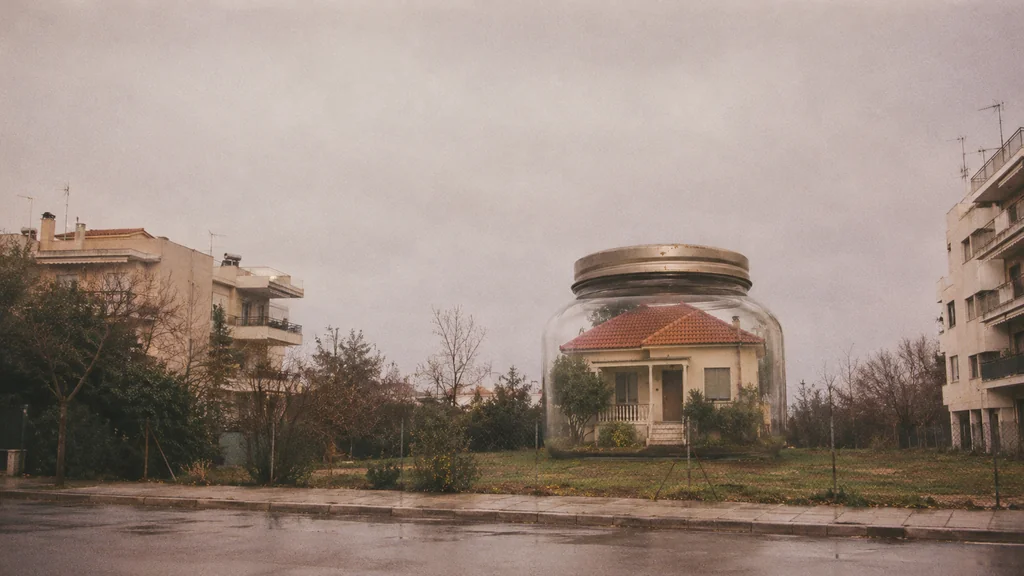
Image composition · tobriefNo municipality in Athens’ northern suburbs will have to accept additional construction through the transfer of building rights without its consent, and no building rights will be transferred in from another municipality. Prime Minister Kyriakos Mitsotakis made that commitment on Monday at Maximos Mansion, his official office, during a meeting with seven mayors (Prime Minister). Six of them had called for the withdrawal of a study that would allow about 584,000 square metres of new construction in 25 zones (Economix).
The mechanism is straightforward. The owner of a listed building, or of a plot reserved for a square or road, cannot build as much as the property’s building rights allow, so receives a certificate for the square metres lost. Those rights can be used to build elsewhere, on properties in Building Rights Reception Zones (ZYS), above the building density limit that applies there (Ministry of Environment and Energy). The zones are established by presidential decree. Before a decree is issued, the Central Council for Urban Planning Issues and Disputes (KESYPOTHA) gives its opinion, and the Council of State, Greece’s top administrative court, reviews it (iefimerida).
What the study proposes
The Ministry of Environment and Energy published the environmental study for the ZYS in Athens’ Northern Sector on 3 November, with a 60-day period for comments (Ministry of Environment and Energy). The study proposes 25 zones in 11 municipal districts. Depending on the area, the building density limits would rise from 0.50–1.20 to 0.60–1.60, and the study estimates that the population would increase by about 9,500 residents (Ecopress).
Chalandri, a northern Athens suburb, would take the largest share: seven zones with 258,159 sq m, about 44% of the total. Metamorfosi would follow with 148,763 sq m, Cholargos with 64,473 sq m and Kifisia with 38,795 sq m; all are in the Athens area (Mononews). In Metamorfosi’s two zones, the building density limit would rise from 1.00 to 1.60, with buildings up to 30% taller and coverage of up to 80% of a plot (Economix).
The six mayors’ letter
The mayors’ letter was published in full on 11 November (Dnews). According to Greek business news outlet OT, the invitation to the meeting was sent a few hours after the letter went out (OT). It was signed by the mayors of Lykovrysi-Pefki, Kifisia, Nea Ionia, Papagou-Cholargos, Filothei-Psychiko and Chalandri, all municipalities in the Athens area. They accept that owners of listed buildings and properties reserved for public use should be compensated, but describe the plan as rushed and inadequately justified. According to the letter, the study counts properties belonging to the state, KTYP SA, the state building infrastructure company, and the Ministry of Defence, which the state does not necessarily intend to develop. The mayors fear pressure on roads, stormwater and sewerage networks, and parking spaces. They asked for the study to be withdrawn and redone from scratch with the municipalities, including an assessment of how much construction each area can accommodate (Dnews).
The letter puts additional construction at 793,546 sq m. A published analysis of the study gives the same figure a different meaning: in that analysis, the 793,546 sq m represents building rights awaiting transfer. Of that, 21,939 sq m comes from active certificates, 301,129 sq m from listed buildings and 470,478 sq m from pending compensation for land reserved for public use. The 584,405 sq m is the amount the 25 zones can accommodate (Enypografa).
Chalandri Mayor Simos Roussos argued that the study used a building density limit of 1.3 for his municipality, although the limit in the relevant areas had been reduced to 0.90 in 2021. Ilias Apostolopoulos, mayor of Papagou-Cholargos, said his municipality was already 95% built up and that the proposed area contained just five vacant plots (Mononews).
At Maximos Mansion
Deputy Prime Minister Kostis Hatzidakis and Environment Minister Stavros Papastavrou attended the meeting. The seventh mayor was Stratos Saraoudas of Metamorfosi (Newsit). Mitsotakis said "no decision" would be made without the consent of the municipal authorities and that "there will be no transfer of building rights beyond the boundaries of each municipality". A municipality that does not want to use the mechanism will not use it. One that does will decide where it applies, with the municipal council’s consent before the decrees are finalised. Where municipalities have specific objections, there will be further consultation (Prime Minister).
According to OT on 13 November, Hatzidakis had already stated the government’s position that transfers between municipalities would be ruled out. Government spokesperson Pavlos Marinakis had said decisions would be made in consultation with mayors and local communities (OT). Mitsotakis himself said the government’s secretary-general had already set out that position and that the government would legislate the restriction if necessary. He also warned that municipalities that keep the current system would receive no substantial additional state support for past expropriations of land reserved for public use (Prime Minister). The Ministry of Environment and Energy’s current information page on the ZYS describes transfers to an adjacent municipality under certain conditions (Ministry of Environment and Energy).
The mayors said they were satisfied with the assurances (Ecopress), but their positions differ. The prime minister described Apostolopoulos as "perhaps the most categorical" (Prime Minister). Charalambos Bonatsos, mayor of Filothei-Psychiko, still wants the study withdrawn or his municipality excluded. Marios Psychalis, mayor of Lykovrysi-Pefki, says the municipality cannot accommodate more construction, although he does not reject the mechanism. Saraoudas views its use in Metamorfosi favourably because the municipality lacks public spaces. Panagiotis Manouris, mayor of Nea Ionia, will take the data to the municipal council. Roussos, who had previously called for withdrawal, now asked for time and agreement before any change (MyOTA, Mononews). Vasilis Xypolytas, mayor of Kifisia, said after the meeting that municipalities would have a decisive role. He added that those wishing to proceed immediately could start within two months, while consultation could last up to three years (Aftodioikisi.gr).
From the opposition, Manolis Christodoulakis and Christos Gokas of PASOK, the centre-left party, said in a joint statement that the prime minister was announcing changes to core provisions of the new Spatial Planning and Urban Development Code just five months after it was ratified. The party does not reject the transfer of building rights. It wants consistent rules for all municipalities, rather than involvement that, it says, begins only after objections erupt (PASOK).
The first milestone is the end of the 60-day consultation period in early January. Municipal consent will become binding when it is written into the presidential decrees, which go through KESYPOTHA and the Council of State, or into law, as the prime minister himself said.
Details about this article
- Model:
- claude-opus-5-5
- Generated:
- 11/17/2026, 4:37:48 AM
- Pipeline run:
- incremental_20261117_033012
- Watermark:
- SynthID (Google's invisible watermark)
- Human review:
- None before publication