Mochovce’s 440 MW redraws power flows
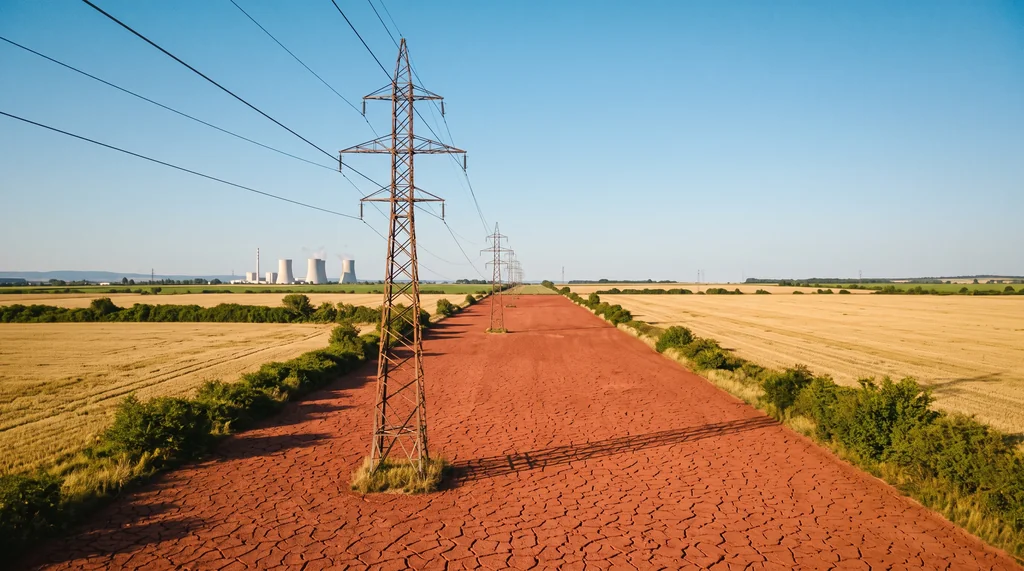
Mochovce adds power, but the grid determines who receives it.
Image composition · tobriefSlovakia's nuclear regulator ÚJD SR authorised "energy start-up" at Mochovce Unit 4 on 18 September, the phase where engineers gradually raise the reactor's output while connecting it to the electricity grid (ÚJD SR, SITA). The reactor first sustained a controlled chain reaction on 6 August (Slovenské elektrárne). Commercial operation still requires staged testing at higher power. But the question already shaping Central European electricity economics is straightforward: when Unit 4 runs at full capacity, who actually gets the power?
From chain reaction to kilowatt-hours
During energy start-up, engineers raise the reactor's thermal output in steps, connect the turbines to the grid, and run tests at each plateau. The regulator must approve each increase before the next begins (Aktuality.sk).
The best guide to how long this takes is Unit 3, the nearly identical sister reactor next door. Its energy start-up was authorised in January 2023; it completed its 144-hour full-power demonstration run nine months later, in October (ÚJD SR). Slovakia's grid operator SEPS has targeted full power for Unit 4 by year-end 2026, with the substation connection ready (Energie-portal). That remains a target. As of 19 September, first grid synchronisation had not been publicly announced.
The first effect: fewer Slovak imports
Slovenské elektrárne, the plant's operator, estimates Unit 4 could cover about 13% of Slovakia's electricity consumption and push the country's nuclear share to roughly 77.5% (Slovenské elektrárne). That is large relative to Slovak demand.
The reactor's most likely first effect is to reduce how much Slovakia buys from its neighbours. In 2025, Slovakia imported roughly 4.36 TWh net from Czechia alone (Novinky). Unit 4's annual output will probably displace much of that, meaning Czech generators lose an export customer before any new electricity flows outward.
How this affects neighbouring prices depends on a mechanism worth spelling out. In Europe's coupled day-ahead market, generators submit hourly bids and an algorithm matches supply with demand across borders (ACER). Once a reactor is built, producing each additional unit of electricity costs relatively little, so nuclear plants bid low and get dispatched early. They push down the wholesale price only in hours when their output displaces the more expensive gas or coal plant that would otherwise set the rate. And they lower prices for neighbours only when cross-border transmission lines have spare capacity. When those lines are full, the benefit stays inside Slovakia.
Hungary's conditional upside
Hungary is the neighbour most often cited as a beneficiary. It imported about 9 TWh net in 2025, with imports covering 20.2% of supply (Infostart). That dependence spiked during August 2026's heatwave, when trouble at the Paks nuclear plant forced Hungary to rely even more heavily on foreign power (Profitline, Telex).
An additional Slovak nuclear source can soften such episodes. But a Hungarian benefit requires three things at once: Unit 4 running reliably, available transmission capacity on the Slovak-Hungarian border, and price differences large enough to make the trade worthwhile. None of those is guaranteed. And even at full output, Unit 4 cannot substitute for Paks's 2,000 MW if it goes offline again.
Cost overruns and Russian fuel
Units 3 and 4 were originally expected to cost around €2.8 billion and finish by 2012–2013. Post-Fukushima safety redesigns, contractor disputes and repeated delays pushed the combined bill above €6 billion (Slovenské elektrárne). That money is sunk. The forward question is whether decades of roughly 440 MW net of low-cost generation justify the remaining commissioning risk.
The reactor still depends on Russian-designed VVER fuel. Slovenské elektrárne has signed agreements with Westinghouse and Framatome to develop alternatives, but qualifying new fuel, getting regulatory approval and scaling production takes years (European Commission). Unit 4's initial loads come from the existing supply chain.
Unit 4 adds real generating capacity to a region that needs it. Its regional value, though, depends less on the 440 MW on the nameplate and more on how many hours it actually runs and whether the transmission lines connecting Slovakia to its neighbours can carry the surplus.
Details about this article
- Model:
- claude-opus-4-6
- Generated:
- 9/20/2026, 1:37:18 AM
- Pipeline run:
- eu_pipeline_20260920_005006
- Watermark:
- SynthID (Google's invisible watermark)
- Human review:
- None before publication